- Start shelf-life design with the product's actual promise: whole-piece crunch, color, powder flow, or post-open stability.
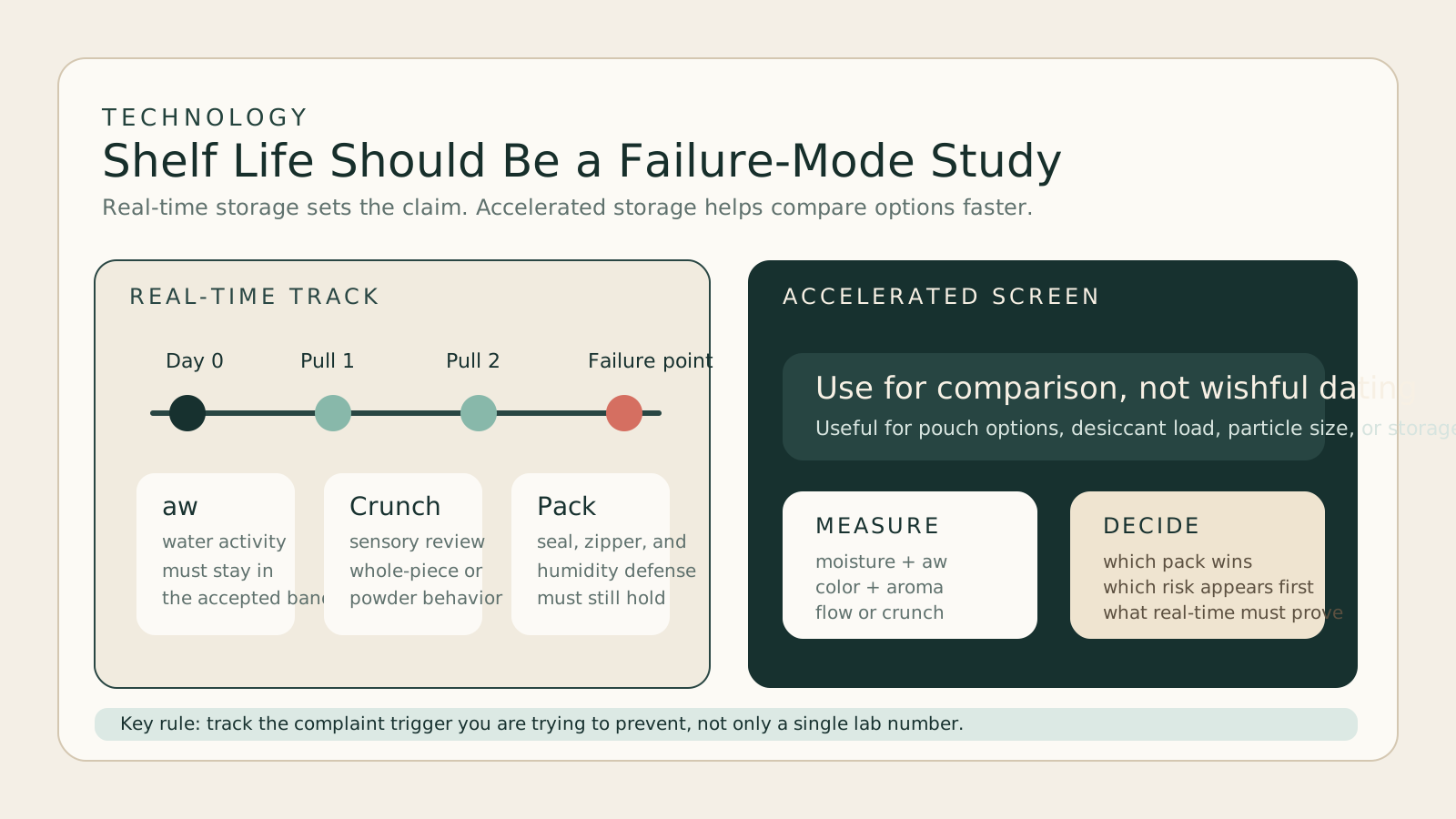
- Real-time storage is the release truth; accelerated studies are best used to compare options and catch obvious weaknesses faster.
- Measure the failure modes that drive complaints, not only one lab line such as moisture.
- A good shelf-life plan includes unopened storage, post-open handling, and packaging validation together.
Shelf-life work fails when it starts with a date instead of a failure mode.
For freeze-dried fruit, the commercial end of life is often texture, color, aroma, or package performance long before a shopper sees anything dramatic on the outside of the pouch. That is why a useful study has to ask a sharper question than "how long does it last?"
The direct answer
Design freeze-dried fruit shelf-life testing around the way the product is actually supposed to win: crisp texture, strong color, clean aroma, stable powder flow, or acceptable post-open behavior. Then test that product in the actual package, under real-time storage, with accelerated work used only as a faster screen.
The practical mistake is to track one number and assume the rest of the product will follow.
1. Start with the commercial promise
Different freeze-dried fruit products fail in different ways.
A premium whole-strawberry pouch may fail when too many pieces soften or powder out. A mango powder may fail when it cakes and stops flowing. A family-size resealable bag may fail when the fruit performs acceptably unopened but goes soft too quickly after first open.
That means the first shelf-life question should be:
- what exactly is the product promising?
- what complaint would end the product's acceptable life?
- what evidence would prove that point has been reached?
For many freeze-dried fruit items, the answer is not only microbial stability. It is the loss of the eating or handling quality that justified the premium product in the first place.
2. Lock the package and storage assumptions
Shelf-life data only travels as far as the package assumptions stay true.
If the study is run in one pouch structure and the launch product uses another, the data is already weaker than it looks. The same problem applies when the test pack has a different zipper, a different desiccant load, different headspace, or a different fill weight than the market pack.
Freeze-dried fruit is especially unforgiving here because the package is part of the preservation system, not a decorative wrapper. Before the study starts, lock down:
- the actual film structure
- whether the product is sealed or resealable
- whether desiccants or oxygen absorbers are included
- the intended storage temperature and humidity range
- whether the product is sold for pantry storage, ingredient storage, or bulk foodservice use
If those points drift mid-study, the interpretation drifts with them.
3. Use real-time storage to set the claim
Real-time storage is the part of the study that earns the actual date.
That sounds obvious, but teams still try to turn a harsh accelerated chamber into a market claim without enough live storage behind it. Accelerated work is valuable, especially for packaging comparison and fast screening, but it does not perfectly recreate every pathway of quality loss. Crunch decline, aroma fade, zipper fatigue, and consumer reclose behavior do not all compress neatly into one formula.
Real-time work should therefore anchor:
- the unopened shelf-life claim
- the preferred storage language
- the date window the business is willing to defend
For a new SKU, real-time work is also where the team learns whether the product's real weak point is the fruit, the package, or the handling after packing.
4. Use accelerated work for screening, not for wishful thinking
Accelerated studies are still worth doing. They are just often asked to do the wrong job.
They are useful when the team needs to compare:
- two pouch structures
- two desiccant strategies
- two powder particle-size profiles
- two storage environments
- two fruit formats that may react differently to humidity
In other words, accelerated work is excellent for ranking risk faster. It is weaker as a stand-alone substitute for the market date.
The disciplined approach is simple: use accelerated storage to narrow the field, then let real-time storage decide what the label and sales team can honestly claim.
5. Measure the things that actually fail
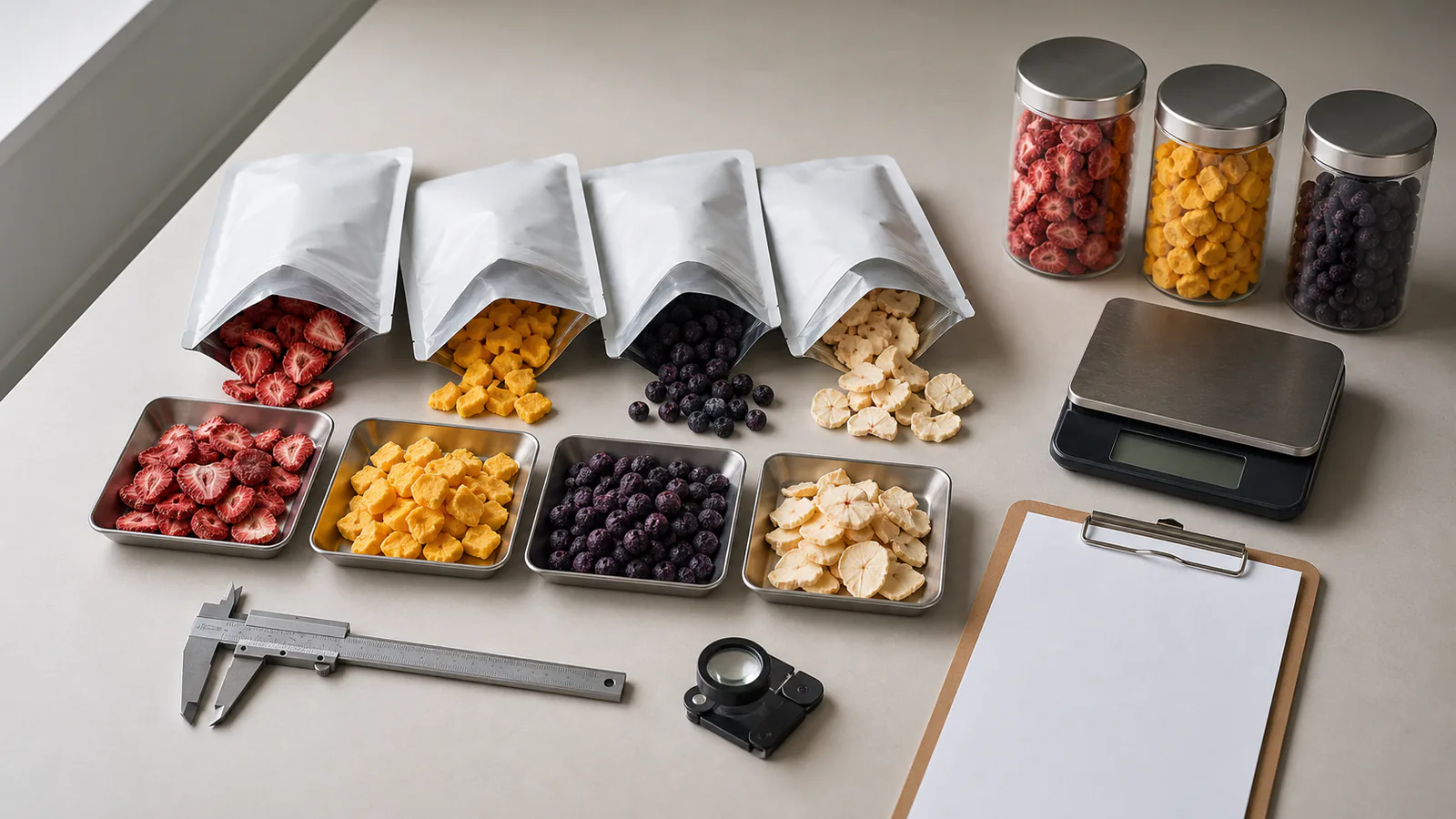
For freeze-dried fruit, the study should usually include more than one line of evidence.
Useful measurements often include:
- moisture content
- water activity
- sensory texture or crush performance
- color drift
- aroma strength
- visible clumping or loss of flow for powders
- seal or zipper performance when relevant
The right mix depends on the product. A powder program may care deeply about free-flowing behavior and less about whole-piece breakage. A premium snack pouch may care more about crunch, dusting, and visual color than about fine differences in powder flow.
The common mistake is to let moisture do all the talking. Moisture matters, but customer complaints usually arrive as soft fruit, stale aroma, faded color, or caked powder. The study should track the signals that explain those outcomes.
6. Write the shelf-life claim after the study, not before
Shelf-life wording should come from the data, not from the sales deck.
If the product is still safe but no longer commercially convincing at month nine, then a twelve-month claim is weak even if the bag survives technically. If the product is strong unopened for twelve months but becomes disappointing three days after first open, then the package directions and pack format need attention.
That is why the final readout should answer three separate questions:
- how long is the unopened product commercially acceptable?
- how does the product behave after first open?
- what storage language does the evidence support?
Those are different questions, and freeze-dried fruit often gives different answers to each.
A practical study template
For many freeze-dried fruit products, a sensible study structure looks like this:
- Identify the intended pack, storage environment, and commercial promise.
- Pull a day-zero baseline for moisture, water activity, sensory texture, and visual condition.
- Store sealed samples under real-time conditions for the target shelf-life window.
- Run a smaller accelerated chamber study to compare packaging or format alternatives.
- Add a post-open handling test if the product is sold in a resealable pack.
- Review the pull points against the actual complaint threshold, not only a lab average.
That approach will not remove every judgment call. It will at least make the judgment defensible.
Conclusion
Good shelf-life testing for freeze-dried fruit is really failure-mode testing. It asks when the product stops being the product it was sold to be.
If the study starts from that premise, the date on the bag tends to become more credible, the packaging choices become easier to justify, and the complaint conversations become much less subjective.
Frequently Asked Questions
What is the most important part of shelf-life testing for freeze-dried fruit?
Defining the real failure mode before the study starts. For many freeze-dried fruit products, the commercial failure comes from crunch loss, color drift, aroma fade, or package weakness before a basic safety concern appears.
Should freeze-dried fruit shelf life be tested only in unopened packages?
No. Unopened storage matters for the stated shelf-life claim, but many consumer complaints happen after first open. If the product is sold in a resealable pouch, post-open performance should be tested too.
Is accelerated shelf-life testing enough by itself?
Usually no. Accelerated work is useful for screening packaging options, identifying obvious humidity sensitivity, and comparing formulations quickly. It should not be treated as the only basis for a market-facing shelf-life claim.
What should be measured during the study?
Use a combination that fits the product: water activity, moisture, sensory texture, color, aroma, seal condition, oxygen level where relevant, and powder flow or clumping when the product is sold as a powder.
How often should samples be pulled?
That depends on the intended shelf life and the likely failure speed, but the intervals should be fixed before the study begins. Closer spacing early in the study often helps catch the real turning point instead of only the final failure.
Primary sources & further reading
- Water Activity (aw) in Foods U.S. Food & Drug Administration Referenced for FDA's explanation that water activity affects food stability and must remain in an acceptable range during storage.
- Shelf-Stable Food Safety USDA Food Safety and Inspection Service Referenced for USDA's description of shelf-stable drying and the role of enough moisture removal plus protective packaging.
- Shelf Life of Food Products Kansas State University Referenced for the intrinsic and extrinsic factors that shape food shelf life, including water activity, temperature, humidity, gases, and physical stress.
- Preserving Food at Home: Freeze-Drying University of Minnesota Extension Referenced for the practical connection between low water activity, rapid packaging, humidity exposure, and freeze-dried-food quality loss.
External links open in a new tab. We do not receive compensation from any organization listed; sources are referenced because they are primary, current, and publicly verifiable.