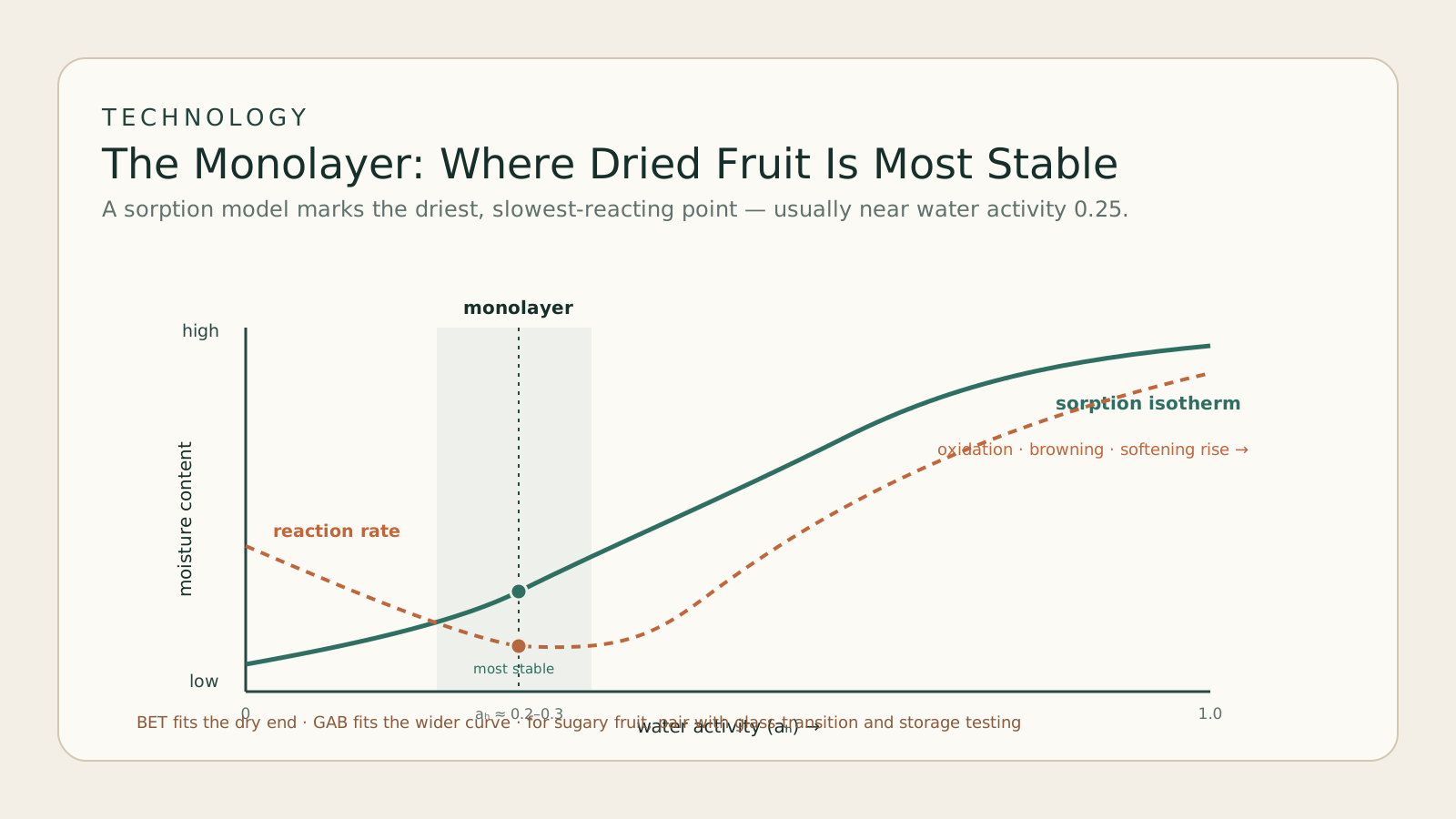
- The BET (and the broader GAB) model fits a sorption isotherm to find the monolayer value: the amount of water that sits in a single bound layer on the fruit solids, usually landing near a water activity of 0.2 to 0.3.
- Around the monolayer, most spoilage reactions — oxidation, browning, texture loss — are at or near their slowest, which makes it a sensible internal target for a moisture or water-activity spec rather than 'as dry as possible.'
- For sugar-heavy fruit the monolayer is a guide, not a guarantee: glass transition and amorphous sugar behavior also govern stickiness and crunch, so a spec should pair the monolayer target with a water-activity ceiling and real storage testing.
Ask someone how dry freeze-dried fruit should be and the instinct is usually "as dry as possible." That sounds right and is mostly wrong. There is a specific, estimable moisture level where dried fruit is at its most stable — where the reactions that fade color, dull aroma, and soften texture run slowest — and it is not zero. It is called the monolayer value, and it comes out of a sorption isotherm fitted with a model known by the initials BET. Understanding it turns a vague "keep it dry" into a defensible target you can put on a spec.
The direct answer
The monolayer value is the amount of water that forms a single, tightly bound layer on the fruit's solids. Fitting a sorption model — BET, or its wider-range cousin GAB — to the fruit's moisture-versus-water-activity data estimates that value, which for many fruits lands near a water activity of 0.2 to 0.3. That point is treated as the state of maximum stability, because the small amount of water present is held so firmly it can barely participate in spoilage reactions. It gives you a rational anchor for a moisture or water-activity spec: not "as low as physically possible," but "at or just below the monolayer."
What a sorption isotherm actually shows
A sorption isotherm is a curve. On one axis is water activity — a measure of how available the water is, running from 0 to 1. On the other is moisture content — how much water the fruit actually holds. Hold the temperature constant, let pieces come to equilibrium at a series of humidities, and you can plot how moisture content changes as water activity rises. The result is a characteristic S-shaped or J-shaped curve that is a fingerprint of that particular fruit.
The shape matters because water in a dried food is not all the same. At the very dry, low-water-activity end, the first water to arrive binds tightly to the solids and is essentially locked in place. As water activity climbs, later water binds more loosely, fills pores, and eventually behaves almost like free liquid. The isotherm is the map of that transition, and the monolayer is the model's estimate of where the first, most tightly bound layer is complete.
Where BET and GAB come in
You cannot read the monolayer straight off the plotted points; you estimate it by fitting an equation. The BET model — named for Brunauer, Emmett, and Teller — is the classic tool. It works well across the low-water-activity region, roughly up to 0.4 or 0.5, which conveniently includes the dry zone where the monolayer sits. Feed it isotherm data from that range and it returns a monolayer moisture value along with a measure of binding strength.
GAB, a later refinement, fits a much wider slice of the curve, often out to a water activity near 0.9. Because it describes the whole isotherm rather than just the dry end, labs often prefer GAB for a complete picture and still extract a monolayer figure from it. For the practical question of where the fruit is most stable, BET and GAB usually agree closely, so the choice is more about how much of the curve you want to model than about a disagreement over the target.
The monolayer value is a model output fitted to real sorption data, not something you weigh directly. That is fine — it is a well-established, widely used estimate — but it means the number carries the assumptions of the model and the quality of the underlying data. Treat it as a strong guide with a margin around it, not a single exact threshold.
Why the monolayer is the stable point
Picture reaction rates plotted against water activity. Several important deterioration pathways in dried fruit — oxidation of pigments and aromas, nonenzymatic browning, and the softening that comes with picking up moisture — each depend on water being available to move molecules around and let reactions proceed. Below the monolayer, water is scarce and tightly held, so most of these reactions are slow. Above it, additional water loosens up, mobility rises, and reaction rates climb, often steeply through the mid range of water activity.
The monolayer tends to sit near the bottom of that combined trade-off. It is dry enough that browning and hydrolytic reactions are suppressed, but not so bone-dry that you are spending cycle time for no return — and, for some foods, extreme over-drying can even let oxidation creep back up because there is too little water to shield reactive sites. That balance is why food scientists have long used the monolayer as shorthand for "the most stable moisture content" of a dried food.
Turning it into a spec
For a buyer or processor, the monolayer reframes the moisture conversation. Instead of arguing about whether drier is always better, you can set a target moisture or water-activity ceiling anchored to the fruit's monolayer, then finish product a little below it. The small gap gives headroom: freeze-dried fruit inevitably picks up some moisture during the minutes it spends in a packaging room and over the life of the pouch, and starting below the monolayer keeps it inside the stable zone rather than drifting above it.
This also explains why a water-activity limit in the region of 0.2 to 0.3 shows up so often on freeze-dried fruit specs. It is not a copied-and-pasted number; it roughly tracks the monolayer region for many fruits and reflects the point where crunch, color, and aroma hold up best. Pairing a moisture target with a water-activity ceiling covers both what the fruit holds and how available that water is.
Where the monolayer stops being enough
For fruit specifically, the monolayer is necessary context but not the whole story, and it is worth being cautious here. Freeze-dried fruit is dominated by sugars, and sugar-rich systems have a second control knob: the glass transition. Below its glass transition temperature the amorphous sugar matrix is a rigid glass that gives crunch; warm it past that point, or let it absorb humidity, and it turns rubbery and sticky regardless of how neatly you hit a monolayer target. A piece can be at a sensible moisture content and still slump if storage runs warm or humid.
So the honest positioning is this: the BET or GAB monolayer gives you a principled starting target for a moisture and water-activity spec, grounded in decades of dried-food science. It sits alongside glass-transition thinking and, above all, real storage testing that watches how color, crunch, and aroma actually hold over months at realistic temperatures. Use the monolayer to set the target, and use storage data to confirm the fruit behaves the way the model predicts.
Frequently Asked Questions
What is the 'monolayer' moisture value?
It is the estimated amount of water that forms a single molecular layer tightly bound to the surface of the dried solids. Below it, the fruit is very dry and the little water present is held so firmly it can barely take part in reactions. Above it, water starts filling additional, looser layers and becomes progressively more available to drive oxidation, browning, and softening. The monolayer sits at the bottom of that trade-off, which is why food scientists treat it as the point of maximum stability for a dried food.
What water activity does the monolayer usually correspond to?
For many dried fruits and similar foods it falls somewhere around a water activity of 0.2 to 0.3, though the exact figure depends on the fruit, its sugar content, and temperature. This is useful context when you see a water-activity ceiling on a spec sheet: a target in that range is not arbitrary, it roughly tracks the most stable zone. It is not a food-safety line — freeze-dried fruit is well below the water activity that supports microbial growth — it is a quality-and-shelf-life line.
What is the difference between the BET and GAB models?
Both are equations fitted to sorption data to estimate the monolayer. BET is the classic model and works well at low water activity, roughly up to 0.4 to 0.5, which covers the dry end where the monolayer lives. GAB is a refinement that fits a wider range, often up to about 0.9, so labs frequently use GAB to describe the whole isotherm and still read a monolayer value from it. For the practical question of 'where is this fruit most stable,' the two usually land close together.
If the monolayer is the most stable point, should I dry fruit even further?
Not necessarily. Drying well below the monolayer costs extra cycle time and energy for little stability gain, and for some foods over-drying can even nudge certain oxidation reactions back up. The monolayer is closer to a floor of diminishing returns than a hard minimum. In practice most freeze-dried fruit is finished a bit below its monolayer to leave headroom for moisture pickup during packaging and shipping, not to chase an ever-lower number.
Does hitting the monolayer guarantee the fruit stays crunchy?
No, and this is the important caveat for fruit. Crunch and stickiness in sugar-rich freeze-dried fruit are governed heavily by the glass transition temperature and the behavior of amorphous sugars, not by the monolayer alone. A piece can be at a sensible moisture target and still soften if it warms past its glass transition or picks up humidity in storage. The monolayer is a strong starting point for a spec, but it works alongside glass-transition thinking and real-world storage testing, not instead of them.