- Freshly dried fruit leaves primary and secondary drying at its driest and most porous, which makes the vacuum-break moment the point of maximum vulnerability to ambient moisture and oxygen.
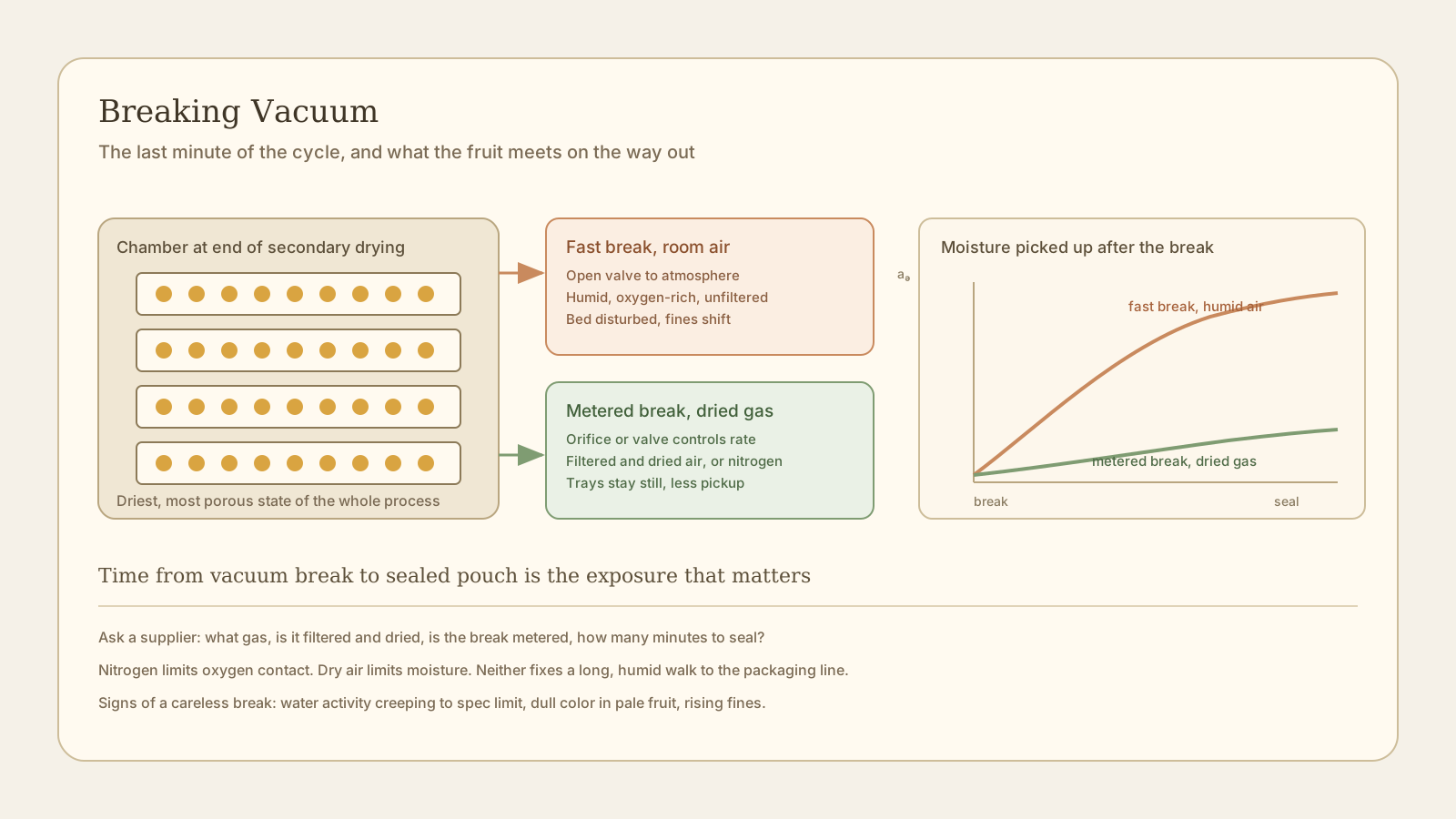
- Breaking vacuum quickly with untreated room air pushes humid, oxygen-rich air deep into the pore network; a slow break with dry filtered air or nitrogen limits how much the fruit picks up.
- Backfill gas choice mainly matters for oxidation-sensitive fruit, while break rate and air dryness matter for almost everything, including crunch.
- Buyers cannot see this step on a spec sheet, but they can ask what gas is used, whether it is filtered and dried, and how long trays sit in the chamber after the break.
Most descriptions of freeze-drying stop at secondary drying. The chart flattens, the product temperature meets the shelf temperature, and the operator calls the cycle finished. What happens in the next few minutes gets far less attention, even though it is the moment when the fruit is at its most absorbent and least protected.
Breaking vacuum is a process step. It has a rate, a gas, and a consequence.
The direct answer
At the end of a cycle, the chamber is at deep vacuum and the fruit is as dry as it will ever be. To open the door, the chamber has to be brought back to atmospheric pressure, which means letting gas in. The two decisions that matter are how fast that gas enters and what the gas is.
Room air that has not been filtered or dried carries water vapor and oxygen straight into an open pore network that is thermodynamically eager to take both. A slow break with dried, filtered air or nitrogen limits the exchange. Neither choice can rescue a badly run cycle, but a careless break can undo the last hours of one.
Why the product is vulnerable at exactly this point
Freeze-dried fruit finishes the cycle as a rigid sponge. The ice that used to occupy most of its volume has left as vapor, and what remains is a solid matrix threaded with open pores that connect all the way to the surface. Two properties of that structure explain the vulnerability:
- Surface area. The internal surface a gram of freeze-dried fruit exposes is orders of magnitude larger than its external surface. Moisture does not have to soak in slowly; it has direct access.
- Distance from equilibrium. Fruit leaving secondary drying typically sits at low water activity. In a packaging room at ordinary humidity, the gap between the product and the air is large, and that gap is the driving force for moisture pickup.
This is the same physics that makes an opened bag lose crunch on the counter. The difference is that in the chamber, the operator controls the air.
The vacuum break, the door opening, and the walk to the packaging line are one continuous exposure event. Treating them separately is how a well-controlled cycle ends up with a bag that fails water-activity spec.
What break rate changes
Bringing the chamber up quickly is tempting because it frees the machine sooner. It has two costs.
The first is mechanical. A fast inrush moves air through the trays with real velocity. Light pieces, fines, and powder shift, and thin slices can be pushed against tray walls or lifted. In fruit lines that sell on whole-piece integrity, this is a quiet source of breakage that no one attributes to unloading.
The second is a mass-transfer effect. A rapid break sends a larger volume of ambient gas through the bed in a shorter time. If that gas is humid, more water vapor is carried into contact with more internal surface before the door is even open. A slow, metered break brings the chamber up over minutes rather than seconds and gives less total ambient contact per gram.
Most operations land somewhere in the middle: fast enough to keep the schedule, slow enough that trays are not disturbed.
What the backfill gas changes
The gas itself governs a different variable: oxygen.
- Untreated room air brings both moisture and oxygen. It is the default in many food operations and is workable when the packaging room is well conditioned and the time to seal is short.
- Filtered and dried air removes the moisture problem and the particulate problem, but leaves oxygen at roughly 21 percent.
- Nitrogen removes both, at least during the chamber phase, and is the choice that makes sense for fruit where color and aroma degrade oxidatively — light-colored fruits prone to browning, and aromatic fruits whose volatiles are fragile.
Nitrogen backfilling is not a shelf-life claim on its own. Once the door opens, the fruit is in room air anyway. What backfilling buys is a cleaner starting condition and less oxygen contact during the minutes when the pore structure is fully open and unshielded by packaging.
Where this shows up in the finished bag
The signs are indirect but consistent.
- Water activity that creeps toward the upper spec limit even when the drying curve looked textbook. Moisture picked up after the cycle is real moisture, and the meter cannot tell where it came from.
- Crunch that is fine on day one and mediocre a month later. Product that started closer to its critical water activity has less margin against small packaging leaks over time.
- Color drift in pale fruit. Apple, banana, pear, and light-fleshed tropicals show oxidative dulling earlier than dark berries do.
- Higher fines in whole-piece grades, when a violent break has been shifting the bed for months without anyone connecting the two.
What operators can control
Four levers, none exotic:
- Meter the break. Use a valve or orifice sized so the chamber comes up over a defined interval rather than whatever the plumbing allows.
- Condition the gas. Filter it, and dry it. A filter without a dryer solves the particulate problem and none of the moisture problem.
- Decide gas by fruit. Nitrogen where oxidation is the known failure mode; dried air where it is not, if nitrogen cost or supply is a constraint.
- Shorten the tail. Time from break to seal is the exposure that matters most. Trays that sit on a cart in an unconditioned room for forty minutes have already given back part of the cycle.
What buyers can ask
None of this appears on a certificate of analysis, and no supplier will volunteer it. But the questions are simple and the answers are diagnostic:
- What gas do you use to break vacuum, and is it filtered and dried?
- Is the break metered, or is it open-valve to atmosphere?
- What is the typical elapsed time from vacuum break to sealed package?
- Is the packaging room humidity-controlled, and is it monitored?
A supplier who can answer these without hesitation is running a controlled process. A supplier who has never thought about the question is probably losing a little quality at the end of every cycle and pricing it into their variability.
The takeaway
The vacuum break is the seam between a controlled vacuum environment and an uncontrolled room. Fruit crosses that seam at its driest and most porous. Deciding deliberately how fast it crosses, and what it meets on the other side, is one of the cheapest quality improvements available in a freeze-drying operation — and one of the least discussed.
Frequently Asked Questions
What does breaking vacuum actually mean?
It is the controlled admission of gas into the freeze-dryer chamber at the end of a cycle to return it from deep vacuum to atmospheric pressure so the door can be opened. The gas can be room air, filtered and dried air, or an inert gas such as nitrogen.
Why is fruit especially vulnerable at that moment?
It has just finished secondary drying, so its moisture content is at its lowest and its open pore structure is fully exposed. A dry, highly porous solid sitting in a humid room will pull water vapor from the air until it approaches equilibrium.
Does nitrogen backfilling improve shelf life on its own?
Not on its own. It reduces oxygen contact during unloading, which helps color- and aroma-sensitive fruit, but shelf life still depends on final moisture, water activity, barrier packaging, and how long the product sits before sealing.
Is a slower vacuum break always better?
Slower breaks limit turbulence and reduce how forcefully ambient air is pushed into the product bed, but they cost cycle time. Most operators settle on a break rate that avoids blowing light pieces around and keeps ambient exposure short.
What can a buyer reasonably ask about this?
Ask what gas is used to break vacuum, whether it passes through a filter and a dryer, how the room where the chamber sits is conditioned, and how many minutes typically pass between the break and the first seal.
Primary sources & further reading
- Current Good Manufacturing Practice, Hazard Analysis, and Risk-Based Preventive Controls for Human Food - Processes and Controls Electronic Code of Federal Regulations Requires that food handling, processing, and packaging steps be conducted under conditions and controls that minimize contamination and deterioration, which includes post-drying handling.
- Water Activity in Foods: Fundamentals and Applications Wiley / Institute of Food Technologists Reference text on moisture sorption behavior of dried foods and how porous solids equilibrate with ambient humidity.
External links open in a new tab. We do not receive compensation from any organization listed; sources are referenced because they are primary, current, and publicly verifiable.