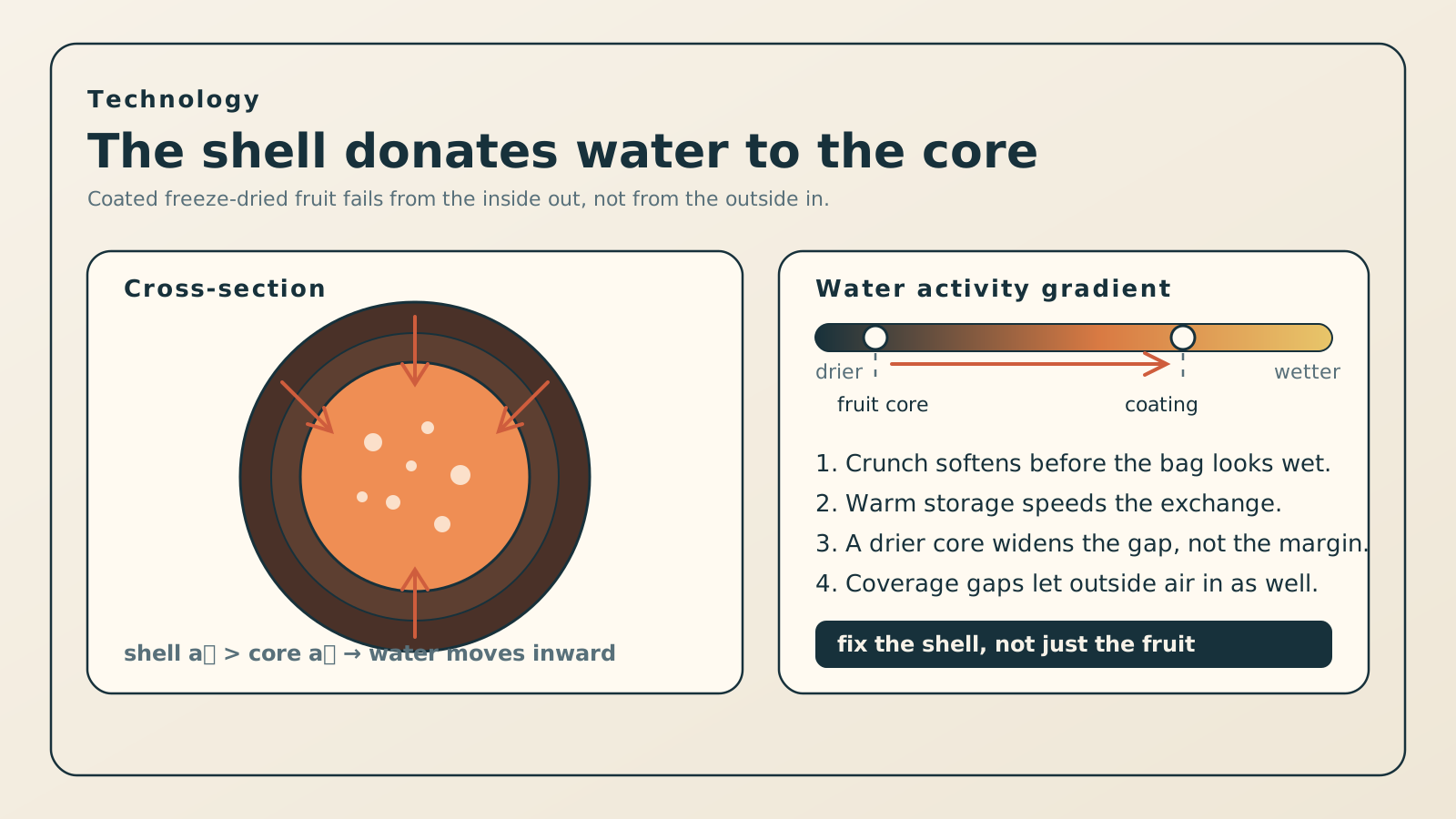
- Coated freeze-dried fruit fails from the inside out: water activity in the shell is almost always higher than in the fruit core, so moisture migrates inward over time.
- The coating is a fat or sugar barrier, not a moisture-proof one — it slows migration but rarely stops it, and tempering, thickness, and coverage decide how much it slows.
- Matching water activity between shell and core, rather than just lowering the fruit's moisture, is the practical way to protect texture.
- Shelf-life testing for coated pieces should measure core crunch and bloom separately, because the coating can look fine while the fruit inside has gone leathery.
Coated freeze-dried fruit is one of the most commercially attractive formats in the category. It looks premium, it survives a retail shelf, and it turns a fragile snack into something that can be sold by the piece.
It is also one of the easiest formats to get quietly wrong, because the failure mode is invisible from the outside.
The direct answer
Chocolate and yogurt coatings change moisture migration in freeze-dried fruit by creating a sealed two-phase system in which the shell and the core start at different water activities. Water moves from the higher-water-activity phase to the lower one until they approach equilibrium — and the freeze-dried core is almost always the drier phase. The result is a piece where the coating still snaps and the fruit inside has gone chewy.
The coating is not primarily failing to keep external humidity out. It is handing over its own water.
Two materials, one equilibrium
Water activity (aw) describes how available the water in a material is, not how much of it there is. A well-made freeze-dried fruit piece typically sits very low — dry enough that its sugar-and-fiber matrix stays in a glassy, brittle state.
Coatings do not live there.
- Couverture and compound chocolate are fat-continuous and carry little free water, but they are not at zero.
- Yogurt-flavored coatings usually include dairy solids, sugars, and sometimes humectant-adjacent ingredients that hold noticeably more available water.
- Any coating applied warm and cooled against a porous fruit surface will have some vapor exchange during setting itself.
Once the two are pressed together and sealed in a pouch, the system does what physics asks it to. Moisture leaves the phase where it is more available and enters the phase where it is less available. The freeze-dried core, with its open pore structure and enormous internal surface area, is an excellent sink.
It is tempting to think a drier fruit core is a safer core. In a coated piece, the opposite can be true. A larger water-activity gap between shell and core creates a stronger driving force for migration. The goal is not maximum dryness — it is a small, stable gap.
Why the crunch goes first
Freeze-dried fruit holds its crunch because its solids sit below the glass transition temperature at the storage condition. That state is sensitive: small gains in adsorbed water lower the glass transition, the matrix softens toward a rubbery state, and the piece stops fracturing cleanly.
The amount of water needed to do this is small — often far less than what would show up as a visible defect or a failed moisture spec on the whole coated piece. That is why a composite moisture reading on a finished coated product can look perfectly acceptable while the fruit inside has already lost its snap. The average hides the gradient.
What the coating actually controls
The shell still matters. It just matters for different reasons than most people assume.
Coverage and continuity. Pinholes, thin spots, and uncoated tails are the fastest route for outside humidity to reach the core directly. Coverage is a texture-protection variable, not just a cosmetic one.
Thickness and pickup. More coating means a longer diffusion path for external vapor, but also a larger internal reservoir of water to donate. Increasing pickup does not monotonically improve stability.
Fat phase and temper. A properly tempered, well-crystallized fat structure is a more tortuous path for water vapor than a poorly set one. Bloom — fat or sugar migrating to the surface — is a signal that the shell's structure has moved, and a bloomed shell is usually a leakier shell.
Sugar in the coating. Sugars in the shell are hygroscopic. In humid warehousing, they pull water in, raise the shell's water activity, and then pass some of it inward.
Temperature is the accelerator
Migration is not a fixed rate. Warm storage does three things at once: it raises the vapor pressure driving the exchange, it moves the fruit core closer to its glass transition, and it softens the fat phase in the coating so that its barrier structure becomes more permeable.
This is why coated freeze-dried fruit that behaved well in a climate-controlled trial can arrive from a summer container looking intact and tasting flat. The pouch never failed. The environment simply ran the same reaction faster.
Practical controls that actually help
For processors and product developers, the levers that change outcomes are narrower than the levers that get discussed:
- Measure both phases. Water activity of the uncoated fruit and of the coating as applied, not just of the finished piece.
- Bring the coating down, not the fruit further. Reformulating the shell toward a lower water activity shrinks the gradient without making the core more desperate for water.
- Inspect coverage as a spec, not a look. Define acceptable pinhole and thin-spot rates and check them on production lots.
- Control the enrobing room. Warm, humid air at the moment the shell is setting is the one point where the fruit is exposed and the coating is not yet a barrier.
- Keep the barrier film honest. A good coating does not excuse a weak pouch. External humidity still reaches thin spots and cut edges.
How to test it properly
Shelf-life work on coated pieces should not stop at "did the bag stay sealed."
- Track core texture separately from shell appearance. A trained panel or an instrumented fracture test on the fruit interior tells you what a visual check cannot.
- Run at least one elevated-temperature condition that reflects real distribution, not just ambient office storage.
- Pull water activity on the composite piece and, where feasible, on a dissected core, so you can see the gradient closing.
- Record bloom and shell integrity as separate observations. They often move before the sensory panel notices anything.
What buyers should ask
If you are sourcing coated freeze-dried fruit rather than making it, the useful questions are specific:
- What is the water activity of the finished piece, and what was it for the uncoated fruit?
- What is the coating pickup percentage and how is coverage verified?
- What packaging and storage conditions was the stated shelf life established under?
- Was texture measured across shelf life, and how?
- Has the product been tested after a realistic heat exposure, or only under ideal conditions?
A supplier who can answer those five without hedging has almost certainly done the work. A supplier who talks only about the chocolate's origin and the fruit's variety may not have looked at the interface between them at all — which is exactly where this product succeeds or fails.
Frequently Asked Questions
Does a chocolate coating protect freeze-dried fruit from moisture?
Partly. A continuous fat-based shell slows water vapor transfer from outside air, but it also sits in direct contact with the fruit. If the coating itself carries more available water than the fruit, it becomes an internal moisture source rather than a shield.
Why does coated freeze-dried fruit go soft even in a sealed bag?
Because the softening is internal. Water migrates from the higher-water-activity coating into the lower-water-activity fruit until the two approach equilibrium. A perfect seal does not stop that exchange.
Is yogurt coating worse than chocolate for this?
Typically yes, in the sense that many yogurt-flavored coatings carry dairy solids and sugars that hold more available water than a well-made compound or couverture chocolate. The gap between shell and core is usually wider.
Can the fruit be dried further to compensate?
Drying the fruit lower increases the gradient, which can accelerate migration rather than prevent it. The more useful lever is lowering the water activity of the coating and controlling storage temperature.
What should a buyer ask a supplier about coated pieces?
Ask for the water activity of the finished coated piece and of the uncoated core, the coating pickup percentage, whether coverage is inspected, and how texture was measured across the intended shelf life — not only at production.