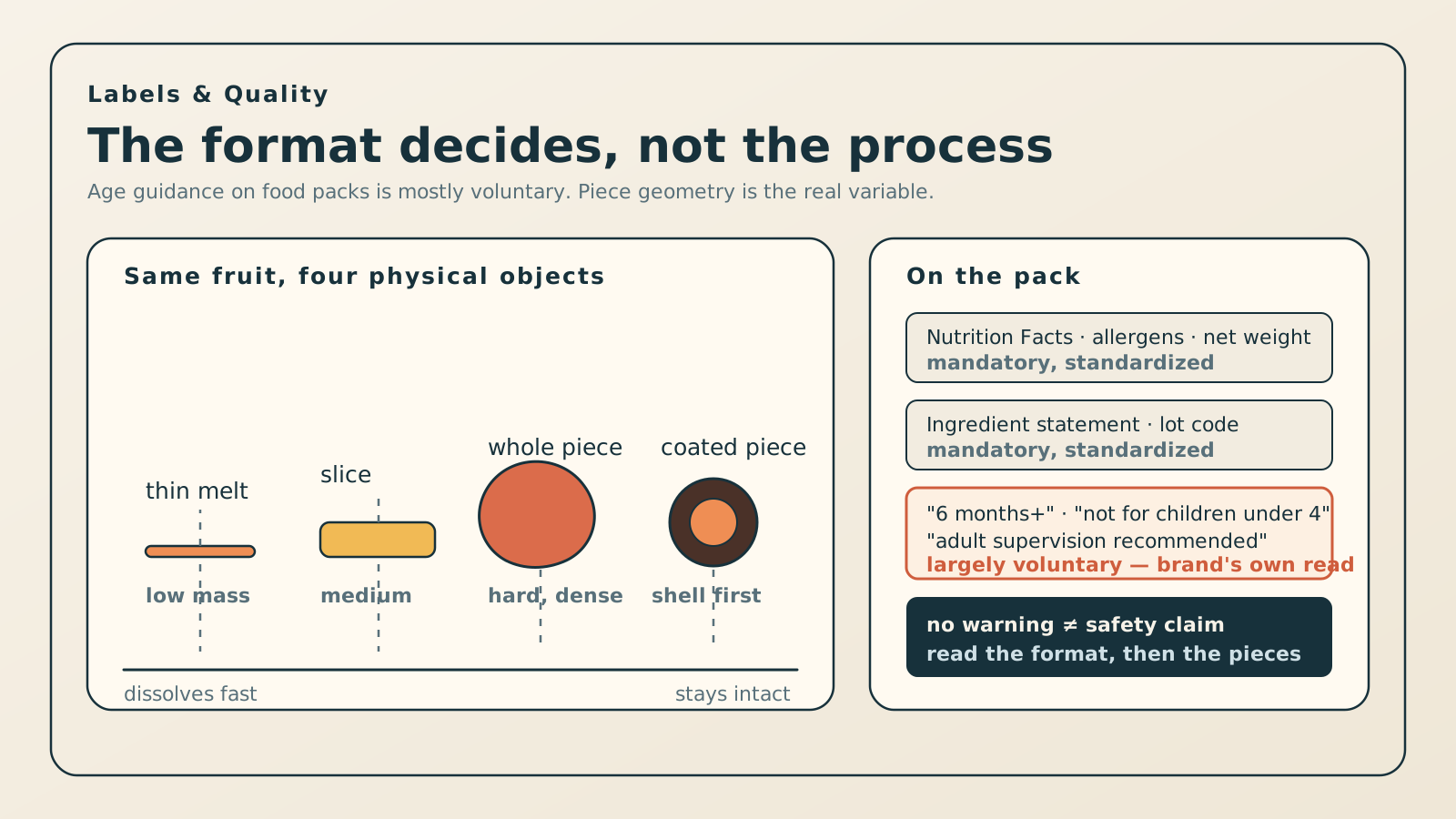
- Choking-hazard and age statements on food packaging are largely voluntary and brand-driven, not the product of a single mandatory standard the way allergen or nutrition labeling is.
- The relevant variable is physical form — piece size, shape, hardness, and how the piece behaves in a wet mouth — not whether the fruit is freeze-dried.
- Freeze-dried fruit's fast dissolution is why some brands market it to young children, but dissolution speed varies sharply by fruit, thickness, and coating.
- Absence of a warning is not a safety claim. Presence of one is not an admission of risk. Read the format description instead.
Walk down a snack aisle and you will find freeze-dried fruit marketed simultaneously as a first food for infants and as a product that carries a "not suitable for young children" warning. Both statements can be accurate. The apparent contradiction is one of the more confusing things on freeze-dried fruit packaging.
The direct answer
Choking-hazard and age statements on freeze-dried fruit are, in most cases, voluntary. They are not derived from a single mandatory standard the way the Nutrition Facts panel, the allergen declaration, or net weight are. What they reflect is the brand's own assessment of the product's physical form — piece size, hardness, shape, and how quickly the piece breaks down in a wet mouth.
That means two things. First, comparing warnings across brands tells you less than you think. Second, the absence of a warning tells you almost nothing at all.
What actually determines the hazard
Choking risk in food is a mechanical question, and the food science literature and pediatric guidance converge on a fairly consistent set of physical characteristics:
- Size relative to the airway. Pieces that approximate the diameter of a young child's airway are the concern.
- Shape. Round, cylindrical, and coin-shaped items are more problematic than irregular fragments.
- Hardness and compressibility. Material that does not deform under bite pressure is harder to clear.
- Slipperiness and cohesion. Foods that stay in one piece and can slide are riskier than those that fragment.
- Dissolution behavior. How quickly the piece breaks apart in saliva.
Notice what is not on that list: whether the fruit was freeze-dried. The process determines porosity and moisture, which in turn influence hardness and dissolution — but the process is upstream of the property that matters. A freeze-dried product can sit almost anywhere on these axes.
A paper-thin freeze-dried melt, a whole freeze-dried strawberry, a diced piece, and a chocolate-enrobed piece are four different physical objects. They happen to share a drying process. Treating "freeze-dried fruit" as one safety category is the error that makes the labels look inconsistent.
Why porosity is the selling point — and the caveat
The reason freeze-dried fruit gets marketed as an early food at all is real: the freeze-drying process leaves a highly porous structure, and thin pieces of that structure can take on saliva and collapse quickly. That is the physical basis behind "melts" and similar formats.
But the same porosity behaves very differently as thickness increases. A thick, whole freeze-dried strawberry is porous throughout and still hard, and it does not dissolve in a mouthful of saliva on any useful timescale. Sugar-dense fruits, denser cell structures, and slices cut thick all push in the same direction.
And a coating changes the calculation outright. A fat- or sugar-based shell is not porous. It has to be broken and dispersed before the fruit inside can even begin to hydrate, which makes a coated piece behave, mechanically, much more like a hard confection than like a melt.
How to read the panel
When you are evaluating a pack, the useful reading order is:
- Look at the format description first, not the warning. "Melts," "puffs," and "thin slices" describe one class. "Whole," "halves," "chunks," "coated," and "clusters" describe another.
- Look at the actual pieces if the pack has a window, or check the product photography against the stated piece size.
- Then read the age guidance as the brand's own interpretation of that format.
- Treat any explicit warning as informative and any absence as neutral. A cautious brand may put "adult supervision recommended" on a product that is no different from an unmarked competitor.
What buyers and private-label brands should know
If you are building a product rather than buying one, this is a place where the labeling decision should follow a documented internal assessment rather than a competitor scan.
- Define the piece specification tightly — dimensional range, thickness, hardness, and coating — because the label statement is only meaningful if the product stays inside it.
- Understand that breakage, screening drift, and lot-to-lot piece-size variation can move a product across the boundary you based your label on.
- Recognize that marketing a product for infants or toddlers pulls in a broader set of expectations around specification control, testing, and traceability than a general snack line, regardless of what the choking-hazard statement says.
- Get the claim reviewed by qualified regulatory counsel for your market. Voluntary does not mean consequence-free; a statement that misdescribes the product is still a misbranding exposure.
The plain-language version for shoppers
If you are standing in an aisle deciding whether a bag is appropriate for a small child, the label is not the most reliable instrument available to you. The pieces are.
Thin, light, quick-to-collapse pieces behave one way. Hard, thick, whole, or coated pieces behave another. That distinction is visible without any regulatory knowledge at all — and it is the distinction the warnings are, imperfectly and inconsistently, trying to communicate.
For any question about what is appropriate for a specific child at a specific age, the pack is not the right authority. A pediatric provider is.
Frequently Asked Questions
Are choking-hazard warnings on food legally required?
In the United States, mandatory choking-hazard labeling is tied to specific product categories — most notably certain toys and small parts under consumer product rules, and a small set of foods with specific statutory requirements. Most food choking-hazard statements are voluntary risk communication chosen by the brand, not a universal mandate.
Why do some freeze-dried fruit packs say '6 months+' and others say 'not for children under 4'?
Because they are different physical products. A thin, fast-dissolving melt designed for infants behaves very differently in the mouth than a thick, hard, whole freeze-dried strawberry or a coated piece. The brand is describing the format, not disagreeing about the fruit.
Does freeze-dried fruit dissolve fast enough to be safe for toddlers?
It depends entirely on the piece. Some thin, porous formats dissolve very quickly with saliva; dense pieces, thick slices, and coated pieces do not. Do not generalize from one product to the category, and follow the specific product's guidance and your pediatric provider.
Is a missing warning a good sign?
No. It carries no information. Some brands add cautious statements as a matter of policy and some do not add them at all. Judge the product by its described format and by looking at the pieces.
Do coated freeze-dried fruit pieces change the picture?
Yes. A fat or sugar coating slows dissolution and adds hardness, so a coated piece behaves less like a melt and more like a hard candy or a nut in terms of physical form.