- A sensory line that says 'typical' or 'characteristic' is unenforceable; it gives the supplier and the buyer no shared reference to argue from.
- A usable sensory spec names specific attributes, states how the sample is prepared and evaluated, and defines the panel — how many people, trained or untrained, and the pass rule.
- The retained reference sample is the backbone of any sensory spec; without a physical standard to compare against, written descriptors drift.
- Sensory is the one quality dimension where the buyer's own preference is legitimately part of the spec — but only if it is written down before the lot ships, not after.
Pull up a freeze-dried fruit specification sheet and scroll to the sensory section. In most cases you will find a single line:
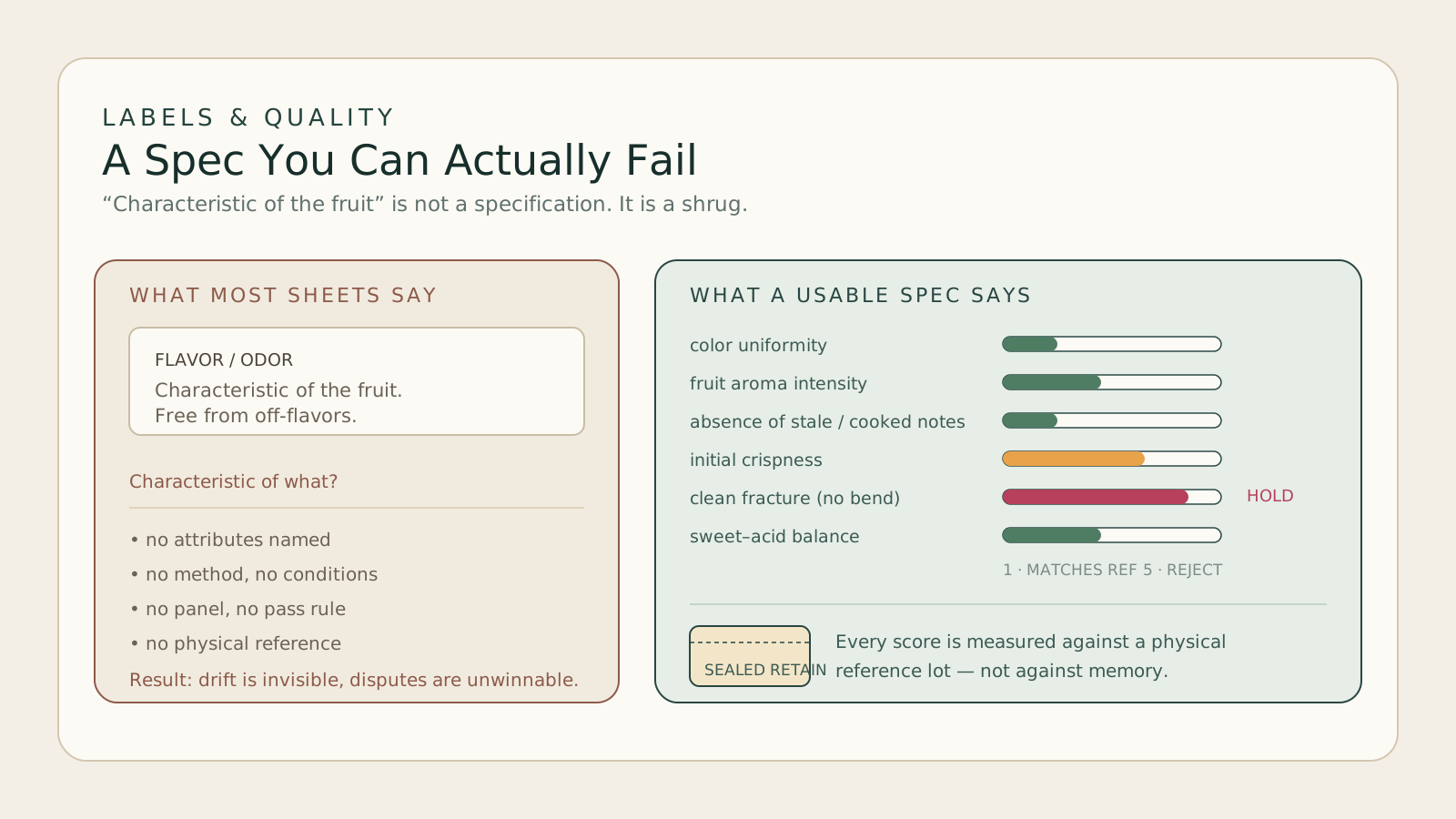
Flavor/Odor: Characteristic of the fruit. Free from off-flavors and foreign odors.
That line is on nearly every spec sheet in the industry, and it settles nothing. It cannot be tested, cannot be failed, and cannot be defended in a dispute. When a lot arrives tasting flat, this line is what you are holding.
This article is about what a sensory spec should contain instead, and how to read one to tell whether it will actually protect you.
The direct answer
A sensory specification is usable when it answers four questions:
- Which attributes are being judged? Named, not implied.
- How is the sample prepared and evaluated? Method, quantity, conditions.
- Who judges, and what is the pass rule? Panel size, training level, scoring.
- What is the reference? A retained physical standard, not a memory.
A spec that answers none of these is decoration. A spec that answers all four is a contract term.
Attribute 1: name the attributes
Fruit sensory splits cleanly into four groups. A good spec lists the ones that matter for that fruit rather than gesturing at all of them.
- Appearance. Color intensity and uniformity, surface bloom, visible fines, piece integrity. This overlaps with the color and defect specs, and should cross-reference them rather than duplicate them.
- Aroma. Fruit-forward intensity, presence of cooked or caramelized notes, presence of foreign or carryover notes, staleness or cardboard notes indicating oxidation.
- Texture. This is where freeze-dried fruit earns its price. Initial crispness, fracture behavior (clean snap vs bend), meltaway rate, and any leathery or chewy character indicating residual moisture.
- Flavor. Sweetness, acidity, bitterness (relevant in citrus, pomegranate), astringency (persimmon, some berries), and aftertaste.
Flavor in freeze-dried fruit is largely determined by the raw material. Texture is largely determined by the process. If you want a sensory spec that actually detects manufacturing problems — under-drying, collapse, moisture pickup during packing — texture attributes are where they surface first. A lot that bends instead of snapping is telling you something a flavor descriptor never will.
Attribute 2: define the method
An unspecified method produces unrepeatable results. The spec should say, briefly:
- Sample size and sampling point. How many pieces, drawn from where in the lot.
- Conditioning. Sample equilibrated to room temperature in a sealed container before opening. Evaluating cold or freshly opened product changes both aroma release and perceived crispness.
- Presentation. Neutral lighting for color evaluation (colored lighting is sometimes used deliberately to mask color when judging flavor alone). Coded samples if comparison is involved.
- Order. Appearance, then aroma, then texture on first bite, then flavor. Once you chew, you cannot un-chew.
- Palate cleansing. Water and a neutral cracker between samples. Freeze-dried fruit is intense; the third sample tastes different from the first without a reset.
None of this is exotic, and all of it takes one paragraph. Its absence is the difference between two people disagreeing productively and two people disagreeing pointlessly.
Attribute 3: define the panel and the rule
This is the part most spec sheets skip entirely.
Who evaluates? Options, in increasing rigor:
- One QC technician against a reference sample. Fast, cheap, sufficient for routine release when the standard is clear.
- A small internal panel of three to five people who have been oriented to the reference. This is what most mid-size buyers should be doing.
- A trained descriptive panel scoring named attributes on a scale. Appropriate when flavor is central to the product claim, or when a recurring supplier dispute needs arbitration.
What is the pass rule? The most common workable structure is a simple scale against the reference:
| Score | Meaning | Disposition |
|---|---|---|
| 1 | Matches reference | Accept |
| 2 | Slight deviation, within normal seasonal range | Accept |
| 3 | Noticeable deviation, still saleable | Accept with note; trend it |
| 4 | Clear deviation from reference | Hold for review |
| 5 | Off-flavor, off-odor, or wrong texture class | Reject |
The exact scale matters less than the fact that there is one, that both parties agreed to it, and that a number maps to a decision.
Attribute 4: the retained reference sample
This is the foundation, and it is the thing most often missing.
When you approve a supplier and a product, you should be keeping a sealed retained sample of the approved production lot — not the golden pre-production sample, which is often made under unrepresentative conditions, but a real lot you accepted. Store it in a barrier pouch, cool and dark, and date it.
Every later lot gets compared against it. When the retain ages out — and it will, because even well-stored freeze-dried fruit changes over a year or two — you replace it with a current approved lot and log the changeover.
Without a physical standard, "characteristic" is re-anchored to whatever arrived most recently. A lot that is 5% worse than the last one always looks acceptable. Repeat that twenty times and the product is unrecognizable, and no single lot was ever rejectable. The retain is what makes drift visible.
Retains also do a second job: when a customer complaint arrives, the retain from that lot is the only way to tell whether the product left the plant wrong or went wrong in the field.
Reading a supplier's sensory spec: the red flags
"Typical of the product." Circular. Typical of what the supplier normally ships, which is the thing in question.
No method, no panel. A sensory line without an evaluation procedure means the supplier's release decision is one person's judgment on a busy day.
Sensory listed but not a release criterion. Check whether the sensory result appears on the COA and whether the contract makes it a condition of acceptance. If it is descriptive only, you cannot reject on it.
No reference sample maintained. Ask directly: "Do you hold a retained reference for this SKU, and can you send me a sample of the current retain?" A supplier who cannot produce one is managing sensory by memory.
Sensory delegated entirely to the buyer. Some spec sheets effectively say "buyer to evaluate on receipt." That is not automatically wrong, but it means all sensory risk sits with you, and the time to negotiate that is before the container ships.
What to write into your own spec
A workable sensory section, in five lines:
- Attributes: color intensity and uniformity, fruit aroma intensity, absence of cooked/stale/foreign notes, initial crispness and clean fracture, sweetness–acidity balance, absence of leathery or chewy pieces.
- Method: sample equilibrated to ambient, evaluated under neutral lighting, order = appearance → aroma → texture → flavor, palate cleansed between samples.
- Panel: minimum three assessors oriented to the current retained reference.
- Rule: 1–5 scale against retain; ≥4 on any attribute holds the lot for joint review.
- Reference: current approved retain held by both parties; replaced annually with a mutually agreed production lot.
That is a paragraph. It converts the vaguest line on the spec sheet into something both sides can actually use — and, more importantly, something a lot can actually fail.
The practical read
Sensory is the quality dimension where buyers have the most legitimate authority and the least documentation. A lab can tell you the moisture is 2.1%. Only a person can tell you the strawberries taste like cardboard.
The gap between those two facts is where most freeze-dried fruit disputes live. Closing it does not require a laboratory or a trained panel. It requires naming the attributes, writing down the method, keeping a sealed bag of the product you approved, and agreeing in advance what happens when the new lot does not match it.
Frequently Asked Questions
What is wrong with 'characteristic flavor, free from off-flavors'?
It has no reference point. Characteristic of what — which variety, which season, which supplier's process? And an off-flavor to whom? The line reads like a specification but functions as an opinion, which means disputes get settled by whoever pushes hardest rather than by the document.
Do I need a trained sensory panel to write a real spec?
No. A small internal panel with a written procedure and a retained reference sample is far better than nothing and is what most mid-size buyers actually use. Trained descriptive panels are worth it when flavor is the core of your product claim or when you are arbitrating recurring disputes with a supplier.
How does the retained reference sample fit in?
It is the physical anchor for every written descriptor. When you approve a supplier, you keep a sealed sample of the approved production lot under controlled conditions and compare later lots against it. Without that, 'characteristic' quietly redefines itself over a couple of years of gradual drift.
Can a lot pass every lab test and still fail sensory?
Yes, and this is the case that causes most arguments. Moisture, water activity, microbiology, and defects can all be in spec while the fruit tastes flat, cooked, or faintly like the previous run. If the contract does not make sensory a release criterion with a defined method, the supplier has a reasonable argument that the lot conforms.
Primary sources & further reading
- United States Standards for Grades of Dried Fruits USDA Agricultural Marketing Service Referenced for the way official grade standards define flavor, odor, and appearance attributes and tie them to defined evaluation practice.
- Current Good Manufacturing Practice, Hazard Analysis, and Risk-Based Preventive Controls for Human Food (21 CFR Part 117) U.S. Electronic Code of Federal Regulations Referenced for the general expectation that specifications and verification activities be defined and documented rather than informal.
External links open in a new tab. We do not receive compensation from any organization listed; sources are referenced because they are primary, current, and publicly verifiable.