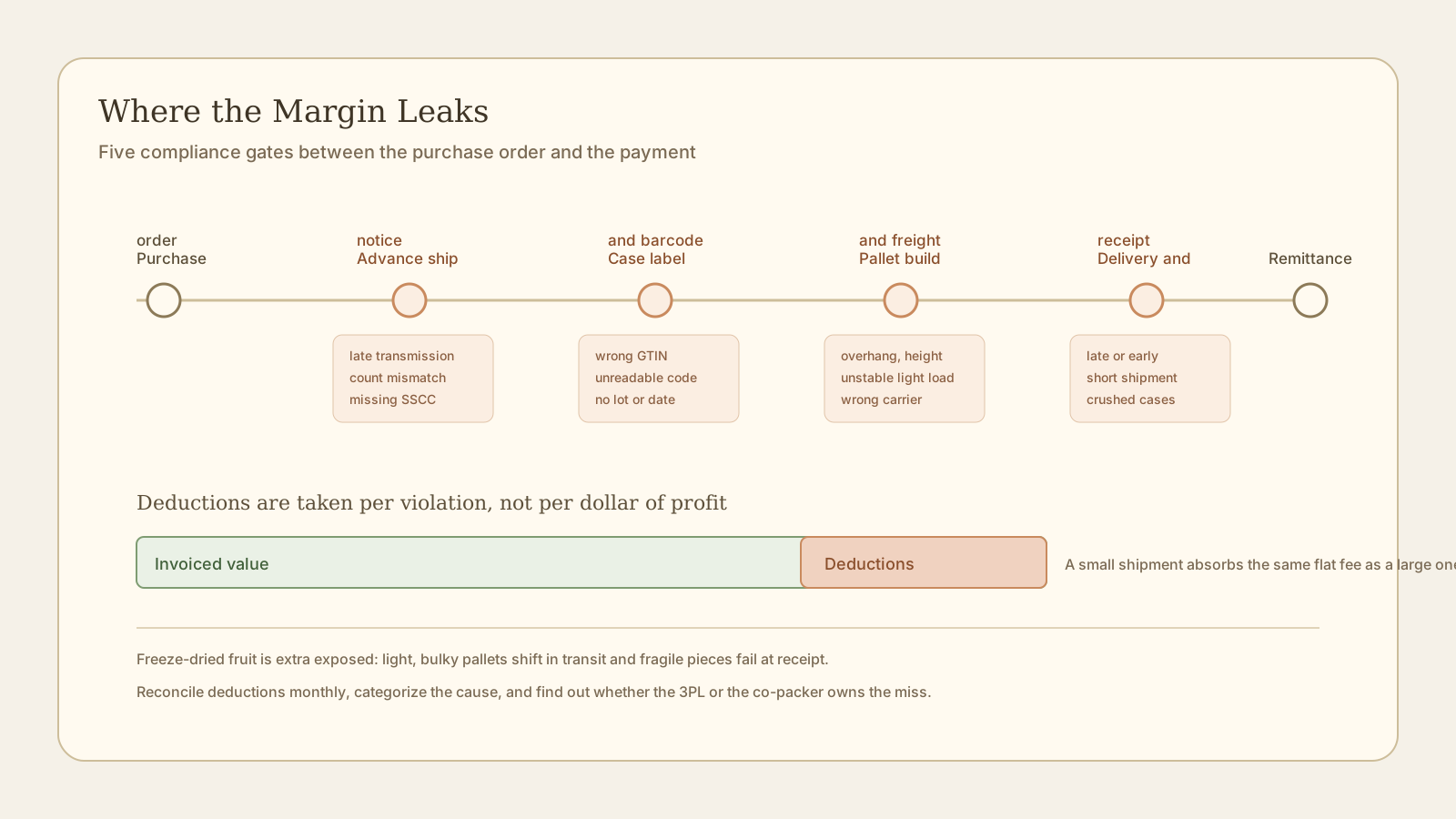
- Chargebacks are deductions retailers take for supply-chain non-compliance, and they are assessed per violation, not per dollar of profit, so a small brand can lose more on penalties than it earns on the order.
- The most common triggers in snack categories are late or early delivery, incorrect case labels and barcodes, wrong pallet configuration, and missing or malformed advance ship notices.
- Freeze-dried fruit is unusually exposed because case weights are light, cases crush easily, and pallet builds that look fine on paper fail in transit.
- Budgeting a chargeback allowance and auditing deductions monthly is cheaper than assuming compliance and discovering the leak two quarters late.
A snack founder who lands a regional grocery chain usually spends the next month on artwork, forecasts, and cases per store. Very few spend that month reading the retailer's routing guide. The invoice teaches them later.
Chargebacks — the deductions retailers take when a shipment does not follow their rules — are one of the most reliably underestimated costs in packaged food. For freeze-dried fruit, a category with light cases, fragile product, and small brands, the exposure is worse than average.
The direct answer
A retailer's purchase order tells you what they want. Their routing guide tells you how it must arrive: which carrier, in what window, on what pallet, with what label, preceded by what electronic message. Each requirement carries a penalty for non-compliance, and the penalties are assessed on the shipment, not on the profit.
That asymmetry is the whole problem. A per-purchase-order fee that is a rounding error for a national supplier shipping forty pallets is a material loss for a brand shipping two.
Where the deductions actually come from
The categories repeat across chains, even when the names and amounts differ.
- On-time in-full (OTIF) misses. Delivering late is penalized. Delivering early is often penalized too, because the retailer's dock and warehouse slots are scheduled. Short-shipping against the ordered quantity is a separate miss.
- Advance ship notice (ASN) failures. The electronic message that tells the warehouse what is arriving must be sent within a defined window and must match the physical shipment exactly. A wrong case count or a missing SSCC on a pallet label breaks receiving.
- Case marking and barcode errors. Wrong GTIN, unreadable barcode, label in the wrong place, or missing lot and date coding.
- Pallet configuration. Wrong pallet type, over-height loads, overhang, unstable wrap, mixed SKUs where mixing is not allowed.
- Product and packaging issues at receipt. Crushed cases, damaged shelf-ready trays, and product that does not match the approved specification.
Most brands watch the delivery clock and ignore the document clock. The ASN usually has to be transmitted before the truck arrives, not after it leaves. Missing that window can generate a fee even when the freight itself is perfect.
Why freeze-dried fruit is disproportionately exposed
Three physical facts about the product turn ordinary logistics into a chargeback risk.
Cases are light and voluminous. Freeze-dried fruit has very low bulk density. A pallet of it weighs far less than a pallet of most grocery items but occupies the same footprint. Light pallets are less stable in transit, and loads that look correctly built in the warehouse can shift on the road. Damage found at receipt is charged back.
The product itself breaks. Compression, drop, and vibration during transit convert whole pieces into fines. A case that passes visual inspection can still be rejected for product condition when a receiver opens it. Brands that have not run drop and compression testing on their e-commerce and retail cases are gambling here.
Moisture and heat are handled casually. The product is hygroscopic. A pallet sitting in a hot, humid cross-dock is losing crunch, and while the retailer will not chargeback for water activity, they will chargeback for consumer complaints and returns that follow.
How to size the exposure before it happens
The number a brand needs is not "what is the fee," it is "what percentage of invoiced revenue comes back as deductions." That figure is knowable only after shipping, but it can be estimated before.
A practical approach:
- Read the routing guide and list every penalty with its amount and its trigger. Most brands have never done this.
- Map each penalty to the internal step that would cause it. ASN transmission, case label generation, pallet build, carrier booking, appointment scheduling.
- Ask who owns that step. If the answer is "our 3PL" or "our co-packer," get their compliance record in writing, because the retailer will deduct from you, not from them.
- Put an allowance in the P&L. A brand entering its first chain account and budgeting zero for deductions is budgeting optimistically.
The reconciliation problem
Deductions arrive as line items on a remittance, often weeks after the shipment, often coded cryptically. The failure mode is not that brands disagree with the charges. It is that no one reads them.
A monthly reconciliation — matching every deduction to a shipment, categorizing the cause, and disputing the ones with documentation — does three things. It recovers some cash. It reveals which internal step is actually broken. And it tells you whether your co-packer or 3PL is the source, which is the conversation you need before the next season's contract.
Brands that skip this discover the pattern only when the annual margin comes in below plan, and by then the root cause is a year of undifferentiated noise.
What to negotiate before the first purchase order
Some terms are movable, especially with regional chains and especially before the relationship starts.
- A compliance ramp. A grace period on penalties for the first several shipments while systems are validated.
- A dispute window that is long enough to matter. Short windows favor the retailer, because small suppliers discover deductions late.
- Clarity on who pays for retailer-caused failures. Refused appointments and dock delays should not be your fee.
- Written pallet and case specifications, confirmed in advance. Get the approval before you build ten thousand cases against a guess.
The takeaway
Retail distribution is not one negotiation, it is two. The first is about price and placement, and everyone prepares for it. The second is about compliance mechanics, and it decides whether the price you negotiated is the price you actually receive. For a low-density, fragile, moisture-sensitive product like freeze-dried fruit, the second negotiation deserves at least as much attention as the first.
Frequently Asked Questions
What is a chargeback in retail distribution?
It is a deduction the retailer takes from the invoice when a shipment does not comply with their published requirements. Rather than refusing the goods, the retailer accepts them and reduces payment, sometimes by a flat fee per violation and sometimes by a percentage of the cost of goods.
What is a routing guide?
It is the retailer's rulebook for how suppliers must ship: carrier selection, delivery windows, appointment scheduling, case marking, pallet standards, electronic document formats, and the penalties for each type of miss. It is usually a long document that changes without much notice.
Why are small brands hit harder than large ones?
Penalties are often assessed per purchase order, per case, or as a flat fee, so they scale with violations rather than with revenue. A large supplier absorbs a fee across a very large invoice. A small brand shipping a few pallets can see the same fee wipe out the margin on the order.
Are chargebacks negotiable?
Some are disputable when the supplier has documentation that the retailer's own system caused the failure, such as a refused delivery appointment. Whether disputes succeed depends on evidence, timelines, and the relationship. Many brands never dispute simply because they do not reconcile deductions in time.
What is the single most preventable category?
Documentation and labeling. Advance ship notice errors and incorrect case marking are administrative failures, not logistics failures, and they are the cheapest to fix once someone owns the process.
Primary sources & further reading
- GS1 US Standards for Barcodes and Product Identification GS1 US Reference for the GTIN, case-level barcode, and shipping-label standards that most US retailer routing guides require suppliers to follow.
- Fair Packaging and Labeling Act Requirements Electronic Code of Federal Regulations Federal requirements for net quantity and identity declarations on consumer packages, which case and shelf-ready configurations must remain consistent with.
External links open in a new tab. We do not receive compensation from any organization listed; sources are referenced because they are primary, current, and publicly verifiable.