- Free samples usually come from existing finished stock, which means they tell you what a supplier already makes, not what they will make for you.
- A paid trial lot exists because someone has to pay for a dedicated dryer cycle; freeze-dryer time is the expensive input, not the fruit.
- Pilot runs and first production lots are where spec drift shows up, so the sample worth paying for is the one produced the way your real orders will be.
- Ask suppliers to break the sample quote into fruit cost, cycle/setup cost, and freight — the shape of that breakdown reveals whether they are a manufacturer or a trader.
Every sourcing conversation starts the same way. A buyer finds a supplier, likes the look of the catalog, and asks for samples. What arrives next — and what it costs — says more about the supplier and about the reliability of your future lots than most buyers realize.
The confusion is linguistic. "Sample" covers everything from a 100-gram pouch pulled off a shelf to a 300-kilogram production-representative run. Those are different objects with different price tags and, crucially, different predictive power.
The direct answer
Freeze-dried fruit samples are priced according to whether the supplier has to make them. A sample pulled from existing finished stock costs the supplier almost nothing beyond freight, so it is usually free. A sample that requires a dedicated freeze-dryer cycle costs real money — because dryer time, not fruit, is the expensive input — so it is usually quoted.
That distinction maps directly onto usefulness. Free stock samples tell you what a supplier already makes. Paid trial and pilot runs tell you what they will make for you. Buyers who skip the second stage are the ones who later complain that production drifted from the approval sample.
Why dryer time, not fruit, sets sample cost
Freeze-drying is a slow batch process. Reviews of plant-based freeze-drying consistently describe long cycle times and high energy demand relative to other drying methods. A chamber runs for many hours to produce one load, and it produces nothing else while it does.
That gives you the cost structure:
- The fruit in a 1 kg sample is trivial. Even premium raw fruit at retail-like prices is a small number.
- The cycle is not trivial. If a supplier has to run a chamber for your sample, they lose that chamber slot. The cost is the same whether the trays are full or nearly empty.
- The changeover is not trivial either. A custom sample in a plant that runs allergen-relevant or strongly aromatic fruits may require a cleaning cycle before and after.
This is why a supplier will happily mail you 200 grams of standard freeze-dried strawberry for free, and quote you a real number to produce 200 grams of a 6 mm diced blend to your spec. The second request is not a bigger version of the first. It is a manufacturing job.
If a supplier offers to custom-make any sample, in any spec, at any small quantity, for free and fast — be curious rather than delighted. Either they are subsidizing acquisition heavily, or they are a trader repacking someone else's stock and describing it as custom production.
The four stages, and what each one actually proves
Most qualification paths move through some version of these stages. The names vary; the economics do not.
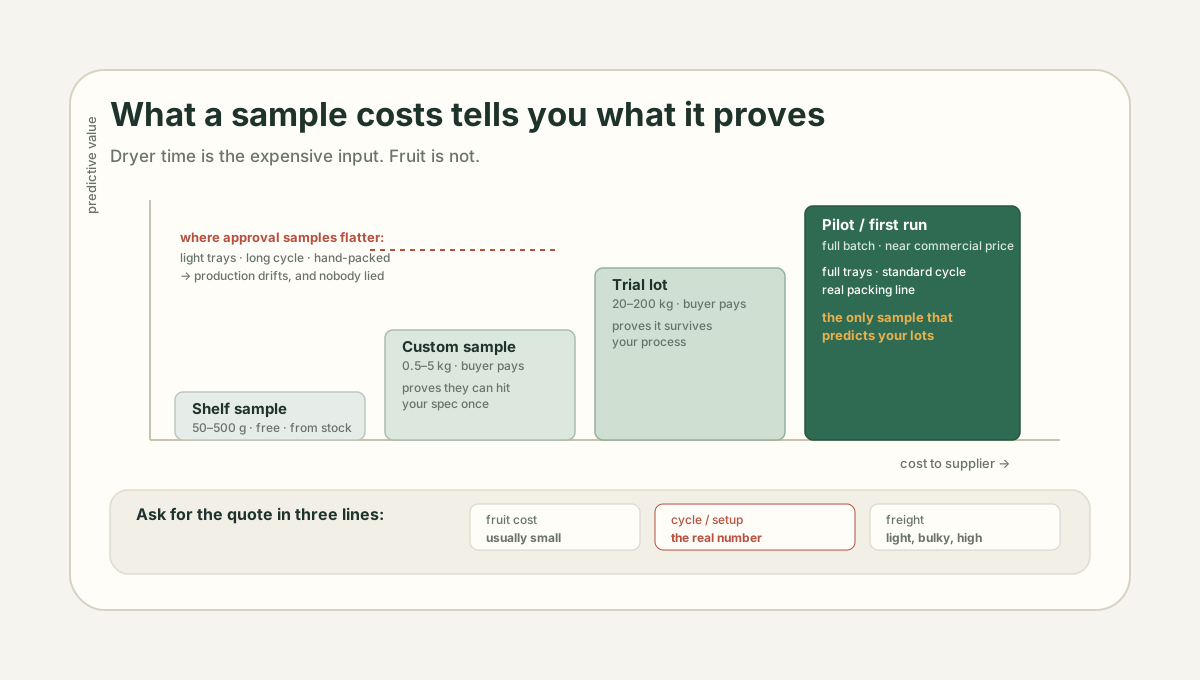
| Stage | Typical quantity | Who pays | What it proves |
|---|---|---|---|
| Shelf sample | 50–500 g | Supplier (free) | The supplier's existing standard item: taste, color, crunch, general quality level |
| Custom sample | 0.5–5 kg | Usually the buyer | That the supplier can hit your cut, size, or blend spec at least once |
| Trial lot | 20–200 kg | Buyer | That the product survives your process — mixing, filling, coating, baking, shipping |
| Pilot / first production run | Full or near-full batch | Buyer (at or near commercial price) | That your spec holds when trays are full and the standard cycle runs |
The predictive value rises down the table, and so does the cost. That is not a coincidence — it is the same fact viewed from two sides.
Why approval samples flatter, and pilots don't
There is a structural reason samples look better than production, and it is not fraud.
A sample is made under attentive conditions. Someone picks good raw fruit. The tray is lightly loaded, which shortens the drying path and improves uniformity. The cycle may run longer than commercial economics would allow, because nobody is counting chamber hours on a 2-kilo run. The finished pieces are hand-selected and hand-packed, so breakage is minimal.
Production is the opposite of all of those things. Trays are loaded to the validated fill weight or beyond. Cycles run to a commercial endpoint. Pieces move through conveyors, sieves, and fillers, each of which generates breakage. FDA's lyophilization guidance is explicit that cycles are validated for specific equipment and loading conditions — which is precisely why a bench-made sample is not evidence about a full chamber.
The result is predictable drift:
- Approval sample: 95% whole pieces, uniform color, crisp bite.
- First production lot: more fines, more color variation, and a few softer pieces from the deepest part of the load.
Neither party lied. The buyer simply paid for the wrong sample.
How to read a sample quote
When a supplier quotes a trial lot, ask for the quote broken into three lines: fruit cost, cycle/setup cost, and freight. The shape of that breakdown is diagnostic.
- Cycle/setup dominates the number. That is a manufacturer. They are pricing chamber time honestly, and the per-kilo cost will fall sharply at commercial volume.
- Fruit cost dominates and setup is near zero. They are pulling from stock or buying from someone else. Fine for a catalog item; a warning sign if you asked for a custom spec.
- Everything is bundled into one round number. You are talking to a trading desk, not a plant. That is not automatically bad, but price your expectations accordingly and ask who the actual processor is.
- Freight dwarfs the product. Normal for small air-shipped samples of a light, bulky product. Not a signal about the supplier.
What to negotiate
A few things are reasonable to ask for, and most credible suppliers will agree to some of them:
- Sample fee credited against the first commercial PO. This is standard and costs a serious supplier nothing if the relationship works out.
- A production-representative pilot before the first full order. Same equipment, same cycle, same fill weight, same packaging line as your commercial lots would use.
- Retained samples from the pilot, held by both sides, so any later dispute has a physical reference point.
- A written spec agreed before the pilot, not after. Moisture, water activity, piece size, breakage percentage, color range. Approve the pilot against that spec rather than against a vibe.
- Clarity on which plant and which line produced the sample. A multi-site supplier can send you a sample from their best facility and fulfill from another.
The practical summary
Free samples are a catalog. Paid samples are a manufacturing decision. Pilot runs are the only sample that predicts your production lots, because they are the only one made the way your production lots will be.
Buyers who treat the sample stage as a free tasting exercise routinely get surprised at first delivery. Buyers who spend a modest amount on a production-representative pilot, and approve it against a written spec, rarely do. The difference in cost is small. The difference in what you learn is not.
Frequently Asked Questions
Why do some freeze-dried fruit suppliers charge for samples?
Because the cost of a sample is rarely the fruit. If the sample has to be made rather than pulled from existing stock, someone has to schedule a dryer cycle, load it, run it, and clean down afterward. Freeze-dryer time is the scarce, expensive resource, so any sample that requires a dedicated run carries real cost regardless of how small the pouch is.
Is a free sample a bad sign?
Not at all. A free sample usually means the supplier already has that item in finished stock and can pull from it. That is a perfectly good way to evaluate an existing catalog product. It just means the sample reflects the supplier's standard item, not a custom spec you have described.
What is the difference between a trial lot and a pilot run?
Terminology varies by supplier, but broadly a trial lot is a small paid quantity made to your spec so you can test it in your own process, while a pilot run is a larger, production-representative batch made on the equipment and cycle that would actually produce your commercial orders. The pilot is the one that predicts your future lots.
Do suppliers credit sample fees against a first order?
Many will, and it is a reasonable thing to negotiate. A credit against the first commercial purchase order is common because it aligns both sides: the supplier recovers cycle cost only if the relationship goes nowhere, and the buyer is not penalized for doing proper qualification.
Why do production lots often differ from the approval sample?
Because approval samples are frequently made under more favorable conditions — hand-selected fruit, a lightly loaded tray, a longer cycle, careful hand-packing. Production runs full trays, standard cycles, and mechanical handling. The gap between the two is real, which is why a production-representative pilot is worth paying for.
Primary sources & further reading
- Freeze-Drying of Plant-Based Foods Foods / PubMed Central Referenced for the description of freeze-drying as a long, energy-intensive batch process, which underpins why dryer time rather than raw fruit dominates the cost of producing a sample.
- Lyophilization of Parenteral (7/93) U.S. Food & Drug Administration Referenced for the principle that cycles are validated on specific equipment and loading conditions, which is why a production-representative run predicts commercial lots better than a bench-made sample.
External links open in a new tab. We do not receive compensation from any organization listed; sources are referenced because they are primary, current, and publicly verifiable.