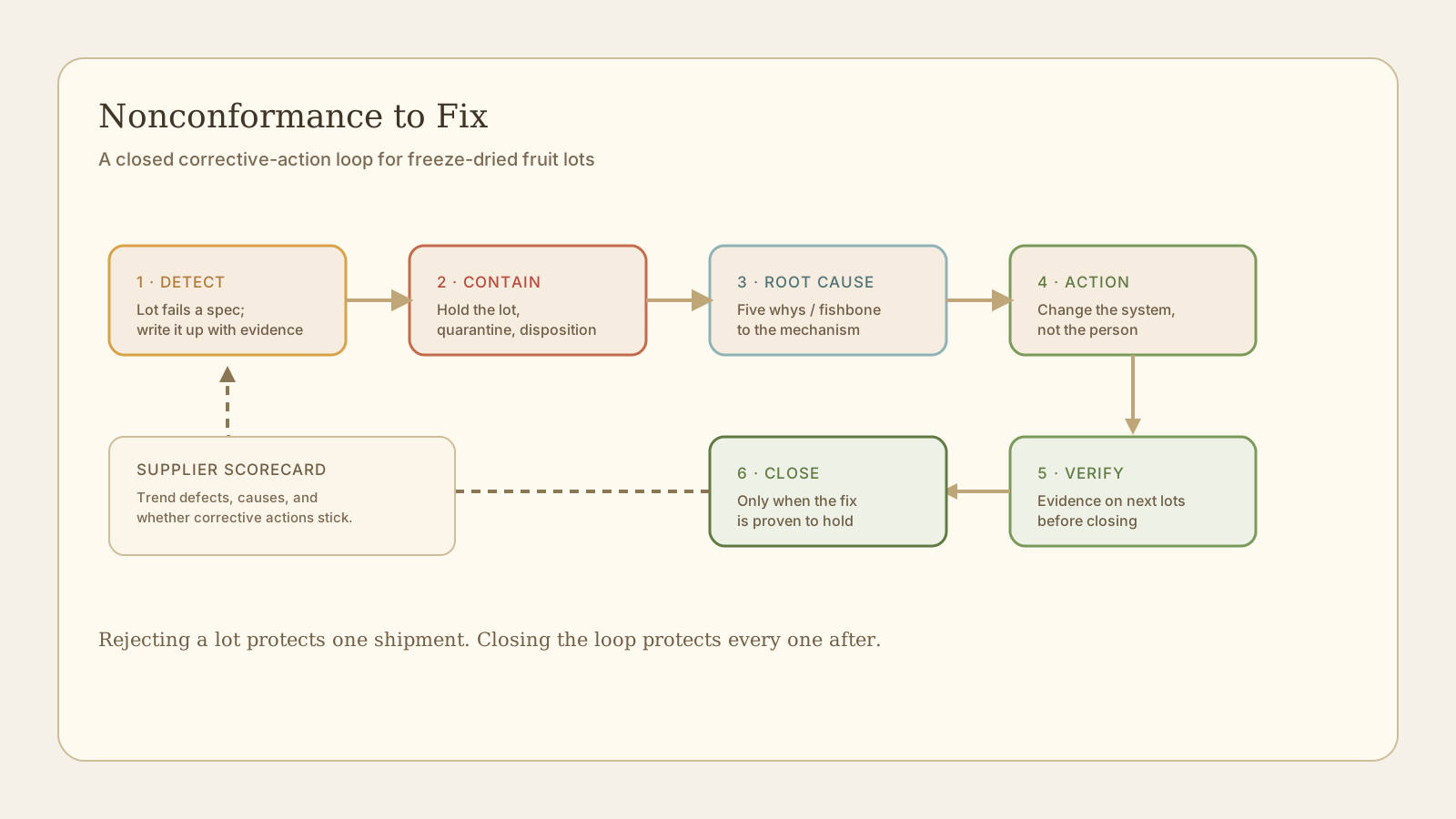
- A nonconformance report documents exactly what failed against which spec, with evidence, so the supplier can act on facts rather than a vague complaint.
- Containment stops the immediate bleeding, root-cause analysis finds why it happened, and corrective action prevents recurrence — skipping any step leaves the problem alive.
- The strongest signal from a supplier is not a fast apology but a documented root cause plus a verified corrective action you can check on later lots.
- Tracking nonconformances over time turns scattered complaints into a scorecard that tells you which suppliers are actually improving.
Every freeze-dried fruit buyer eventually receives a lot that does not meet spec. The moisture reads high, the bags are half fines, the color has gone dull, or a defect scorecard tips past the accept limit. Rejecting that lot feels like the whole job. It is not. The rejection is the easy part. The harder and more valuable part is making sure the same defect does not walk back through the door on the next shipment.
That is what a nonconformance and corrective-action process is for. It is a boring-sounding discipline that quietly separates suppliers who improve from suppliers who keep making the same mistake.
Start with a real nonconformance report
A nonconformance is simply a documented case where a lot or process failed a defined requirement. The value is in how it is written up. A vague email — "the last shipment seemed off" — invites a vague response. A precise report gives the supplier something to act on.
A useful nonconformance report captures:
- the lot or batch code and the affected quantity
- the exact spec that was missed, with the actual measured value next to the limit
- how and when the problem was detected, and by whom
- supporting evidence: photos, lab results, retained samples, receiving records
- the immediate disposition of the affected material
The discipline here is measuring against an agreed spec rather than a feeling. "Moisture 6.2% against a 5.0% maximum on lot code 0710A, verified on our meter and confirmed by a third-party lab" is actionable. "The fruit felt a bit chewy" is not.
Contain before you investigate
The first response to a confirmed nonconformance is containment: stopping the immediate harm before understanding the cause. Containment answers a narrow question — how do we keep this bad material from reaching a customer or a production line?
For freeze-dried fruit that usually means putting the suspect lot on hold, checking whether any of it has already been used or shipped onward, and deciding disposition: return, rework, downgrade, or destroy. It may also mean quarantining adjacent lots from the same production run until you know whether the problem is isolated or systemic.
Containment is not a fix. It is a tourniquet. Treating it as the end of the process is the most common mistake, because it makes the immediate pain go away while leaving the underlying cause untouched.
Find the actual root cause
Root-cause analysis is where the real work happens, and it is the step most often shortchanged. The goal is to explain the mechanism behind the failure, not just restate the failure in different words.
Consider a high-moisture lot. "Moisture was out of spec" is the symptom. Pushing further might reveal that the cycle endpoint was judged on the recipe clock rather than a product-temperature or pressure-rise check, so the densest pieces finished primary drying late. Or that packaging-room humidity spiked and product picked up moisture between the dryer and the seal. Or that a condenser was overloaded and slowed water removal. Each points to a different fix.
Simple structured tools help push past the first convenient answer:
- The five whys: keep asking why until you reach a cause you can actually change.
- A fishbone (cause-and-effect) diagram: sort possible causes across people, process, equipment, materials, and environment.
A root cause you can act on usually names a process or system that failed, not a person who "made an error." If the honest answer is that a control was missing, the corrective action is to add the control.
If the corrective action is only "we will be more careful" or "we retrained the operator," the root cause probably was not found. Careful people still fail when the system lets them. A durable fix changes the system: a required check, a tightened tolerance, an alarm, a revised work instruction.
Corrective action, then verification
Corrective action changes something so the failure cannot recur. Preventive action goes one step further and asks whether the same weakness could cause similar failures elsewhere. For freeze-dried fruit, corrective actions often look like a mandatory endpoint check added to the cycle record, a tightened packaging-room humidity limit, a revised sampling plan, or updated supplier work instructions.
Verification is the step that gives the whole process its teeth. A corrective action is only a promise until there is evidence it worked. Decide up front what proof would satisfy you:
- COA data showing the parameter back in range across several consecutive lots
- updated procedures or work instructions with revision dates
- training or requalification records
- results from the next few production lots, checked more closely than usual
Only after that evidence lands should the CAPA be formally closed. A supplier that closes a corrective action the same day it opened, with nothing to verify, has not really closed anything.
Triage by severity
Not every miss deserves a full investigation. Sensible buyers triage. A food-safety or regulatory failure — an allergen cross-contact, a foreign-material find, an out-of-limit microbiological result — warrants a full CAPA every time. A minor cosmetic issue, such as slightly more fines than usual within a still-passing lot, may be logged and trended rather than investigated in depth.
The rule that keeps triage honest is escalation: a "minor" defect that keeps repeating is no longer minor. Recurrence is itself a signal that a root cause is being tolerated rather than fixed, and it should trip the issue up to a formal investigation.
Turn events into a scorecard
The last piece is memory. A single nonconformance is an incident. A log of nonconformances over time is intelligence. Tracking them by supplier, defect type, and resolution turns scattered complaints into a pattern you can act on.
That record feeds directly into supplier scorecards and quarterly reviews. It answers the questions that matter at renewal time: Is this supplier's defect rate trending down? Do their corrective actions actually stick, or do the same issues resurface under new lot codes? A supplier whose nonconformance history shows real, verified improvement is worth more than one who simply never gets a formal complaint because nobody is tracking.
Bottom line
Rejecting a bad freeze-dried fruit lot protects one shipment. A disciplined nonconformance and CAPA loop protects every shipment after it. Document the failure against a real spec, contain the immediate risk, find the mechanism rather than the symptom, verify that the fix holds, and keep a running record.
The strongest quality signal a supplier can send is not a fast apology. It is a documented root cause and a corrective action you can confirm on the next lots — proof that a problem, once found, was actually closed.
Frequently Asked Questions
What is the difference between a nonconformance and a CAPA?
A nonconformance is the event: a lot or process that did not meet a defined requirement, such as moisture above spec or broken pieces beyond the agreed limit. CAPA — corrective and preventive action — is the structured response that finds why it happened and changes something so it does not recur. The nonconformance is the symptom; the CAPA is the cure.
What should a nonconformance report include?
The lot or batch code, the specific spec that was missed with the actual measured value, how and when it was detected, the quantity affected, supporting evidence such as photos or lab results, and the disposition of the affected material. Precise, evidence-backed reports get faster, more accurate supplier responses than a general complaint email.
What counts as a real root cause?
A real root cause explains the mechanism, not just the outcome. 'Moisture was high' is a symptom. 'The cycle endpoint was called on the recipe clock rather than a product-temperature check, so the densest pieces finished late' is closer to a root cause. Techniques like the five whys or a fishbone diagram help push past the first easy answer.
How do you verify a corrective action worked?
Define what evidence would prove it. That might be tightened endpoint checks documented on the next several lots, updated work instructions, retraining records, or COA data showing the parameter back in range across multiple batches. Verification is what separates a promise from a fix, and it should happen before the CAPA is closed.
Should minor defects go through the same process?
Not always at full depth. Many buyers triage by severity: safety or regulatory issues get a full CAPA, while minor cosmetic misses may be logged and trended without a formal root-cause investigation unless they repeat. The key is that repeating 'minor' issues get escalated rather than absorbed indefinitely.
Primary sources & further reading
- Current Good Manufacturing Practice, Hazard Analysis, and Risk-Based Preventive Controls for Human Food Electronic Code of Federal Regulations FDA rule requiring corrective actions and verification when preventive controls are not properly implemented or a problem is identified.
- SQF Food Safety Code for Manufacturing SQF Institute GFSI-benchmarked scheme requiring documented corrective and preventive action procedures for nonconforming product and process failures.
- BRCGS Global Standard for Food Safety BRCGS Certification standard specifying management of nonconforming product, root-cause analysis, and corrective action requirements.
External links open in a new tab. We do not receive compensation from any organization listed; sources are referenced because they are primary, current, and publicly verifiable.