- Heat reaches frozen fruit mainly by conduction through the shelf and tray, so tray material, wall thickness, and how flat the tray sits all change the effective heat path.
- Aluminum trays conduct heat far better than stainless steel, but stainless is often chosen for durability and cleaning; the trade-off shows up as longer or less uniform cycles.
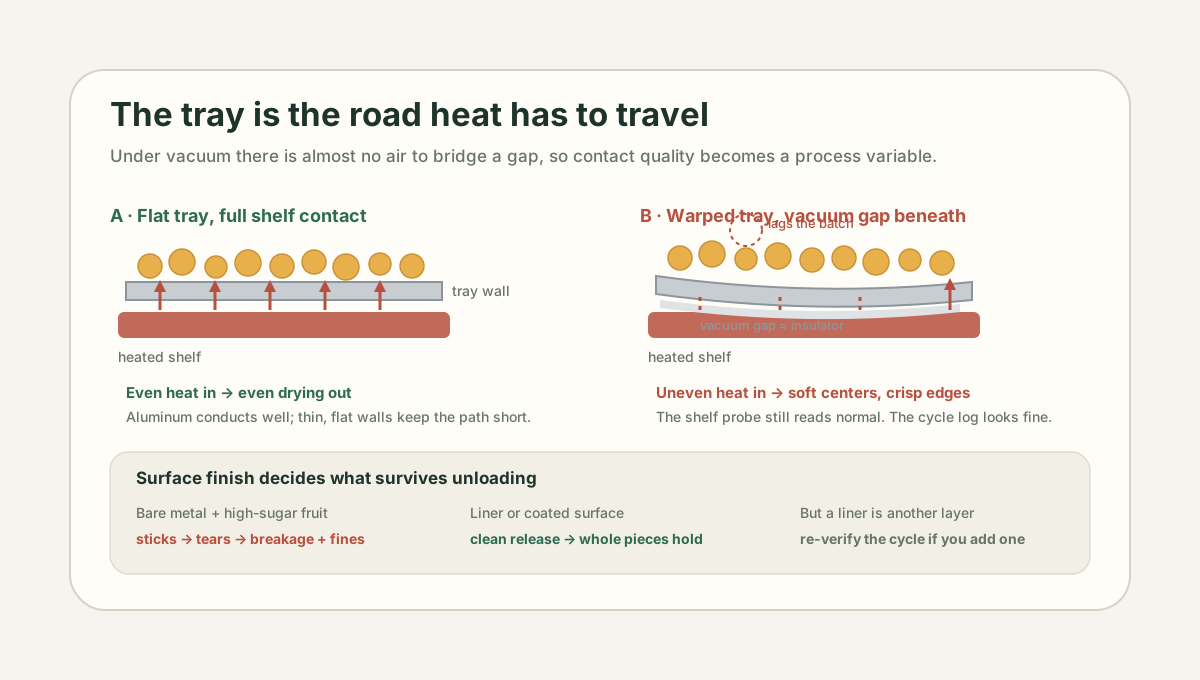
- A warped tray or a tray with a raised lip leaves an air gap under the load, and under vacuum an air gap is close to an insulator.
- Surface finish and any liner determine how much fruit sticks and tears at unloading, which is a direct source of breakage and fines.
Ask a freeze-drying operator what controls a cycle and you will hear about shelf temperature, chamber pressure, and condenser capacity. Ask about the tray and you will often get a shrug. The tray is treated as furniture: something the fruit sits on while the real process happens around it.
That is a mistake. Under vacuum, the tray is not furniture. It is the main road that heat has to travel to reach the ice.
The direct answer
Tray material and surface finish change freeze-dried fruit drying in two ways. First, they set how efficiently heat conducts from the shelf into the frozen load, which caps how fast sublimation can proceed. Second, they set how strongly the fruit adheres to the tray at the end of the cycle, which shows up as broken pieces and fines at unloading.
A flat aluminum tray in tight contact with the shelf moves heat well. A thicker stainless tray, a warped tray, or a tray sitting on debris moves heat worse, and no amount of shelf-temperature adjustment fully compensates without pushing the fruit toward collapse.
Why the tray matters more under vacuum than it would in an oven
In a normal oven, hot air surrounds the food. Heat arrives by convection whether or not the pan is perfect.
Freeze-drying takes that away. FDA's lyophilization guidance describes the process as freezing, then vacuum, then controlled heat to drive sublimation. Once the chamber is pumped down, there is very little gas left to carry heat. Reviews of plant-based freeze-drying describe conduction from the heated shelf as the primary heat path into the frozen load, with radiation contributing at the exposed surfaces.
That has a blunt consequence. The heat has to physically travel:
- shelf surface → tray bottom
- through the tray wall
- tray top surface → the frozen fruit resting on it
Every interface in that chain is a place where heat can be lost, and every gap is worse than it would be at atmospheric pressure.
At room pressure, a thin air gap under a tray still conducts some heat, because air molecules bridge it. Under the deep vacuum used in freeze-drying, that gap has far fewer molecules to carry energy. A gap that would be harmless in a bakery becomes close to an insulating layer in a freeze-dryer.
Material: conduction versus durability
The material decides how readily heat crosses the tray wall.
- Aluminum conducts heat several times better than stainless steel. It is also light, which matters when someone is lifting a loaded tray of frozen fruit. This is why aluminum trays are common in food freeze-drying.
- Stainless steel conducts heat less well but resists dents, corrosion, and aggressive cleaning better. Plants with heavy wash-down regimes or acidic fruit residues often prefer it.
Neither choice is wrong. The problem arises when a plant switches tray material mid-life and keeps the old cycle recipe. A cycle proven on aluminum can run long, or leave moist centers, when the same recipe is run on heavier stainless trays, because the heat arriving at the ice front is simply lower for the same shelf setpoint.
Wall thickness matters for the same reason. A thicker tray of the same alloy adds resistance to the heat path and adds thermal mass, which slows how quickly the load responds to a shelf ramp.
Flatness: the variable nobody tracks
Trays live hard lives. They get stacked, dropped, scraped, run through washers, and occasionally pried apart when frozen fruit sticks. Over time they warp.
A warped tray produces exactly the failure mode that is hardest to diagnose:
- The tray touches the shelf at some points and lifts at others.
- Where it touches, heat flows normally.
- Where it lifts, a vacuum gap forms and the fruit above it dries slowly.
- The batch comes out of the dryer with crisp pieces and soft pieces mixed together, and the cycle log looks completely normal.
Because the shelf thermocouple reads the shelf, not the gap, the control system has no idea anything is wrong. The tray fleet is a hidden source of batch-to-batch variability, and it degrades gradually rather than failing outright.
A raised lip or a rolled edge does the same thing on purpose-built trays that have been repaired. So does debris: a single frozen fruit fragment trapped under a tray tilts it and lifts one corner off the shelf.
Surface finish, sticking, and where fines come from
The second job of the tray is to let go of the fruit at the end.
High-sugar fruits — mango, pineapple, banana, sweetened blends — are the usual culprits. During freezing and the early part of drying, sugary surface liquid can wet the tray and bond to it. When the finished, brittle fruit is scraped off a bare metal tray, the bond does not politely release. The piece tears.
Torn pieces are not a cosmetic problem. They become:
- breakage against a whole-piece spec
- fines and powder, which are usually a lower-value output
- inconsistent fill weights, because broken pieces settle differently in a pouch
Mitigations each carry a trade-off:
| Approach | What it helps | What it costs |
|---|---|---|
| Smoother tray finish | Less mechanical keying of fruit to surface | Minimal, but wears over time |
| Release liner or parchment | Clean release, less scraping damage | Adds a thermal layer between shelf and fruit |
| Coated / non-stick trays | Reliable release for sticky fruits | Coating wear, cleaning limits, replacement cost |
| Lighter pre-freeze surface dryness | Less surface liquid to bond | Requires upstream handling control |
The liner case is the one worth flagging. A liner solves a real unloading problem, but it inserts one more resistance in the heat path. If a plant introduces liners after cycle validation and does not re-verify, the same recipe now delivers less heat to the load, and the batch may finish under-dried in the middle.
What this means for buyers
Tray condition is not a spec-sheet item, but it explains a lot of the variability buyers see between lots from the same supplier.
Reasonable questions during a supplier audit or a technical call:
- What trays was the cycle validated on? Material, thickness, and whether liners were in place.
- How is tray flatness controlled? Is there any inspection or retirement criterion, or do trays stay in service until they visibly fail?
- Does the same product ever run on different tray types? If a plant mixes aluminum and stainless in one chamber, expect uniformity to suffer.
- How is fruit released from the tray? Manual scraping on bare metal correlates with higher breakage than a liner or a coated surface.
- Where do fines from unloading go? This tells you whether breakage is being managed or simply absorbed into the whole-piece grade.
None of these questions require a supplier to reveal proprietary cycle detail. They are equipment-condition questions, and a plant that runs a disciplined operation will usually have answers ready.
The practical summary
The tray is a heat exchanger with a job to do, not a shelf accessory. Material and thickness set how much of the shelf's heat reaches the ice. Flatness decides whether that heat arrives evenly or leaves quiet cold spots under warped corners. Surface finish decides how much of the finished batch survives unloading intact.
None of this shows up in a cycle chart, which is exactly why it persists. When a supplier's texture drifts for no explainable reason, and shelf temperature, pressure, and load weight all look right, the trays are worth a look before the recipe is.
Frequently Asked Questions
Does tray material really change freeze-drying cycle time?
It can. Under vacuum, most of the useful heat reaches the frozen load by conduction from the shelf through the tray. A material that conducts heat well and a tray that sits flat against the shelf both shorten the heat path. A thicker, lower-conductivity tray or one with poor shelf contact slows the same cycle recipe without any change to the setpoints.
Why is aluminum common for freeze-dryer trays?
Aluminum has much higher thermal conductivity than stainless steel and is light enough to handle when loaded. That makes it attractive for moving heat from the shelf into the product. Stainless steel is chosen when durability, corrosion resistance, or cleaning validation matter more, and processors accept a slower heat path in exchange.
Why does a warped tray matter under vacuum?
Because there is almost no air left to carry heat across a gap. At normal pressure, a small gap between tray and shelf still conducts some heat through the air. Under deep vacuum, that gap behaves much more like an insulator, so the fruit above it lags the rest of the batch.
Does the tray surface affect sticking and breakage?
Yes. High-sugar fruits can adhere to bare metal, and pulling them free at unloading tears pieces and generates fines. Smooth finishes, release liners, or coated trays reduce that adhesion. The trade-off is that a liner adds one more layer between the shelf and the load.
What should a buyer ask about trays?
Ask what trays the validated cycle was run on, whether trays are inspected for flatness and replaced when warped, and whether any liner used during production was also present during cycle validation. A cycle proven on flat aluminum does not automatically transfer to a mixed, dented tray fleet.
Primary sources & further reading
- Lyophilization of Parenteral (7/93) U.S. Food & Drug Administration Referenced for the description of freeze-drying as freezing followed by vacuum and controlled heat input, and for the emphasis on validated, repeatable cycles and equipment condition.
- Freeze-Drying of Plant-Based Foods Foods / PubMed Central Referenced for the role of conductive heat transfer from heated shelves into the frozen load and for the way heat supply rate limits the sublimation front.
External links open in a new tab. We do not receive compensation from any organization listed; sources are referenced because they are primary, current, and publicly verifiable.