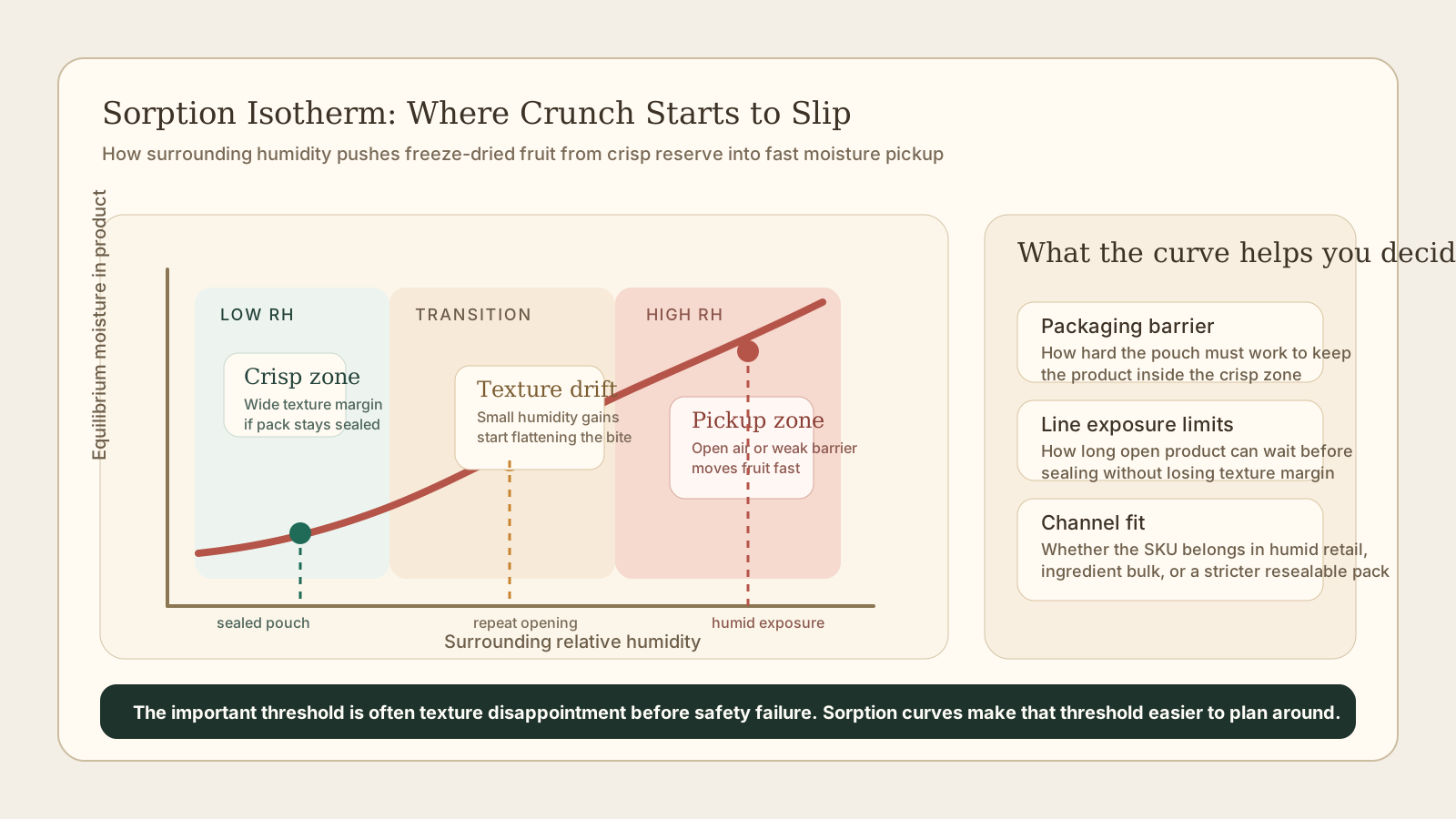
- A sorption isotherm relates product moisture to surrounding relative humidity at a fixed temperature, making humidity risk easier to visualize than a single moisture number.
- Two freeze-dried fruits can leave the dryer with similar residual moisture but gain water at very different speeds once they meet room air.
- The curve is useful because it connects technical drying targets to practical decisions about packaging barrier, exposure time, and storage conditions.
- Buyers and operators do not need a perfect lab model for every SKU, but they do need to understand that crispness depends on where the fruit sits on the moisture-humidity curve.
Most people first meet freeze-dried fruit texture as a yes-or-no question: crisp or not crisp. Operators know it is less binary than that, but the usual quality conversation still tends to stop at one moisture number or one water-activity reading.
That can be too flat. The more useful mental model is a curve.
The direct answer
A sorption isotherm explains crunch loss in freeze-dried fruit by showing how the product's moisture level changes as surrounding humidity changes, at a fixed temperature. That matters because freeze-dried fruit does not only fail when it becomes visibly wet. It usually fails earlier, when it crosses a narrower texture threshold and starts feeling flatter, softer, or slightly leathery.
The curve makes three things easier to understand:
- why the same pouch behaves differently in Arizona and Florida
- why one fruit softens faster than another at the same stated moisture target
- why packaging and room exposure matter just as much as the dryer endpoint
What the curve is actually showing
At equilibrium, food and the surrounding air move toward the same moisture balance. FDA and USDA both frame water activity in terms of equilibrium relative humidity. A sorption isotherm turns that relationship into a practical map: as ambient humidity rises, the product's equilibrium moisture level rises with it.
That does not mean the fruit jumps instantly to the final number. It means the fruit has a direction of travel. Once the pouch is opened, or once the product is held too long in an uncontrolled room, the curve predicts where the texture is heading.
For freeze-dried fruit, the important part is usually not the full scientific curve. It is the bend where moisture pickup accelerates enough that the eating experience changes quickly.
Why one moisture number is not enough
A single residual-moisture number is useful, but it does not tell the whole story. Two products can leave the dryer at similar moisture content and still behave differently because moisture content does not fully describe how tightly the water is held inside the matrix.
That is where the isotherm helps. It adds the missing relationship between:
- product structure
- surrounding humidity
- likely equilibrium point
The result is a better explanation for a common commercial complaint: "The bag tested dry, but it still softened too fast after opening."
Sometimes the issue is not that the product started too wet. It is that the product sits on a part of the curve where normal kitchen air moves it out of the crisp zone quickly.
Why fruit type changes the curve
Freeze-dried fruit is not one material. Strawberries, bananas, apples, mangoes, and berries with waxy skins do not all bind water the same way. Sugar level, cell structure, porosity, fiber, surface damage, and cut size all change how the finished fruit behaves.
That is why one fruit can remain pleasantly brittle across a reasonable storage window while another begins to feel sticky or soft much sooner. A thin, porous, sugar-rich piece has a different moisture-humidity response than a denser, lower-surface-area piece.
For buyers, the practical lesson is simple: do not assume one packaging spec or one open-bag expectation fits every fruit equally well.
Where the curve meets packaging
Sorption isotherms become commercially useful the moment packaging enters the conversation. If you know roughly how quickly a product moves upward on its moisture curve under humid conditions, you have a stronger basis for selecting barrier film, setting exposure limits, and defining consumer-use expectations.
That affects decisions such as:
- whether a clear structure is adequate or a stronger barrier is needed
- how much room-exposure time the line can tolerate before sealing
- whether a resealable pouch is realistic for the product's intended use
- how aggressively a product should be protected in humid distribution channels
This is why packaging failures often look like product failures. The fruit may have been dried correctly. But if the protection system lets the product migrate quickly along the wrong part of the isotherm, the consumer still experiences a soft bag.
The useful threshold is texture, not only safety
Water activity is often discussed first as a food-safety number. That is important, but freeze-dried fruit buyers and brands often run into a different threshold sooner: texture disappointment.
The product can remain microbiologically stable and still lose what made it commercially attractive. That is why a technically safe bag may still be a failed bag. The crunch promise is narrower than the basic safety boundary.
Sorption thinking helps because it reframes the question from "Is the fruit still dry?" to "How close is the fruit to the humidity range where the bite changes noticeably?"
That is a more honest question for snack positioning, premium pricing, and resealable-pack expectations.
What operators and buyers should do with this
Most teams do not need a perfect research-grade isotherm for every SKU before making better decisions. They do need to stop treating moisture as a static number.
Better practical questions include:
- What is the target water activity at release?
- Which fruits in the portfolio soften fastest after opening?
- How long is open product exposed before final seal?
- Which channels expose the pouch to the harshest humidity conditions?
- Does the packaging strategy match the most moisture-sensitive SKU, or only the average one?
Those questions convert abstract water science into a packaging and quality-control plan.
If a product's premium claim depends on audible crunch, the relevant limit is not only microbial safety. It is the point on the moisture-humidity curve where consumers begin to notice texture drift.
Bottom line
Sorption isotherms explain crunch loss in freeze-dried fruit because they show how moisture pickup tracks with surrounding humidity. That curve is what links the dryer endpoint to the open-bag experience.
For operators, it is a better way to think about exposure windows and packaging fit. For buyers, it is a reminder that crispness is not preserved by the final moisture number alone, but by the whole moisture-control system that comes after it.
Frequently Asked Questions
What is a sorption isotherm in simple terms?
It is a curve that shows how much water a food holds at different surrounding humidity levels, at a fixed temperature. For freeze-dried fruit, it helps explain when the product stays crisp and when it starts picking up enough moisture to soften.
Is a sorption isotherm the same thing as water activity?
No. Water activity is one point-in-time measurement. A sorption isotherm is the broader relationship between moisture and equilibrium humidity across a range of conditions.
Why does this matter for freeze-dried fruit more than many other snacks?
Because freeze-dried fruit is porous and hygroscopic. Small changes in humidity exposure can move the product from sharp crunch to leathery texture much faster than casual shoppers expect.
Can two fruits with the same moisture content behave differently?
Yes. Sugar level, fiber, surface area, and structure all change how strongly water is held and how quickly the fruit gains more from the air.
What should buyers ask suppliers about this?
Ask for target moisture and water activity, how long the fruit is exposed before sealing, and what packaging barrier strategy protects the product in the intended channel.
Primary sources & further reading
- Water Activity (aw) in Foods U.S. Food & Drug Administration Referenced for FDA's explanation that water activity is tied to equilibrium relative humidity and for its discussion of preparing food isotherms.
- Pathogen Modeling Program Online: Water Activity in Food USDA Agricultural Research Service Referenced for USDA's plain-language explanation that water activity is commonly measured as equilibrium relative humidity.
- Freeze-Drying of Plant-Based Foods Foods / PubMed Central Referenced for the review's description of freeze-drying stages and the role of remaining bound water after primary drying.
- The Freeze-Drying of Foods—The Characteristic of the Process Course and the Effect of Its Parameters on the Physical Properties of Food Materials Foods / PubMed Central Referenced for the discussion of desorption behavior and how residual water affects physical stability in freeze-dried foods.
External links open in a new tab. We do not receive compensation from any organization listed; sources are referenced because they are primary, current, and publicly verifiable.