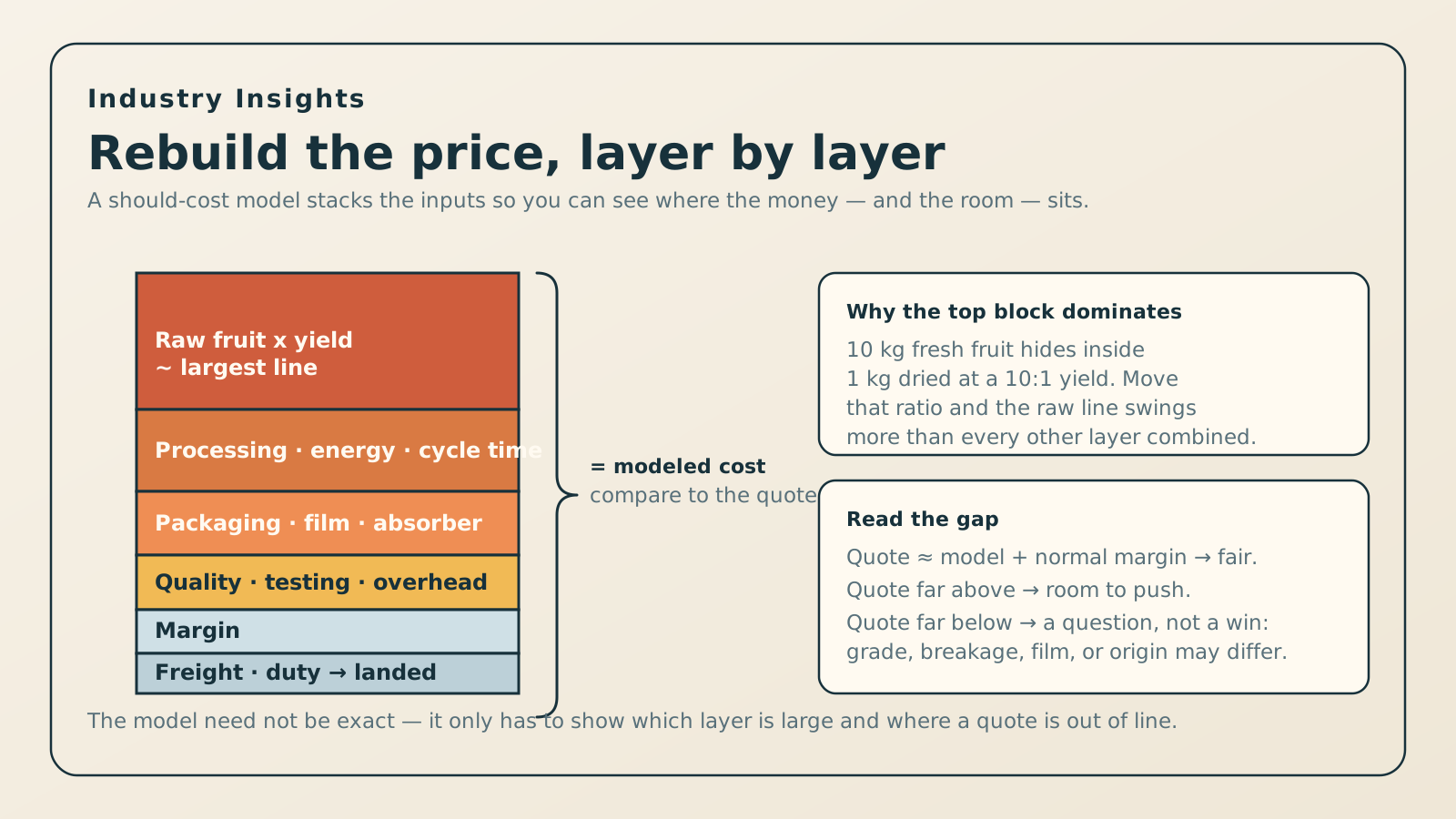
- A should-cost model rebuilds the price from inputs — raw fruit, yield loss, processing, packaging, overhead, and logistics — instead of reacting to the number on the quote.
- Fresh-to-dried yield is usually the single largest driver, because it sets how many kilos of raw fruit are buried in every kilo of finished product.
- The model does not need to be exact to be useful; even a rough build shows which line items are large and where a quote is out of line.
- Use the model to direct negotiation toward the costs that actually move, and to spot quotes that are implausibly low and may signal a spec or quality compromise.
When a freeze-dried fruit quote lands in your inbox, the natural reaction is to compare it to the last quote or to a competing supplier. That is useful, but it only tells you whether one price is higher than another. It does not tell you whether either price is reasonable.
A should-cost model answers the harder question. Instead of reacting to the number, you rebuild it from the inputs: how much raw fruit went in, how much was lost, what it cost to dry, pack, and ship. The point is not to second-guess every cent. It is to know which line items are large, where the real negotiating room is, and when a quote is too good to be true.
The direct answer
A should-cost model for freeze-dried fruit is a bottom-up estimate of production cost, built in layers. You start with the cost of the raw fruit, multiply it by the fresh-to-dried yield to get the raw-material cost per finished kilo, then add processing, packaging, quality and overhead, supplier margin, and finally logistics to landed cost.
You do not need perfect data. You need defensible ranges for each layer and a clear view of which layer dominates. For most freeze-dried fruit, that dominant layer is raw fruit times yield, and getting that one assumption roughly right matters more than polishing everything else.
Layer one: raw fruit and the yield multiplier
Start with the price of the fresh or frozen fruit going into the dryer, then apply the fresh-to-dried yield. This is where freeze-dried fruit economics really live, because the finished product is mostly removed water by weight.
If a fruit dries at roughly a ten-to-one ratio, then one kilo of finished product carries about ten kilos of raw fruit. At that ratio, even modestly priced fruit becomes a large cost line before any energy or labor is added. Lower-moisture fruits dry at a gentler ratio and carry less raw fruit per kilo; high-moisture fruits like melon or citrus are punishing.
Because raw fruit is multiplied by the yield ratio, an error here scales straight through the whole model. Moving an assumption from eight-to-one to twelve-to-one can change the raw-material line by half. Pin this number down before you worry about smaller items.
Layer two: processing cost
The next layer is what it costs to actually run the cycle: energy, labor, dryer time, and the share of the equipment's capital recovered through each batch. Freeze-drying is slow and energy-intensive, and dryer capacity is finite, so cycle time is itself a cost. A fruit that needs a longer cycle ties up a chamber that could be running another batch.
You will rarely get a supplier's true processing cost. What you can do is hold it as a band and watch how sensitive the total is to it. If processing is a modest slice of the total and raw fruit dominates, you know not to spend your negotiation there. If a fruit is cheap but slow to dry, processing can become the swing factor.
Layer three: packaging and protection
Packaging is more than a pouch. For a product whose quality depends on staying dry, the barrier film, any oxygen absorber or desiccant, the seal, and the case all carry cost — and cutting them too far shows up later as moisture pickup and breakage. Model packaging as its own line so you can see it, because a supplier trimming film cost is trimming protection, and that is a spec change, not a saving.
Layer four: quality, overhead, and margin
On top of direct costs sit the things that keep a supplier in business: quality testing and documentation, facility overhead, and a margin. A credible supplier carries real costs for water activity testing, metal detection, lot traceability, and food-safety certification. A quote that appears to leave no room for any of this is not a bargain; it is a question.
Margin varies with relationship, volume, and how commoditized the item is. You do not need to know it exactly. You need a plausible range so that when modeled cost plus a normal margin lands near the quote, you can stop pushing, and when the quote sits far above it, you know there is room.
Layer five: logistics to landed cost
Finally, add the cost of getting the product to your door: freight, duties, insurance, and any handling. For imported freeze-dried fruit this layer can be large and volatile, and it is also the layer most independent of the product itself. Modeling it separately keeps a freight swing from being mistaken for a change in the product's real cost.
A freeze-dried product is light but bulky, so freight is often driven by volume rather than weight. That interacts with packaging: an airier product fills more space per kilo and can cost more to ship than its weight suggests.
Using the model in a negotiation
A should-cost model earns its keep at the table, not on the spreadsheet. Three habits get the most out of it:
- Push where the money is. If raw fruit and yield are eighty percent of cost, a long argument over packaging cents is wasted effort. Direct the conversation to the large lines.
- Treat low quotes as questions, not wins. A price well below modeled cost usually means something is different — grade, breakage tolerance, film thickness, origin, or a yield you have not accounted for. Ask which.
- Update the model with what you learn. Each supplier conversation sharpens your yield and processing assumptions. Over time the model becomes a genuinely good predictor, and your quotes get easier to read.
Bottom line
A should-cost model rebuilds a freeze-dried fruit price from raw fruit, yield, processing, packaging, overhead, margin, and freight, so a buyer reasons from cost rather than anchoring on a quote. It does not have to be precise to be valuable: even a rough build reveals that fresh-to-dried yield usually dominates, shows where negotiation can actually move the number, and flags quotes that are implausibly low and may hide a quiet compromise on grade, protection, or spec.
Frequently Asked Questions
What is a should-cost model?
It is an estimate of what a product should cost to produce, built up from its underlying inputs — raw materials, yield, processing, packaging, overhead, margin, and logistics — rather than taken from a supplier's quoted price. It gives a buyer an independent reference point.
Why does it matter for freeze-dried fruit specifically?
Freeze-dried fruit hides a lot of raw fruit and energy inside a light finished weight. A small change in yield assumption or drying cost can swing the modeled price substantially, so a structured build prevents a buyer from anchoring on the wrong number.
Do I need exact cost data to build one?
No. A model built from reasonable public ranges and a few supplier inputs is enough to flag which line items dominate and whether a quote is plausible. Precision is nice but the directional answer is what drives better negotiation.
What is the biggest single driver?
Usually the fresh-to-dried yield ratio, because it multiplies the cost of raw fruit. If it takes roughly ten kilos of fresh fruit to make one kilo dried, the raw fruit line alone is large before any processing is added.
Can a should-cost model tell me a quote is too low?
Yes, and that is one of its most useful functions. A quote well below modeled cost is a flag to ask what is different — a lower-grade fruit, a thinner film, more breakage tolerance, or a yield the supplier is achieving that you have not accounted for.
Primary sources & further reading
- Producer Price Indexes U.S. Bureau of Labor Statistics Referenced as a public source for input-cost trends (energy, packaging materials, transportation) that feed a should-cost build.
- Fruit and Tree Nuts Data USDA Economic Research Service Referenced as a public source for fresh fruit price context that anchors the raw-material line of the model.
- Water Activity (aw) in Foods U.S. Food & Drug Administration Referenced for the stability target that the finished spec must hold, which constrains how far drying and packaging cost can be cut.
External links open in a new tab. We do not receive compensation from any organization listed; sources are referenced because they are primary, current, and publicly verifiable.