- Mango cultivars vary widely in sugar, fiber, aroma, and skin behavior — all of which show up in freeze-dried form.
- Low-fiber, high-Brix varieties (Ataulfo, Alphonso, Kesar, Nam Dok Mai) tend to freeze-dry into the most premium snacks.
- Higher-fiber workhorses (Tommy Atkins) are common because they ship well, not because they taste best.
- Mango is heavily seasonal and origin-locked — supply realities often dictate which variety actually ends up in the bag.
- When sourcing, ask the variety, the country, and the harvest window — not just "mango."
Tommy Atkins, Kent, Ataulfo, Alphonso, Kesar, Carabao — written on a label, they all read as "mango." Inside the bag, they do not behave the same. Different cultivars carry different sugar levels, different fiber loads, different aroma profiles, and different skin and stone ratios. Every one of those traits shows up in freeze-dried form.
This is a working field guide for the most commonly sourced commercial mangoes. It's written for snack founders, ingredient buyers, and curious consumers who want to know what's actually in the bag and why one freeze-dried mango can taste like cardboard while another tastes like dessert.
Use this guide less like a fruit encyclopedia and more like a sourcing tool. If you are comparing freeze-dried mango samples, the useful question is not only whether the product tastes good. It is whether the cultivar, harvest window, format, price, and label claim all make sense together.
Quick comparison: mango cultivars for freeze-drying
| Cultivar | Freeze-dried personality | Fiber | Sweetness / aroma | Best use |
|---|---|---|---|---|
| Tommy Atkins | Functional, mild, sometimes stringy | Higher | Moderate sweetness, restrained aroma | Budget blends, powders, lower-cost chunks |
| Kent | Smooth, sweet, processor-friendly | Low to medium | Sweet, clean, reliable | Mid-tier snacks, cubes, chunks |
| Keitt | Clean, consistent, late-season | Low | Sweet, mild, steady color | Cubes, slices, alternate-season supply |
| Ataulfo | Dense, honeyed, dessert-like | Very low | High sweetness, rich aroma | Premium snacking, large slices |
| Alphonso | Saffron-orange, intense, aromatic | Very low | Very high aroma and sweetness | Premium South Asian-style products |
| Kesar | Balanced, aromatic, slightly brighter | Very low | Sweet with more acidity than Alphonso | Premium snacks, Alphonso blends |
| Sindhri | Mild, sweet, clean | Low | Sweet, softer aroma | South Asian-market snacks, ingredient streams |
| Nam Dok Mai | Floral, soft yellow, elegant | Low | High sweetness, floral aroma | Thai-origin slices and chunks |
| Carabao | Very sweet, tropical, aromatic | Low | High sweetness, clean tropical aroma | Premium Asian-market mango snacks |
The table is deliberately practical, not botanical. A buyer choosing mango for freeze-drying is usually trying to predict texture, color, aroma, breakage, cost, and whether the product will still taste like mango after water is removed.
Why variety matters in freeze-drying
Freeze-drying preserves what's already there. It does not add sugar, hide fiber, or invent aroma. Three traits decide how a given mango cultivar performs:
- Sugar (Brix) — drives perceived sweetness and concentration. Higher Brix at harvest generally produces more intensely flavored freeze-dried fruit.
- Fiber — visible as stringy texture in fresh fruit and as toughness or chewiness in freeze-dried form. Low-fiber cultivars produce a cleaner, more melt-in-mouth freeze-dried result.
- Aroma compounds — volatile esters and lactones differ sharply by cultivar. Some mangoes smell floral, some smell resinous, some smell like ripe peach or honey. Freeze-drying preserves a meaningful share of these.
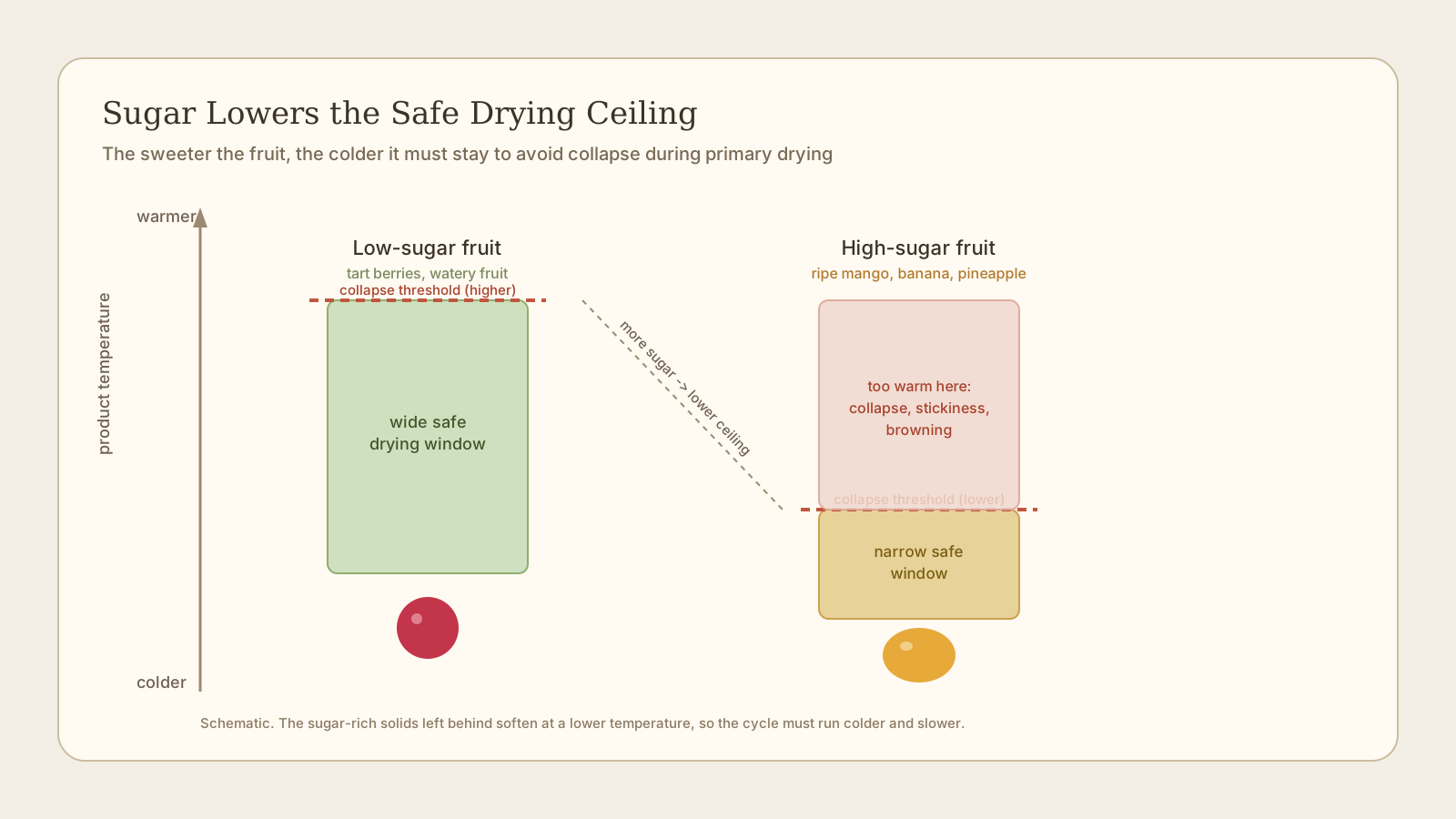
Brix is a rough measure of soluble solids — mostly sugar. Mango at harvest typically falls between 10 and 22° Brix. The same cultivar picked under-ripe and ripened in transit will register lower than one picked tree-ripe.
A processor can choose a cheaper, fibrous, lower-Brix mango and a heroic freeze-drying cycle won't fix it. The variety sets the ceiling. In finished-bag terms, low-fiber cultivars are exactly why good freeze-dried mango chunks stay crisp instead of chewy.
The American supermarket workhorses
These four cultivars dominate North American grocery shelves. They are the mangoes most freeze-dried fruit shoppers have eaten, knowingly or not.
Tommy Atkins
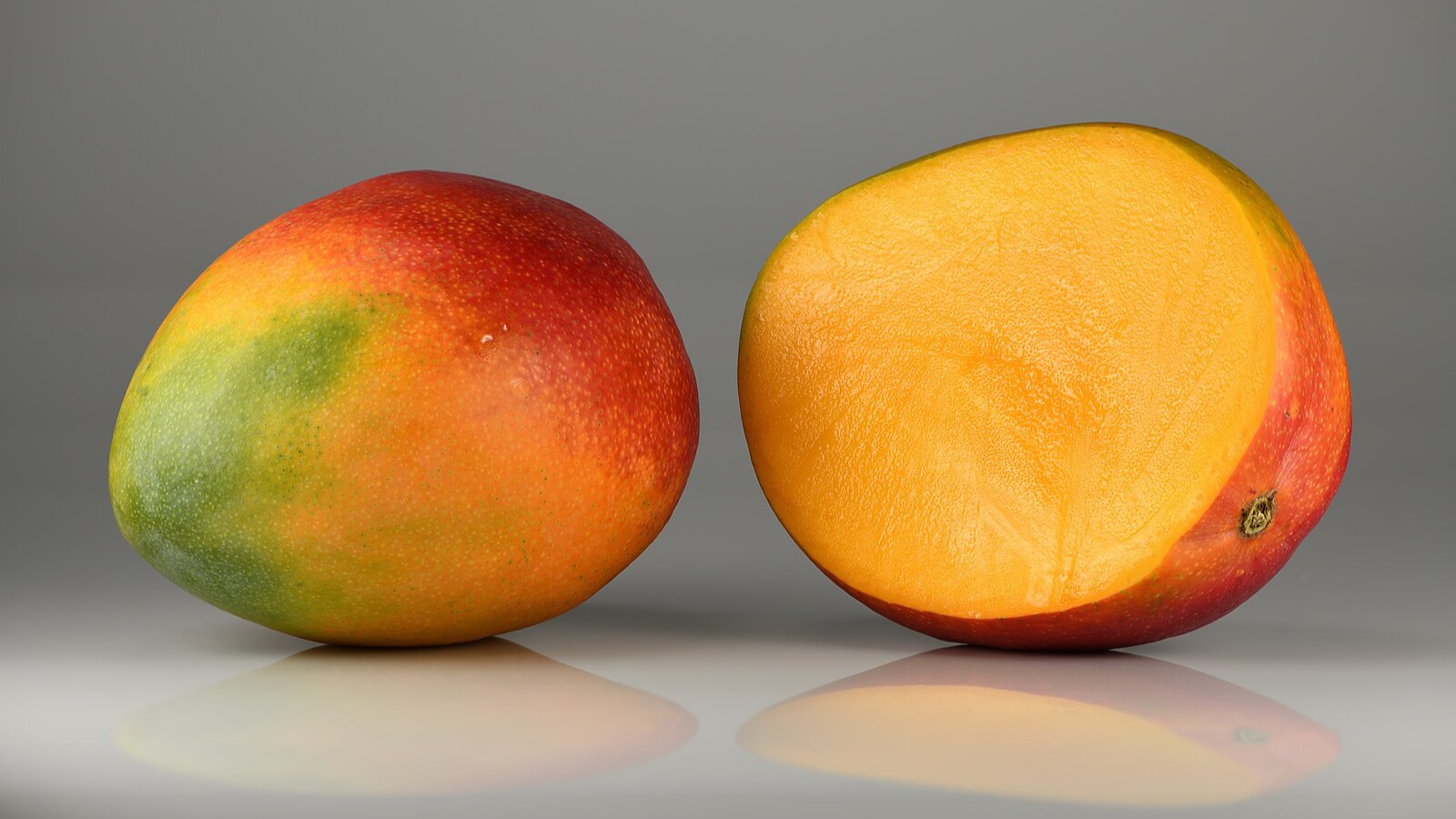
The most common mango in the United States — but not because it's the best-tasting. Tommy Atkins was bred for disease resistance and shelf life. Skin is thick, color is reliably red-and-green, and the fruit ships and stores extraordinarily well. Inside, it has a noticeable amount of fiber and a moderate Brix that depends heavily on ripeness at harvest.
In freeze-dried form, Tommy Atkins is functional but not memorable: pale color, mild sweetness, and a fibrous mouthfeel that becomes more pronounced in larger pieces. It works as a budget input or as part of a blend, but it rarely carries a premium standalone snack.
Kent
A favorite of processors. Kent has lower fiber than Tommy Atkins, sweeter flesh, and a juicier texture when ripe. Skin stays mostly green even when fully ripe, which can confuse retail shoppers but makes no difference in processing.
Kent freeze-dries into a noticeably better product than Tommy Atkins — sweeter, smoother, less stringy. It's a common compromise between cost and quality for mid-tier freeze-dried mango snacks.
Keitt
Late-season and unusually large — a Keitt mango can weigh well over a pound. Like Kent, it stays green when ripe. Fiber is low, flesh is sweet, and the stone is relatively flat, which improves yield.
Freeze-dried Keitt is excellent: clean flavor, low breakage when cubed, and consistent color. The trade-off is timing — Keitt season runs late summer through fall in most markets, so year-round operations have to blend it with other cultivars.
Ataulfo (Honey, Champagne, Manila-type)
The flat, kidney-shaped, butter-yellow mango that has gradually taken over the snacking aisle. Ataulfo has very low fiber, very high Brix, and a rich, almost honey-like aroma. Stones are small, flesh-to-seed ratio is high, and the texture is creamy.
Ataulfo is the cultivar most freeze-dried mango shoppers describe as "tasting like real mango." It's also the most expensive to source.
In freeze-dried form, Ataulfo produces the closest thing to a dessert: deep yellow color, intense sweetness, melting texture, and a recognizable mango aroma. It is the benchmark snacking variety. The cost — both per pound and seasonally — is the main reason it isn't used everywhere.
Premium and origin-specific cultivars
Beyond the supermarket four, a small group of regional cultivars dominate premium and ethnic-market freeze-dried mango. These are usually more expensive, more seasonal, and more flavor-forward.
Alphonso (Hapus)
Often called the "King of Mangoes." Grown almost exclusively in Maharashtra, India. Saffron-orange flesh, very high Brix, a heady aroma layered with notes of peach, citrus, and resin. Fiber is essentially nil. Season is brutally short — typically April through June.
Alphonso is a gold standard for freeze-dried mango in South Asian markets and increasingly in premium Western snack lines. The product is unmistakable: bright orange, intensely aromatic, melt-in-mouth. Pricing is the catch. True Alphonso is typically much more expensive than commodity mango inputs, and lower-cost products may blend it with cheaper Indian cultivars while still leaning on the Alphonso halo.
Kesar
Gujarat's answer to Alphonso. Slightly less aromatic but more acid-balanced, with a saffron-yellow flesh and equally low fiber. Season runs roughly April through July.
Kesar freeze-dries beautifully and is often used as an Alphonso substitute or blended with it to balance cost. Many Indian-origin freeze-dried mango products labeled simply "Indian mango" are Kesar, Alphonso, or a blend of the two.
Sindhri
Pakistan's flagship mango, grown primarily in Sindh province. Large, oval, golden-yellow flesh, very sweet, low fiber, and a softer aroma than Alphonso. Season is May through August.
Sindhri produces a mild, sweet, clean freeze-dried product. It tends to cost less than Alphonso or Kesar and is widely used in South Asian-market freeze-dried snacks and ingredient streams.
Chaunsa
Another Pakistani favorite, often considered Sindhri's sweeter cousin. Higher Brix, more intense aroma, and a slightly later season (July through September). Less common in freeze-dried form than Sindhri but valued where it is used.
Southeast Asian cultivars
Nam Dok Mai
Thailand's most exported mango. Elongated, thin-skinned, golden-yellow when ripe, with low fiber and a distinctive floral aroma. Brix is high. Season runs roughly March through May, with off-season hothouse production extending availability.
Nam Dok Mai freeze-dries into a soft yellow product with strong floral notes. It performs especially well in slices and chunks, and is one of the dominant cultivars in Thai-origin freeze-dried mango.
Carabao (Manila, Philippine)
Internationally recognized for its sweetness, Carabao has a reputation as one of the world's sweetest commercial mangoes. Yellow-green skin, deep yellow flesh, very high Brix, low fiber, and a clean tropical aroma.
Freeze-dried Carabao is intensely sweet and aromatic. The Philippines exports both fresh and freeze-dried Carabao globally, and it's a common premium origin for Asian-market freeze-dried mango.
R2E2
Australian, large, and increasingly common in Asian export markets. Higher fiber than Ataulfo or Carabao but reliable color and shipping behavior. Useful as an alternate-season supply when Northern Hemisphere mangoes are out.
Latin American cultivars beyond Tommy Atkins
Haden
The genetic ancestor of many modern Florida-bred mangoes. Bright red skin, classic mango flavor, moderate fiber. Less common as a single-cultivar freeze-dried product but historically significant.
Palmer
Brazilian. Lower fiber than Tommy Atkins, longer season, used heavily by Brazilian and Mexican processors. Mild flavor, reliable supply.
Francis (Haitian)
Yellow, S-shaped, intensely aromatic, fairly fibrous. Hard to source consistently. When you can find it, it freeze-dries into a distinctly tropical product — but supply is rarely stable enough for industrial use.
Variety vs format
Different cultivars suit different freeze-dried formats. A few rules of thumb:
- Whole pieces and large slices — favor low-fiber, high-Brix varieties (Ataulfo, Kent, Keitt, Alphonso, Kesar, Sindhri, Carabao). Fiber becomes obvious in larger pieces.
- Cubes and chunks — Kent, Keitt, Sindhri, Nam Dok Mai are workhorses. Tommy Atkins works at lower price points.
- Crumbles and powders — fiber matters less because particle size masks it. Tommy Atkins and Palmer often appear here.
- Premium snacking bags marketed on flavor — Ataulfo, Alphonso, Kesar, Carabao. These cultivars drive most of the "tastes like real mango" reviews.
What quality looks like in the finished bag
Variety is not the only driver of quality, but it sets the ceiling. A strong freeze-dried mango sample usually has a few visible traits:
- Color that matches the cultivar rather than a dull beige cast.
- Aroma that appears before the first bite instead of only after chewing.
- Clean breakage without excessive powder at the bottom of the pouch.
- Low stringiness in slices and chunks.
- A finish that tastes like mango, not only sugar.
For processors, this is where the fruit report becomes practical. The cultivar tells you what the sample is capable of. The finished bag tells you whether sourcing, ripeness, cutting, drying, handling, and packaging protected that potential.
Sourcing reality
Cultivar availability is shaped less by buyer preference than by season, origin, and currency.
| Cultivar | Primary origin | Approx. season |
|---|---|---|
| Tommy Atkins | Mexico, Brazil | Year-round |
| Kent | Mexico, Peru, Ecuador | March – November |
| Keitt | Mexico, Peru | August – November |
| Ataulfo | Mexico | March – August |
| Haden | Mexico, Florida | March – June |
| Alphonso | India (Maharashtra) | April – June |
| Kesar | India (Gujarat) | April – July |
| Sindhri | Pakistan (Sindh) | May – August |
| Chaunsa | Pakistan | July – September |
| Nam Dok Mai | Thailand | March – May |
| Carabao | Philippines | March – June (varies) |
| Palmer | Brazil | September – February |
| R2E2 | Australia, Asia | November – February |
A "year-round" freeze-dried mango product almost always blends multiple cultivars and origins to bridge gaps. There is no single-cultivar Alphonso supply that runs January through December — anyone claiming otherwise is either holding a very large freezer or stretching the definition.
When evaluating a mango supplier, ask: Which cultivar (not just "mango")? Which country and growing region? Which harvest window? Is the product single-cultivar or a blend? If a blend, what's the ratio? What's the typical Brix at intake? What's the fiber spec? Is the variety changing across the year?
The buyer's short list
For a premium standalone freeze-dried mango, start with Ataulfo, Alphonso, Kesar, Nam Dok Mai, Carabao, Kent, or Keitt. For a value product, Tommy Atkins, Palmer, or blended mango may be acceptable, but the format matters: smaller pieces, crumbles, powders, or mixed fruit blends can hide some of the texture limits.
For an ingredient buyer, the smartest sample request is not one bag. Ask for the same format across at least two cultivars or origins. Compare color, aroma, fiber, powder at the bottom of the bag, and texture after the package sits open for a short period. The differences will usually be obvious.
How to read a freeze-dried mango label
Most retail bags say "mango" and stop there. A few list "Ataulfo," "Alphonso," or "Kesar" — usually the ones charging a premium for it. Some list "Indian mango" or "Thai mango" without naming the cultivar; that usually means a blend or a regional commodity grade.
A few practical signals:
- Color tells you a lot. Pale yellow or beige usually means Tommy Atkins, Palmer, or a blend. Deep saffron-orange usually means Alphonso, Kesar, or Carabao.
- Aroma tells you more. Open the bag — if the smell is faint or generic, the cultivar is probably a workhorse. If it's intense and floral or honey-like, you're holding something premium.
- Fiber tells you the most. Sticky strings between teeth almost always mean Tommy Atkins or its relatives. Clean, melting texture almost always means a low-fiber cultivar.
How mango compares
A quick reference for how mango sits alongside the freeze-drying personalities of its closest siblings.
| Fruit | Brix | Fiber | Aroma | Color stability | Breakage risk | Typical format |
|---|---|---|---|---|---|---|
| Mangothis report | 10–22° | Low → High (cultivar) | Very strong | Strong | Medium | Slices · cubes · powder |
| Pineapple | 11–15° | High | Strong | Moderate | Medium | Chunks · tidbits · powder |
| Banana | 15–22° | Medium | Strong (ripe) | Poor | Low | Slices · powder |
| Papaya | 8–12° | Low | Mild | Moderate | Medium | Cubes · slices · powder |
| Passion fruit | 13–18° | Low (seeds present) | Very strong | Moderate | n/a (pulp) | Powder · flakes |
| Guava | 8–13° | High | Very strong | Moderate | Medium | Slices · cubes · powder |
Values are typical industry ranges. Variety, origin, harvest window, and process all shift them.
Conclusion
"Mango" on a freeze-dried label is a category, not a specification. The cultivar inside the bag — and the country it came from, and the time of year it was harvested — decides the color, the aroma, the texture, the sweetness, and the price.
For buyers, the right question is not "is this freeze-dried mango good?" It's "which mango is this, and is the cultivar matched to the price and the use case?" For consumers, the same logic applies in shorter form: read the bag, check the color, smell the contents. The cultivar will tell you the rest.
Frequently Asked Questions
Which mango variety freeze-dries best?
For premium snacking, low-fiber high-Brix cultivars dominate: Ataulfo, Alphonso, Kesar, Carabao, and Nam Dok Mai. For reliable cubes and broader ingredient use, Kent and Keitt are workhorses. For powders and lower-cost blends, Tommy Atkins, Totapuri, and Palmer appear most often. Variety sets the ceiling — drying cannot rescue a fibrous, low-Brix input.
Why is Tommy Atkins so common in freeze-dried mango if it's not the best-tasting?
Tommy Atkins was bred for disease resistance and shelf life, not flavor. The skin is thick, color is reliably red-and-green, and the fruit ships and stores extraordinarily well — exactly what export and processing supply chains reward. In freeze-dried form it is functional but mild, with noticeable fiber. It works as a budget input or in blends, rarely as a premium standalone.
What's the difference between Ataulfo and Tommy Atkins freeze-dried?
Ataulfo (sometimes sold as honey or Champagne mango) has very low fiber, very high Brix, and a rich honey-like aroma. Freeze-dried Ataulfo is deep yellow, intensely sweet, with melting texture — the closest thing to a dessert in the category. Tommy Atkins has higher fiber, moderate Brix, and a pale color with restrained aroma. They are the two ends of the freeze-dried mango spectrum.
Why is freeze-dried Alphonso mango so expensive?
Alphonso is grown almost exclusively in Maharashtra, India, and has a brutally short season — typically April through June. Its saffron-orange flesh, very high Brix, and heady aroma (peach, citrus, resin notes) make it a gold-standard premium mango. Genuine single-origin Alphonso is several times the price of commodity mango, and some lower-cost "Alphonso" products lean on the halo while blending in cheaper cultivars.
What does Brix mean for freeze-dried mango?
Brix is a rough measure of soluble solids — mostly sugar. Mango at harvest typically falls between 10 and 22° Brix. Higher Brix at harvest generally produces more intensely flavored freeze-dried fruit. The same cultivar picked under-ripe and ripened in transit will register lower Brix and taste less concentrated after drying.
Why does the same freeze-dried mango product taste different across the year?
Mango is seasonal and origin-locked. Year-round supply almost always means blending cultivars and origins to bridge gaps — Alphonso in spring, Keitt in late summer, Tommy Atkins or Palmer for off-season fill. A product that tastes vivid in May may taste flatter in November if the cultivar mix has shifted. Premium suppliers disclose the blend; commodity suppliers usually do not.
How can I tell what mango variety is in a freeze-dried product?
Color and aroma give it away. Pale yellow or beige usually means Tommy Atkins, Palmer, or a blend. Deep saffron-orange usually means Alphonso, Kesar, or Carabao. Fiber tells you the most — sticky strings between teeth almost always mean Tommy Atkins or its relatives; clean melting texture almost always means a low-fiber cultivar.
What should buyers ask freeze-dried mango suppliers?
Ask which cultivar (not just "mango"), country and growing region, harvest window, single-cultivar or blend (and the ratio), typical Brix at intake, fiber spec, cut format, and whether the variety mix changes across the year. "Mango" on a label is a category, not a specification.