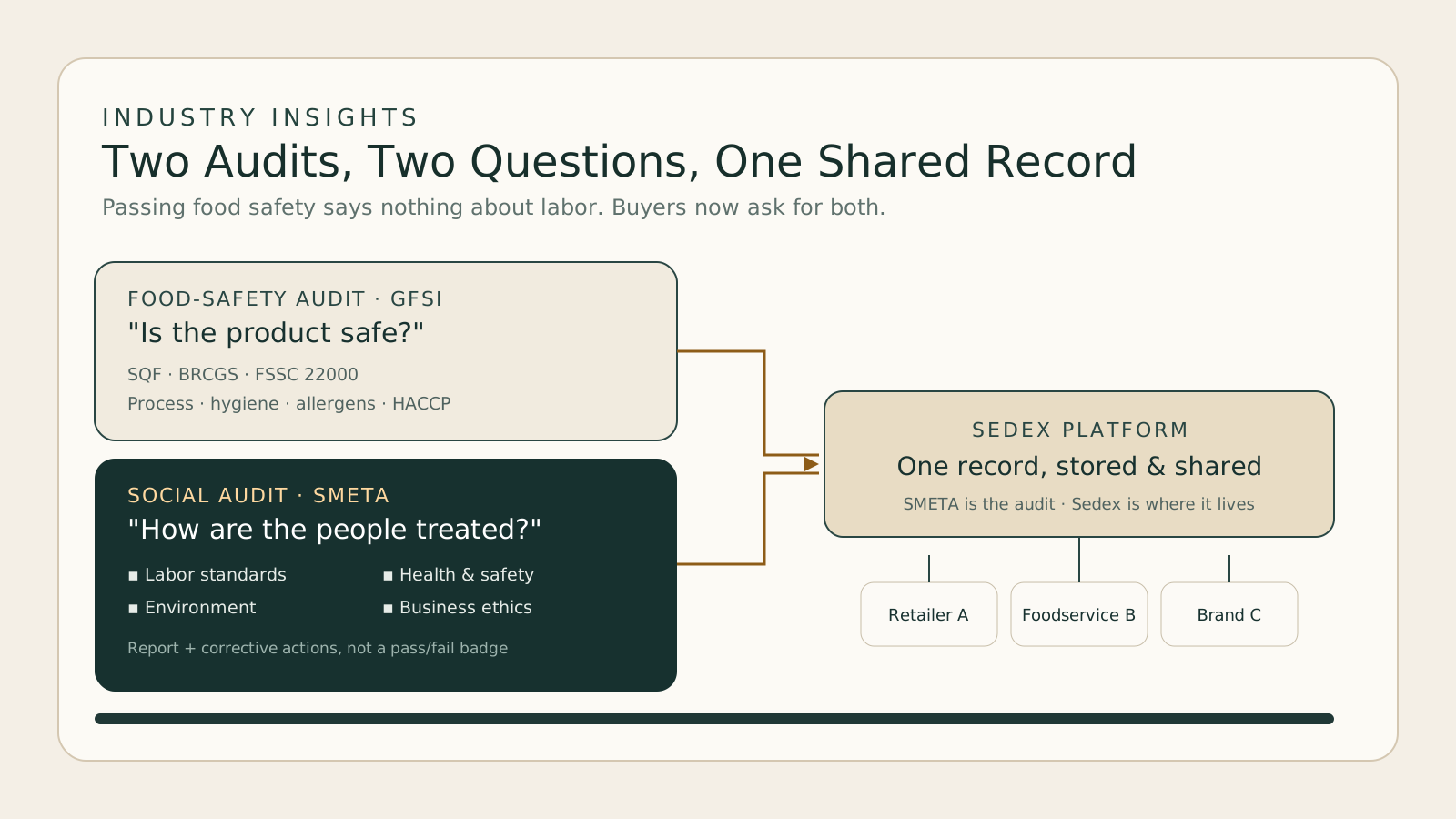
- Social audits like SMETA check labor conditions, worker health and safety, environment, and business ethics — a separate question from whether a freeze-dried fruit supplier makes safe product, which is what GFSI schemes like SQF or BRCGS cover.
- Sedex is the shared platform where results are stored and shared with multiple customers, so one credible audit can satisfy several buyers rather than each running their own, which is why suppliers increasingly maintain a current SMETA rather than treat it as a one-off.
- For buyers, a social audit is about supply-chain risk and customer requirements, not product quality; ask for the pillars covered, the audit date, and the status of any corrective actions rather than just whether a certificate exists.
Most conversations about qualifying a freeze-dried fruit supplier start and end with food safety: which GFSI scheme they hold, what their microbiological limits look like, how they handle allergens. That is the right first question, but for a growing share of buyers it is no longer the last one. Retailers and foodservice groups increasingly want a second kind of assurance — that the product was made under decent labor conditions, in a safe workplace, by a business that operates ethically. That is what a social audit covers, and Sedex and SMETA are the names that come up most often.
Two different questions
It helps to separate two things that are easy to blur. A food-safety audit answers whether the process reliably produces safe, legal product. A social audit answers whether the people and practices behind that product meet accepted standards. They overlap in one narrow place — worker health and safety touches both — but otherwise they look at different parts of the same factory.
A freeze-dried fruit processor can hold an immaculate BRCGS certificate and still have never been assessed on wages, working hours, or hiring practices. Nothing about the food-safety audit examines those. So when a customer asks for a social audit, they are not doubting the product; they are asking a question the food-safety audit was never designed to answer.
What SMETA actually looks at
SMETA — the Sedex Members Ethical Trade Audit — is the most common methodology in food supply chains. It is built around pillars. Two are always included: labor standards and health and safety. Two more are commonly added: environment and business ethics. The exact scope is agreed before the audit, which is why "we have a SMETA" is an incomplete statement until you know whether it was the two-pillar or four-pillar version.
The labor pillar draws on an established framework, the Ethical Trading Initiative Base Code, which covers issues like freely chosen employment, freedom of association, safe working conditions, no child labor, living wages, reasonable working hours, no discrimination, and regular employment. In a fruit-processing plant, the practical checks are things an auditor can see and verify: pay records against legal minimums, working-hour logs, age documentation, functioning machine guarding, accessible fire exits, and grievance mechanisms for workers.
SMETA does not issue a certificate in the way a food-safety scheme does. It produces a report and a corrective-action plan. "Passing" really means the findings were minor or have been closed out — which is why the corrective-action status matters as much as the audit date.
Where Sedex fits
SMETA is the audit; Sedex is the platform. Sedex is a membership organization whose online system stores audit reports and lets a supplier share results with the customers they choose. That sharing model is the practical reason the pair has spread through food supply chains.
Before shared platforms, a supplier selling to five retailers could face five separate social audits, each on the customer's own template, each consuming days of management time. Sedex lets one credible SMETA satisfy multiple customers who accept the methodology. For the supplier, it turns a repeated cost into a single maintained record. For the buyer, it means the information is standardized and comparable rather than arriving in five different formats.
Why this reaches freeze-dried fruit specifically
Freeze-dried fruit sits on a supply chain that often starts with agricultural labor in one country, moves through processing in another, and ends on a shelf in a third. That geography is exactly the kind of multi-tier, cross-border structure where labor and ethics risk is hardest to see from the buyer's desk — and therefore where large customers most want documented assurance.
There is also a commercial pull. As retailers and foodservice operators publish responsible-sourcing commitments, they push the requirement down to their suppliers, who push it to their processors. A freeze-dried fruit supplier that wants to sell into those channels increasingly finds a valid social audit listed alongside the food-safety certificate on the onboarding checklist. It has moved from a nice-to-have to a gate.
How buyers should read a social audit
For a buyer, the temptation is to treat a social audit like a certificate: present or absent, pass or fail. It rewards a closer look. A few questions separate a meaningful audit from a checkbox.
Which pillars were covered — two or four? A two-pillar audit says nothing about environment or business ethics. When was it conducted, and is it current? Social conditions change, and audits are point-in-time. What were the findings, and what is the corrective-action status? An audit with open non-conformances that are being closed out on schedule can be more reassuring than a suspiciously clean one, because it shows the process is real. And who conducted it — an audit body the customer recognizes carries more weight than an unfamiliar one.
It is also worth being honest about the limits. A social audit is a sample taken on a given day. It can miss issues, and unannounced or semi-announced audits catch more than fully announced ones. Serious buyers treat SMETA as one input into a broader supplier-risk picture, alongside their own due diligence, rather than as proof that everything is fine.
The practical takeaway
Social compliance has become a second, parallel track in freeze-dried fruit sourcing, sitting next to food safety rather than inside it. For suppliers, maintaining a current SMETA on Sedex is increasingly the cost of reaching serious retail and foodservice customers, and the shared platform makes that cost pay for itself across accounts. For buyers, the useful move is to ask the specific questions — pillars, date, corrective actions — rather than to accept the existence of an audit as the answer. The certificate on the wall tells you the process is safe; the social audit tells you something the certificate never claimed to.
Frequently Asked Questions
Is a social audit the same as a food-safety audit?
No, and conflating them is a common mistake. A GFSI-benchmarked food-safety audit (SQF, BRCGS, FSSC 22000) asks whether the process makes safe, legal product. A social audit like SMETA asks whether the people making it are treated and protected properly and whether the business operates ethically. A supplier can hold one and not the other.
What is the difference between Sedex and SMETA?
SMETA (Sedex Members Ethical Trade Audit) is the audit methodology — the actual on-site assessment. Sedex is the membership platform where the audit report and corrective actions are stored and shared with approved customers. In short, SMETA is the audit; Sedex is where it lives and who can see it.
Does a SMETA audit guarantee there are no labor issues?
No audit guarantees that. An audit is a point-in-time snapshot by sampling, and it can miss things or reflect only the day it was conducted. It raises the floor and creates a record and corrective-action trail, but buyers treat it as one input into supplier risk, often alongside their own due diligence, not as a clean bill.
Why would a small freeze-dried fruit supplier bother?
Because their customers ask. Larger retail and foodservice buyers frequently make an acceptable social audit a condition of onboarding. For a supplier hoping to sell into those channels, maintaining a current SMETA on Sedex is often the price of entry, and sharing it through the platform saves repeating the exercise for each new customer.
Primary sources & further reading
- About SMETA Sedex Referenced for the structure of the SMETA methodology and the pillars it can cover.
- ETI Base Code Ethical Trading Initiative Referenced for the labor-standards framework that underpins ethical-trade auditing.
External links open in a new tab. We do not receive compensation from any organization listed; sources are referenced because they are primary, current, and publicly verifiable.