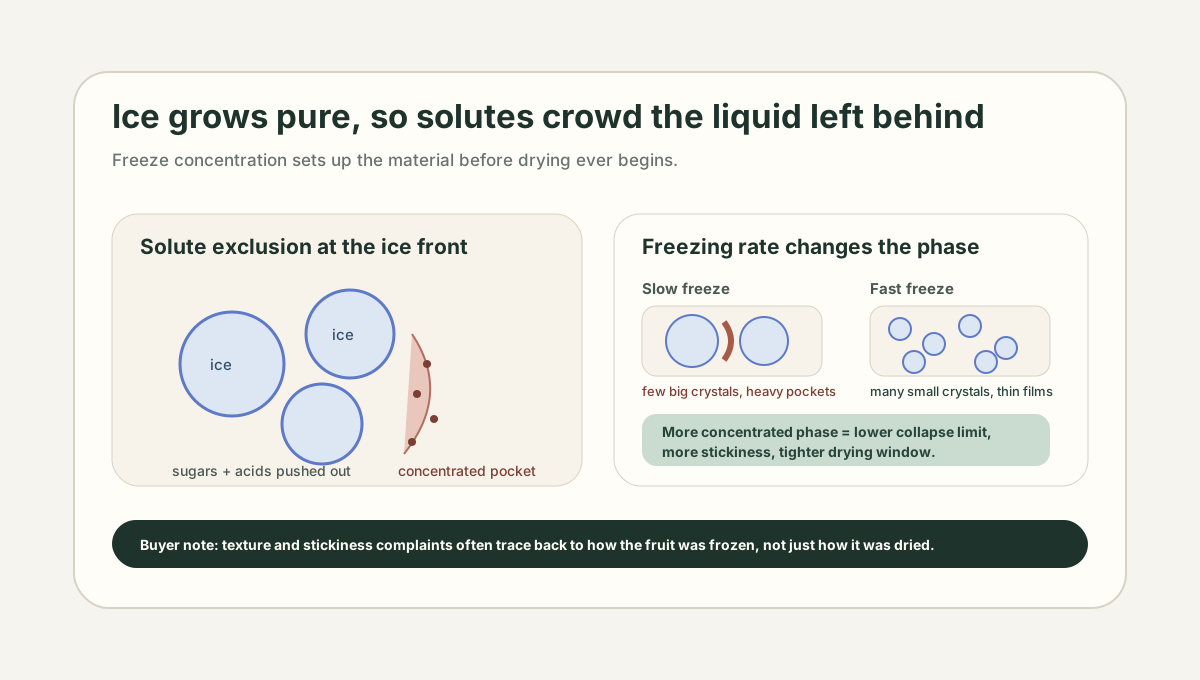
- As ice forms, it excludes dissolved sugars and acids, concentrating them into a shrinking volume of unfrozen liquid around the crystals.
- Slow freezing gives that concentrated phase more time to build up, which can raise local stickiness and lower the temperature at which the structure collapses.
- Freeze concentration helps explain why high-sugar fruits are harder to dry cleanly and why freezing conditions upstream change the finished bite.
- Buyers evaluating texture problems should ask about freezing method and rate, not only the vacuum drying cycle.
Most conversations about freeze-dried fruit focus on the vacuum, the shelves, and the drying endpoint. But a lot of what determines the finished bite is decided earlier, in the few minutes or hours while the fruit is freezing. That is when freeze concentration happens, and it quietly reshapes the material before any moisture is removed.
Understanding it helps explain a common frustration: why the same fruit, run on the same dryer, can come out crisp one week and slightly sticky or collapsed the next.
The direct answer
When fruit freezes, water crystallizes into nearly pure ice. The dissolved sugars, acids, and other solutes cannot fit into that ice, so they are pushed out into the liquid that has not frozen yet. As more ice forms, that unfrozen liquid shrinks in volume but keeps roughly the same amount of dissolved material, so it becomes steadily more concentrated. That is freeze concentration.
The slower the freezing, the more time this concentrated phase has to develop and redistribute. By the time the fruit is fully frozen, it is no longer a uniform block. It is a network of ice crystals surrounded by thin films of a very concentrated, syrup-like phase.
That concentrated phase is what the dryer then has to deal with.
Why exclusion happens
Ice is a well-ordered crystal. As it grows, its structure has little room for foreign molecules like glucose, fructose, or citric acid. So growing ice tends to reject them at the advancing crystal boundary.
Those rejected solutes accumulate just ahead of the ice front. In fruit, which is full of sugars and acids, this exclusion is significant. A berry that starts as fairly dilute cell fluid can end up with pockets of extremely concentrated solution wedged between ice crystals.
Think of freezing a tray of dilute fruit juice. The first ice to form is close to pure water. What is left in the middle gets sweeter and more sour as freezing continues. The same thing happens at microscopic scale inside every piece of fruit.
Why freezing rate changes the outcome
Freezing rate controls two things at once: how big the ice crystals grow, and how the concentrated phase is arranged.
Slow freezing tends to produce fewer, larger ice crystals. It also gives the excluded solutes more time to migrate and pool. The result is a coarser structure with larger unfrozen pockets that are heavily concentrated.
Fast freezing produces many small crystals and traps solutes more locally, so the concentrated phase is spread into thinner, more distributed films. The material is more uniform, though the crystal size and drying behavior come with their own trade-offs.
Neither extreme is automatically "correct." The point is that the freezing step is a lever, not a fixed background condition. Change the freezing rate and the concentrated phase the dryer inherits changes with it.
The link to collapse and stickiness
This is where freeze concentration connects to problems buyers actually see.
That concentrated, sugar-rich unfrozen phase has a low temperature at which it loses rigidity. In freeze-drying terms, it sits close to the collapse temperature: the point above which the drying structure can no longer support itself and starts to slump. The more concentrated and sugar-heavy that phase is, the lower and more fragile that limit tends to be.
So a lot with heavy freeze concentration gives the dryer a narrower safe operating window. Push the product temperature a little too high during drying and the concentrated regions soften, the pore walls sag, and the fruit finishes denser, chewier, or visibly collapsed rather than light and crisp.
It also connects to stickiness. Concentrated sugars are hygroscopic and can turn tacky with only small amounts of residual or re-absorbed moisture. Fruit that carried a heavily concentrated phase into drying is more prone to feeling sticky before it ever looks wet.
Why high-sugar fruit is harder
This is a big part of why high-sugar fruits are more difficult to freeze-dry cleanly. They simply have more dissolved material to concentrate.
A high-Brix mango or pineapple pushes more sugar into the unfrozen phase during freezing, producing a more concentrated, lower-collapse-temperature matrix. That means:
- a smaller margin for error during drying
- more sensitivity to freezing conditions upstream
- a higher chance of collapse, chew, or stickiness if the cycle is rushed
Lower-sugar fruits are more forgiving because there is less solute to concentrate in the first place. Freeze concentration still happens, but the resulting phase is less extreme.
What this means in practice
The practical lesson is that freezing is not just a way to get the fruit cold enough to load. It sets up the material the rest of the process has to work with.
For operators, controlling freezing rate and consistency is part of controlling finished texture. A dryer that freezes fruit unevenly, or lets freezing rate drift between batches, will hand the drying stage a moving target.
For buyers, this reframes some texture complaints. If a fruit is finishing sticky, collapsed, or inconsistent, the cause may sit upstream of the vacuum cycle. Asking only about drying time misses half the picture.
How is the fruit frozen before drying, and how fast? Is freezing rate controlled and repeatable batch to batch? For high-sugar fruit, how is the cycle adjusted to respect a lower collapse temperature? These questions get at freeze concentration without needing lab data.
The takeaway
Freeze concentration is one of the least-discussed but most influential parts of making freeze-dried fruit. Long before the vacuum removes any moisture, freezing decides how the fruit's sugars and acids are arranged, how fragile the drying structure will be, and how much room the operator has to work with.
It is a good reminder that finished quality is a chain. The crisp, clean bite buyers want is not created at a single step. It is preserved, or lost, across freezing, drying, and packing together.
Frequently Asked Questions
What is freeze concentration in freeze-dried fruit?
Freeze concentration is what happens when water in the fruit freezes into pure ice and leaves the dissolved sugars, acids, and other solutes behind. Those solutes crowd into the shrinking amount of liquid that has not yet frozen, so that unfrozen phase becomes far more concentrated than the original fruit juice.
Why does slow freezing matter for texture?
Slower freezing generally produces larger ice crystals and gives the concentrated unfrozen phase more time and room to build up. That can leave behind a stickier, lower-collapse-temperature matrix that is harder to dry into a clean, crisp structure.
Does freeze concentration affect drying speed?
Indirectly, yes. The concentrated phase influences the collapse temperature and how much bound moisture stays associated with sugars, which affects how gently and how long the fruit has to be dried to reach a stable endpoint.
Which fruits are most affected by freeze concentration?
High-sugar and high-acid fruits such as mango, pineapple, and many berries show the strongest effects because they carry more dissolved solutes to concentrate in the first place.
What should buyers ask suppliers about freezing?
Ask how the fruit is frozen before drying, roughly how fast, and whether freezing conditions are controlled batch to batch. Freezing is upstream of the vacuum cycle but often explains texture and stickiness complaints.