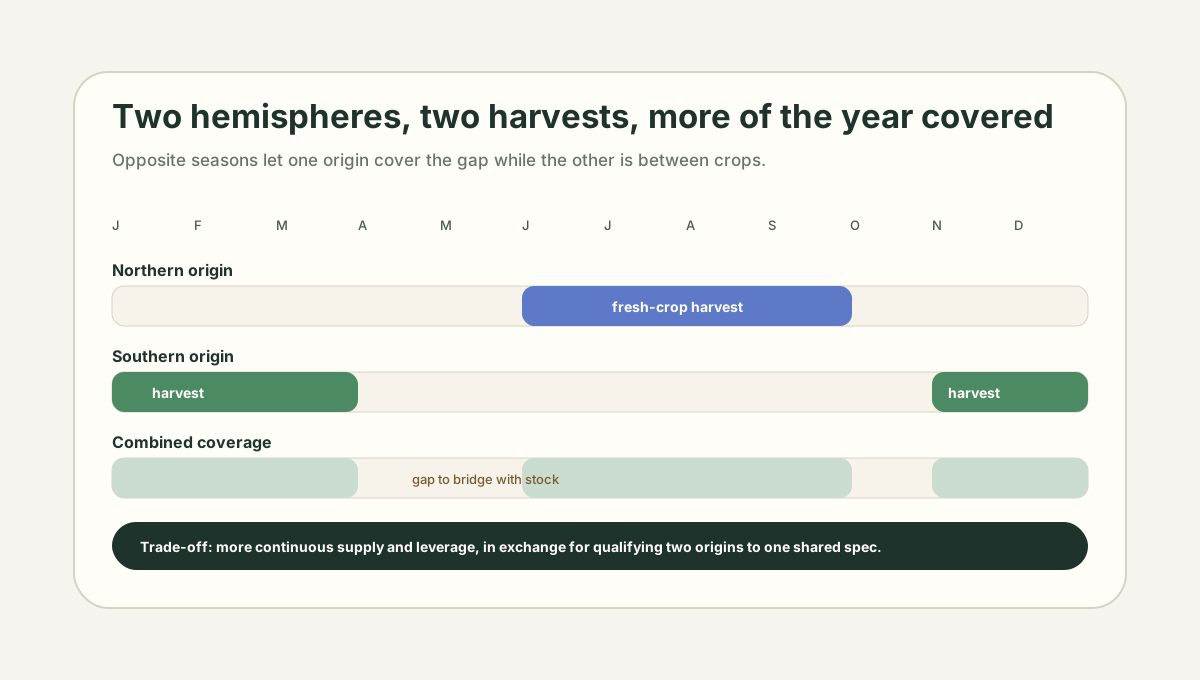
- Counter-seasonal sourcing pairs a northern-hemisphere origin with a southern-hemisphere one so harvest windows overlap less and cover more of the year.
- The main benefits are steadier availability, less exposure to a single crop failure, and more negotiating leverage across the calendar.
- The main costs are more suppliers to qualify, potential spec drift between origins, and added logistics and documentation complexity.
- It works best for fruits with genuine production in both hemispheres and matters most for buyers who cannot tolerate multi-month gaps.
Every fruit has a harvest window, but very few snack lines, ingredient programs, or private-label products can afford to only sell during that window. The gap between a seasonal crop and year-round demand is one of the quiet structural problems in freeze-dried fruit sourcing. Counter-seasonal sourcing across hemispheres is one of the cleaner ways to close it.
The direct answer
Counter-seasonal sourcing means buying the same fruit from two origins in different hemispheres, so their harvest seasons land at different times of the year. When a northern-hemisphere supplier is between crops, a southern-hemisphere supplier is in season, and vice versa. Together, the two harvest windows cover far more of the calendar than either could alone.
The result is steadier access to fresh-crop raw material, less dependence on any single harvest, and more room to negotiate across the year instead of buying into one tight window.
Why a single origin is fragile
Sourcing a fruit from one region ties the buyer to one growing season. That creates a few predictable pressures.
There is a peak buying window when the crop comes in, and then a long stretch where fresh material is limited and increasingly drawn from cold storage. As stored raw material ages and tightens, price and availability both move against the buyer. If that single harvest is hit by weather, disease, or a poor yield year, there is no fallback within the same calendar.
Single-origin sourcing also concentrates every other risk: one country's export rules, one currency, one logistics corridor, one set of quality conditions. When all of those line up well, it is efficient. When one goes wrong, there is nowhere to turn until the next harvest.
How counter-seasonal sourcing helps
Pairing hemispheres attacks the timing problem directly.
Northern and southern hemispheres have opposite seasons. A berry that harvests in the northern summer will have a counterpart harvesting around the southern summer, roughly half a year apart. Buying from both means fresh-crop material is available across more of the year instead of clustered in one season.
The practical benefits stack up. Availability becomes more continuous, so the buyer leans less on aging stored fruit at the end of a long single season. Crop risk is diversified, because a bad year in one hemisphere does not automatically empty the pipeline. And the buyer gains commercial leverage, since there is usually an in-season origin to quote against rather than one supplier holding all the timing power.
For buyers who genuinely cannot tolerate multi-month gaps, this continuity is often worth more than a marginal price difference.
The costs and trade-offs
Counter-seasonal sourcing is not free, and it is not right for every program.
The most important issue is spec consistency. The same fruit grown in two regions can differ in variety, Brix, color, size, and how it behaves through freeze-drying. Without careful alignment, buyers can end up with two origins that both meet a loose spec but produce visibly different finished fruit. Managing that requires a shared, detailed specification and real approval work on both sides.
There is also more to maintain. Two origins means two suppliers to qualify, audit, and monitor, each with its own documentation, food-safety scope, and import considerations. A second country of origin adds its own tariff classification, compliance paperwork, and logistics corridor. That overhead is manageable, but it is real, and small buyers may find it outweighs the benefit.
The most common disappointment is not a supply gap but inconsistency. If the two origins are not held to the same detailed spec, the finished product can shift noticeably when the program rotates from one hemisphere to the other. Aligning specs up front is the core of making dual-origin sourcing work.
Which fruits it fits
The approach depends on the fruit actually being produced commercially in both hemispheres.
Several berries and some tree fruits have genuine freeze-drying supply in both northern and southern regions, which makes counter-seasonal pairing realistic. Others are concentrated in one part of the world, and for those, hemisphere pairing is not an option. In that case, buyers usually rely on cold-stored raw material, forward booking against the single harvest, or blending to stretch coverage, each with its own trade-offs.
Before assuming a fruit can be dual-sourced, it is worth confirming that both origins have real, qualifiable production rather than a nominal one that cannot support consistent volume.
How to approach it as a buyer
For buyers considering this, a few practical moves make it work more smoothly.
Start by mapping the harvest calendars of candidate origins to see how much of the year two of them actually cover together. Then build one detailed, shared specification and qualify both origins against it, rather than treating them as separate one-off suppliers. Plan the rotation deliberately so that fresh-crop buying shifts from one hemisphere to the other with enough lead time, and keep documentation and import compliance ready for both countries of origin so a handoff never stalls at the border.
Done well, the buyer ends up with a supply picture that looks less like a seasonal spike and more like a rolling, year-round program.
The takeaway
Counter-seasonal sourcing does not create fruit out of nothing, and it does not remove the reality that harvests are seasonal. What it does is let a buyer stitch two seasons together, trading some added qualification and logistics work for steadier availability, diversified crop risk, and better leverage across the calendar. For programs that need to run all year, that trade is often worth making, as long as both origins are held to the same spec.
Frequently Asked Questions
What is counter-seasonal sourcing for freeze-dried fruit?
It is the practice of buying the same fruit from origins in different hemispheres so their harvest seasons fall at different times of year. When one hemisphere is between crops, the other is harvesting, which gives the buyer more continuous access to fresh-crop raw material.
Why does hemisphere matter for fruit supply?
Because harvest timing follows the growing season, and the northern and southern hemispheres have opposite seasons. A fruit that peaks mid-year in one hemisphere often peaks around the start or end of the year in the other, so together they cover more of the calendar.
Does counter-seasonal sourcing lower price?
Not automatically. It can reduce the price spikes that come from buying against a single tight season, and it gives buyers more leverage, but it also adds qualification and logistics costs. The net effect depends on volume and how much continuity is worth to the buyer.
What are the risks of dual-hemisphere sourcing?
The main risks are spec drift between origins, the effort of qualifying and maintaining more than one supplier, and added complexity in shipping, documentation, and import compliance for a second country of origin.
Which fruits suit this approach best?
Fruits with real commercial freeze-drying production in both hemispheres, such as several berries and some tree fruits. Fruits grown mainly in one region are harder to source counter-seasonally and may need cold-stored raw material instead.