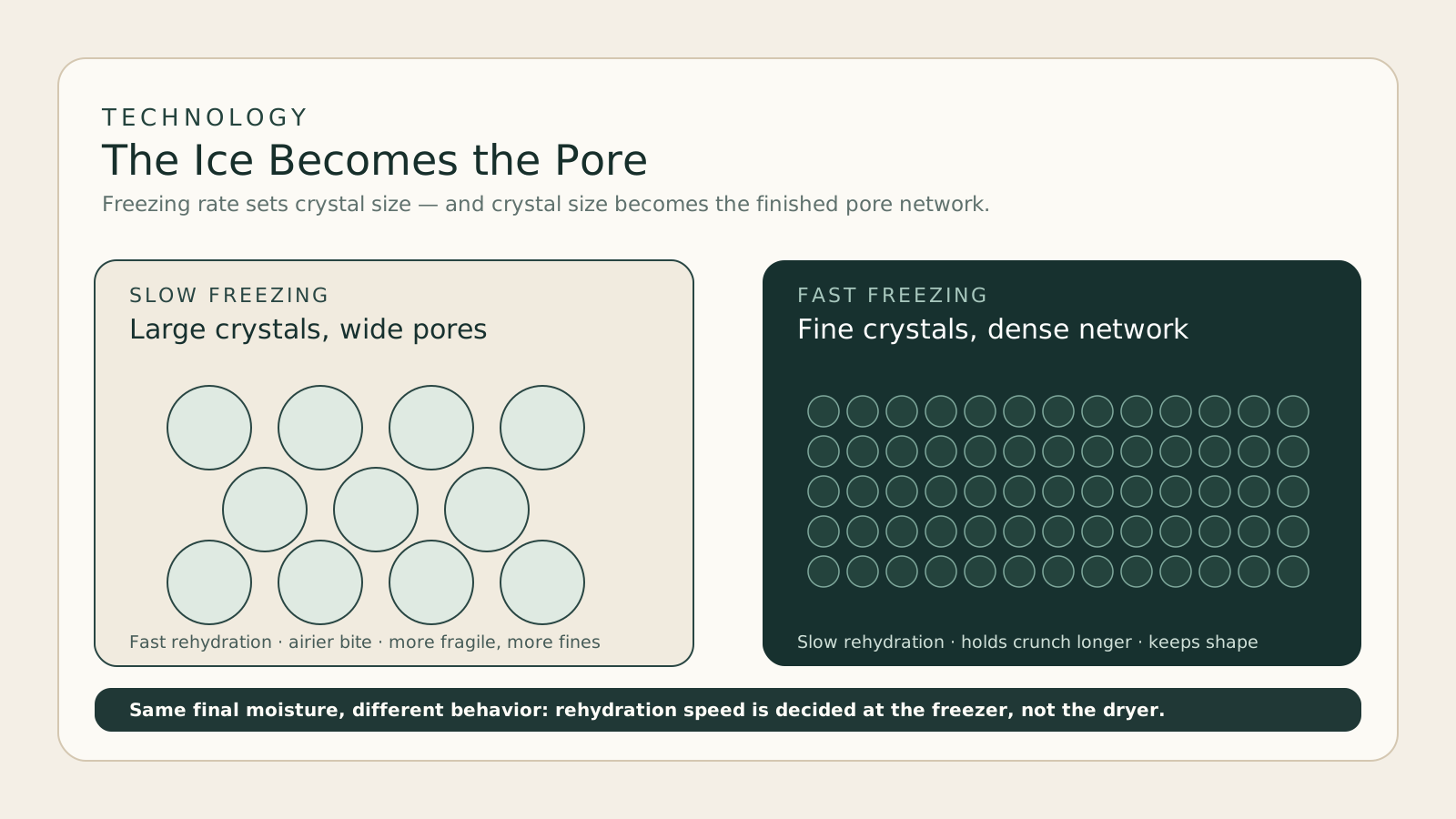
- Ice crystals formed during freezing sublimate away and leave pores behind, so crystal size and shape become the finished pore structure.
- Slow freezing tends to grow larger crystals and wider pores that rehydrate quickly but can feel more fragile; fast freezing gives fine crystals, a denser matrix, and slower wetting.
- Rehydration speed, crunch, and breakage are downstream of the same freezing decision, so there is no single 'best' crystal size — it depends on the end use.
- Buyers who care about reconstitution behavior should ask suppliers about the freezing method, not just the final moisture number.
Cut a freeze-dried strawberry in half and look at the inside. The dry, brittle honeycomb you see is a fossil record of how the fruit was frozen. Every empty pore was once a crystal of ice.
That single fact explains a lot of the behavior buyers and operators care about: how fast a piece rehydrates, how crunchy it stays in yogurt, how much it crumbles into fines during shipping. All of it traces back to a decision made before the vacuum pump ever turns on.
The direct answer
During freezing, water inside the fruit crystallizes into ice. Under vacuum, that ice sublimates — it goes straight from solid to vapor — and leaves a void exactly where the crystal used to be. So the size, shape, and connectivity of the ice crystals become the size, shape, and connectivity of the pores in the finished piece.
Because rehydration is mostly a matter of how quickly liquid can travel into and through those pores, the freezing step effectively sets the rehydration speed long before drying begins.
Why freezing rate controls crystal size
Ice does not form all at once. It nucleates at scattered points and then grows. How fast the fruit passes through the freezing range decides how that growth plays out.
When freezing is slow, relatively few crystals nucleate and each one has time to grow large. The result is a small number of big ice crystals, often spearing across cell walls. When freezing is fast, many crystals nucleate almost simultaneously and none of them has time to grow much, so you end up with a large number of fine crystals distributed through the tissue.
That difference carries straight through to the pores:
- Slow freezing tends to give larger, more open pores with wide connecting channels.
- Fast freezing tends to give finer, more numerous pores in a denser matrix.
Large ice crystals can physically rupture cell walls as they grow. That damage is part of why some freeze-dried fruit looks slightly collapsed or feels more fragile — the structure was already breached during freezing, not during drying. Fine crystals are gentler on cell walls but leave a tighter network behind.
How pore structure sets rehydration speed
Rehydration is capillary action. When a dry piece meets liquid, the pores pull water in the way a paper towel pulls up a spill. Two things govern how fast that happens: how wide the pores are and how well they connect.
Large, well-connected pores behave like wide, straight straws. Liquid rushes in, the piece softens quickly, and reconstitution can happen in seconds — useful for instant oatmeal, soups, purées, and anything meant to be eaten wet.
Fine, tightly packed pores behave like a bundle of narrow, tortuous straws. Water has to work through a longer, more resistant path, so wetting is slower and the piece holds its dry texture longer. That is often exactly what you want in a snack eaten straight from the bag, or a topping that should stay crisp on top of yogurt for more than a moment.
So the same property that makes one product a fast-rehydrating recipe ingredient makes another a durable dry snack. Neither is "better" in the abstract.
The trade-offs buyers actually feel
The freezing decision is not free in either direction. It shows up in several attributes at once, and they pull against each other.
Faster freezing and a denser matrix generally help a piece hold its shape and resist collapse, and can support a cleaner, crisper bite. But that density usually means slower rehydration and, in some fruits, a harder or glassier texture.
Slower freezing and larger pores generally give fast rehydration and a lighter, airier bite, but the more open, cell-ruptured structure can be more fragile — more prone to breakage, fines, and powder during handling and transport.
This is why two suppliers can both deliver "good" freeze-dried fruit at the same final moisture and water activity, yet the pieces behave differently in a bowl. The number on the certificate of analysis says nothing about the pore geometry that freezing locked in.
What this means for spec conversations
If reconstitution behavior matters to your application — because you are formulating instant products, sauces, or anything rehydrated — the useful question is not only "what is the moisture and water activity?" but also "how is the fruit frozen, and how consistent is that freezing?"
Practical things worth asking a supplier:
- Freezing method and rough rate: blast/plate freezing versus slower in-chamber freezing, and whether it is controlled batch to batch.
- Piece thickness: thicker pieces freeze more slowly at the center than at the surface, which can create a mixed pore structure within a single piece.
- Target texture or rehydration behavior: state whether you want fast-wetting or crunch-holding pieces, so the supplier can freeze toward that goal rather than optimizing only for throughput.
None of this requires a lab on your side. It just requires knowing that rehydration speed is a physical consequence of freezing, not a quality grade that can be dialed in at the end.
The takeaway
The pores in freeze-dried fruit are the empty shells of ice crystals, and those crystals are shaped during freezing. Larger crystals leave wide, fast-wetting channels; finer crystals leave a dense, slow-wetting network. Rehydration speed, crunch retention, and fragility all flow from that one upstream choice — which is why the most useful barrier-to-behavior questions start at the freezer, not the dryer.
Frequently Asked Questions
Do the pores in freeze-dried fruit come from the drying step or the freezing step?
Mostly the freezing step. Ice crystals grow during freezing, and when they sublimate under vacuum they leave voids in the same locations and roughly the same sizes. Drying removes the ice but does not create the pore geometry.
Does faster freezing always make a better product?
No. Fast freezing produces fine crystals and a denser matrix, which can help retain shape and structure but usually rehydrates more slowly. Slow freezing gives larger pores that wet quickly but can feel more fragile. The right choice depends on whether the piece is eaten dry or reconstituted.
Why does one freeze-dried fruit rehydrate in seconds and another stays crunchy in liquid?
Pore connectivity. A piece with large, well-connected pores draws liquid in fast by capillary action. A dense, fine-pored piece resists wetting, so it holds its crunch longer in yogurt or milk.
Can I tell crystal size from the finished piece?
Not precisely by eye, but a very open, sponge-like interior generally reflects larger crystals, while a tight, glassy fracture surface reflects finer ones. Under magnification the pore network is visible directly.
Primary sources & further reading
- Freeze-Drying of Plant-Based Foods (review) National Library of Medicine (PMC) Referenced for the relationship between freezing rate, ice crystal size, pore structure, and rehydration behavior in freeze-dried plant tissue.
- Water Activity (aw) in Foods U.S. Food and Drug Administration Referenced for the role of residual water and moisture uptake in dried foods, which interacts with pore structure during storage.
External links open in a new tab. We do not receive compensation from any organization listed; sources are referenced because they are primary, current, and publicly verifiable.