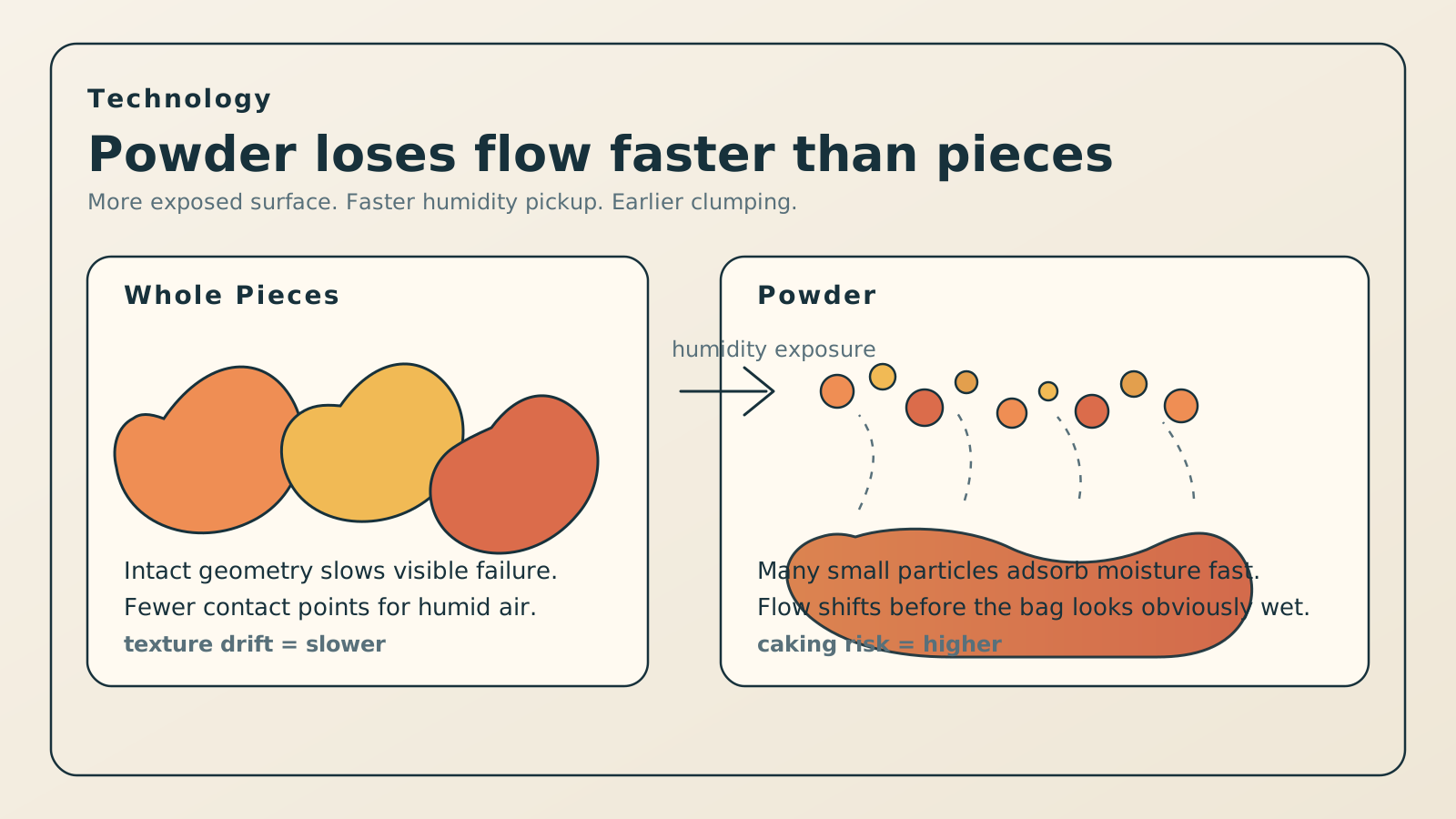
- Freeze-dried fruit powder exposes far more surface area to air than pieces, so humidity shows up faster as stickiness, clumping, and flow problems.
- Sugar-rich powders are especially vulnerable because small moisture gains can soften the dry matrix before the product looks visibly wet.
- Water activity, packaging barrier, particle-size distribution, and room exposure time matter more for powder than many buyers expect.
- A powder quote should be evaluated with its flow behavior, sieve profile, and anti-caking strategy in mind, not only its fruit identity and color.
Freeze-dried fruit powder often looks easier to handle than pieces. It pours, blends, doses, and colors formulas neatly when everything is going right.
The catch is that powder usually leaves the safe zone faster.
The direct answer
Freeze-dried fruit powder cakes faster than pieces because milling turns the fruit into many small particles with far more exposed surface area. That makes the powder more responsive to ambient humidity, more likely to soften at the particle surface, and more likely to bridge, clump, or lose flow before a larger whole piece would show the same failure.
The problem is not only "too much water." It is how quickly a dry fruit system starts reacting once moisture becomes available.
Pieces have structure; powder has exposure
Whole pieces and slices are still hygroscopic, but they keep some structural protection. A powder does not. Every broken face becomes another point where water can adsorb, and every fine particle increases the total surface that the room can reach.
That is why powder often shows trouble first as:
- soft clumps in the bag
- lumpy flow through scoops or fillers
- dust that turns tacky around the edges
- poor dispersion in a dry blend
The finished product may still look colorful and technically dry enough to pass a quick visual check. The handling failure shows up sooner than the obvious appearance failure.
Particle size changes the risk
Smaller particles are not only lighter. They also behave differently around moisture. Research on freeze-dried apple powders has shown that finer fractions can be more hygroscopic than coarser ones, which helps explain why aggressive milling and high fines content often make a powder harder to hold in a free-flowing state.
That matters in commercial practice because "powder" is rarely one uniform format. A supplier may be shipping:
- a coarse crumble
- a medium powder for drink or bakery use
- an ultra-fine color or flavor powder
Those are different products from a storage and handling standpoint, even when they start from the same fruit lot.
Sugar-rich fruits usually fail earlier
Fruit powder is not an inert mineral powder. It is a dried biological system built around sugars, acids, fiber, and damaged cell structure. That chemistry matters.
High-sugar fruits and high-sugar fractions tend to become tacky sooner because small moisture gains can soften the dry matrix quickly. In practical terms, the powder may move away from a brittle, glassy state and toward a more rubbery state even before the bag looks damp.
That is why tropical powders, berry powders with high fine content, and powders made from very ripe fruit can be harder to keep free-flowing than buyers expect. A powder can be excellent for color and aroma while still being unforgiving in storage.
Water activity explains the early warning zone
FDA frames water activity as a measure of how available moisture is in a food. That distinction matters here because a powder can still be commercially drifting even when a simple moisture percentage sounds acceptable.
For powder, the more useful question is often not only "what is the moisture content?" but:
- what is the release water activity?
- how quickly does it rise after opening?
- how much humid-room exposure occurs before final seal?
- which particle-size fraction is drifting first?
That is why some powders seem fine in the lab sample and disappointing in the real bag. The product may be spending too much time near the edge where flowability starts to collapse.
Packaging matters more for powder than many teams assume
A powder pack is not protected by fruit geometry the way a pouch of slices is. Once moisture gets in, the product has far more contact points to respond with. That raises the value of:
- stronger humidity barrier
- faster fill-to-seal handling
- smaller headspace where appropriate
- tighter zipper and seal performance for resealable packs
- portion sizes that reduce repeated open-air exposure
For ingredient formats, inner liners and case packing logic matter too. A good powder can leave the dryer in range and still arrive difficult to use if the protection system was designed like a piece-fruit pouch rather than a sensitive powder system.
Buyers should approve powder as a handling format, not only a flavor format
A lot of fruit-powder buying still overweights color and aroma and underweights physical behavior. That is backward. The powder has to remain usable in the customer's process.
Before approving a fruit powder, buyers should want clarity on:
- target moisture and water activity
- particle-size distribution or sieve profile
- proportion of fines
- anti-caking or carrier ingredients when present
- expected storage conditions after opening
- whether the intended use is topping, blending, dosing, or dry mixing
Those questions are especially important when one supplier is quoting "powder" and another is really quoting a coarser crumble.
If the application depends on clean scooping, even color distribution, or accurate dosing, powder should be judged as a flow system, not only as dried fruit reduced to a smaller size.
Bottom line
Freeze-dried fruit powder cakes faster than pieces because it gives moisture more surface to work on and less structure to resist the change. Smaller particles, higher fine content, sugar-rich fruit chemistry, and weak humidity control all compound the risk.
For operators and buyers, the takeaway is simple: powder is usually the more sensitive format. Treat it that way in the spec, the packaging plan, and the storage expectations.
Frequently Asked Questions
Why does freeze-dried fruit powder clump faster than pieces?
Because powder exposes much more surface area to the air. That gives humidity more contact points, so the product picks up moisture and loses free-flowing texture sooner than larger intact pieces.
Is powder caking only a storage problem?
No. Storage matters, but powder can also start drifting during milling, screening, filling, or any long hold before final seal if the room is humid enough.
Do all fruit powders cake at the same speed?
No. Sugar profile, acidity, particle size, porosity, and the amount of fine material all change how quickly a powder becomes sticky or lumpy.
Does low moisture content guarantee a free-flowing powder?
Not by itself. A powder can meet a moisture target and still handle poorly if its water activity is drifting, its particle-size distribution is too fine, or its packaging protection is weak.
What should buyers ask for when approving a fruit powder?
Ask for target moisture and water activity, particle-size distribution, anti-caking or carrier disclosure when relevant, and evidence that the powder stays flowable across the intended storage window.
Primary sources & further reading
- Water Activity (aw) in Foods U.S. Food & Drug Administration Referenced for FDA's explanation that water activity tracks available moisture rather than total moisture alone.
- Cell Wall Polysaccharides and Related Physicochemical Properties of Freeze-Dried Apple Pomace as Affected by Particle Size Food Chemistry / PubMed Referenced for the paper's discussion of how smaller apple-powder particles show higher hygroscopicity and how fructose-rich fractions are especially moisture-sensitive.
- Effects of Gliadin and Glutenin on the Hygroscopicity of Freeze-Dried Apple Powders Food Hydrocolloids / PubMed Referenced for the observation that freeze-dried apple powders are susceptible to moisture and temperature changes that lead to caking during storage.
- Moisture-Induced Caking of Beverage Powders Food Chemistry / PubMed Referenced for the broader powder-science explanation that moisture sorption can reduce flowability and trigger visible caking before the product seems obviously wet.
External links open in a new tab. We do not receive compensation from any organization listed; sources are referenced because they are primary, current, and publicly verifiable.