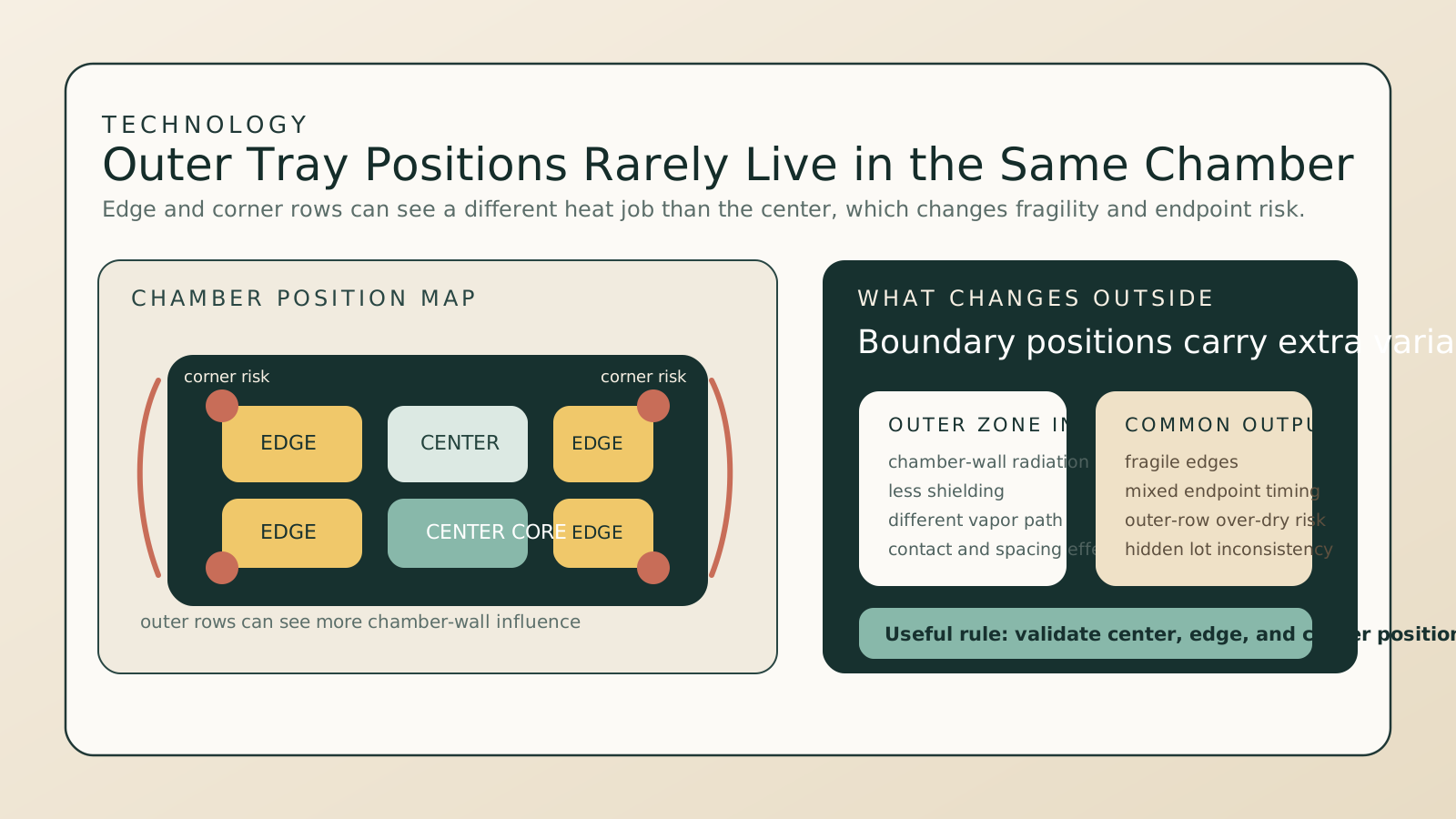
- Edge and corner positions can see a different heat load than center positions, especially during primary drying.
- The problem is not only tray loading. Chamber-wall radiation, shielding, and local contact conditions can change how fast outer zones finish.
- Mixed endpoint behavior often shows up later as fragile edges, soft centers, or lot-to-lot inconsistency that looks mysterious on paper.
- Processors should validate outer and inner tray positions separately instead of assuming one moisture result represents the whole load.
Many teams talk about endpoint as if the whole tray lived in one clean average condition.
Commercial freeze-dried fruit rarely behaves that neatly.
The direct answer
Edge and corner tray positions can dry differently because the outer parts of the load do not always receive and shed heat the same way as the center. Even when the fruit is cut consistently and the recipe is unchanged, the chamber geometry can expose outer positions to a different thermal environment.
That matters because freeze-drying is not only about the programmed shelf temperature. It is about where the energy actually goes and how evenly vapor can leave the product.
Why the chamber gives outer positions a different job
The center of a loaded tray is surrounded mostly by more product. Edge and corner positions sit closer to open space, metal boundaries, or chamber walls.
That changes several things at once:
- how much radiative heat the position sees
- how much neighboring product shields it
- how easily vapor leaves the local zone
- how strongly the product tracks the shelf versus the wider chamber
In plain terms, the outer positions can feel like they are running a slightly different process from the middle.
This is one reason a center-focused sample can mislead a team into thinking the whole load was uniform when the outer rows were not.
This is not only a tray-loading problem
Tray loading still matters. Uneven layer depth, mixed cut size, and piled fruit all create their own non-uniformity.
But chamber-position effects deserve separate attention because they can remain even after tray loading improves.
A well-loaded strawberry tray can still show:
- faster-drying outer slices
- corner positions that become more fragile
- center zones that stay closer to the slowest endpoint
- inconsistent product temperature history across the same batch
That distinction matters operationally. If a team blames every uniformity issue on loading labor, it can miss the chamber-position pattern that keeps repeating.
What this looks like in finished fruit
Position effects do not always create one dramatic wet corner. More often they show up as mixed commercial behavior:
- outer pieces chip too easily
- corner rows look slightly more collapsed
- some slices feel lighter and more brittle than the rest
- the slowest inner positions decide the final cycle length
- the lot passes a moisture check but still eats unevenly
That is why endpoint work needs more than one convenient sample. A chamber can produce an acceptable average and still produce a commercially annoying spread.
Why edge positions sometimes create opposite complaints
Outer positions can trigger two different failure patterns depending on the load and the recipe.
One pattern is faster finishing. More exposed outer positions may see stronger effective heat transfer, so they become lighter, drier, and more fragile before the center is ready.
The other pattern is higher variability. If load geometry, shielding, or contact conditions are inconsistent, the outer positions can drift more from run to run than the middle. In that case the problem is not simply "outer dries faster." It is "outer behaves less predictably."
That is why the safest rule is not to memorize one direction. It is to validate the positions that sit at the boundaries of the load.
What good validation looks like
Strong freeze-drying teams usually do more than verify one tray and one location.
Useful validation habits include:
- checking center, edge, and corner positions separately
- comparing product temperature behavior across those zones
- confirming final moisture or water activity from more than one location
- reviewing breakage and texture by position, not only by lot average
- repeating the comparison when fruit size, tray fill, or product format changes
For buyers, this translates into a simple screening question: does the supplier talk about chamber uniformity like a real process variable, or like an abstract machine capability?
What buyers should ask
Buyers will not usually stand beside the dryer, but they can still learn a lot from the supplier's answers.
Useful questions include:
- Which positions are treated as the worst-case endpoint locations?
- Do you compare center, edge, and corner trays during validation?
- What usually drifts first when chamber uniformity weakens: moisture, texture, or breakage?
- How do you change loading or cycle design when the product format changes?
Clear answers usually indicate a plant that has studied its own chamber honestly. Vague answers usually mean the team is leaning too hard on nominal recipe settings.
Bottom line
Edge and corner tray positions dry differently because the chamber does not treat every position identically. Radiation, shielding, vapor escape, and local geometry all change the thermal job the fruit experiences.
For freeze-dried fruit, that means chamber-position validation is part of endpoint control, not an optional technical detail.
Frequently Asked Questions
Why do edge and corner tray positions dry differently?
Because the outer positions can receive heat differently than the center of the load. Chamber-wall radiation, shelf contact, open exposure, and nearby empty space can all change how quickly those pieces move through primary drying.
Is this the same problem as uneven tray loading?
Not exactly. Uneven loading can make the problem worse, but position effects can still appear even when cut size and layer depth are well controlled.
Do edge positions always dry faster?
Not always. Some outer positions run hotter and finish earlier; others become more variable because the local geometry and shielding change. The real lesson is that outer positions should be checked, not guessed.
What defects can this create in freeze-dried fruit?
Common outcomes include mixed texture within one lot, fragile outer pieces, denser late-finishing zones, and endpoint decisions that satisfy the average tray while missing the slowest positions.
What should buyers ask suppliers about chamber uniformity?
Ask whether validation compares center, edge, and corner positions, how endpoint is confirmed across those zones, and what the supplier does when outer positions drift from the middle.
Primary sources & further reading
- Practical Advice on Scientific Design of Freeze-Drying Process: 2023 Update PubMed Central / Pharmaceutical Research Referenced for the process-design explanation that product temperature depends on more than the shelf recipe and that load position changes heat-transfer conditions.
- Heat Flux Analysis and Assessment of Drying Kinetics during Lyophilization of Fruits in a Pilot-Scale Freeze Dryer PubMed Central / Foods Referenced for fruit-specific pilot-scale observations that drying kinetics and product temperature vary across the load.
- Mechanistic Modeling and Analysis of Thermal Radiation in Conventional, Microwave-assisted, and Hybrid Freeze Drying for Biopharmaceutical Manufacturing arXiv / Massachusetts Institute of Technology Referenced for the chamber-radiation explanation behind edge and corner heat-transfer differences. The fruit-specific implications in this article are editorial inferences from that freeze-drying geometry.
External links open in a new tab. We do not receive compensation from any organization listed; sources are referenced because they are primary, current, and publicly verifiable.