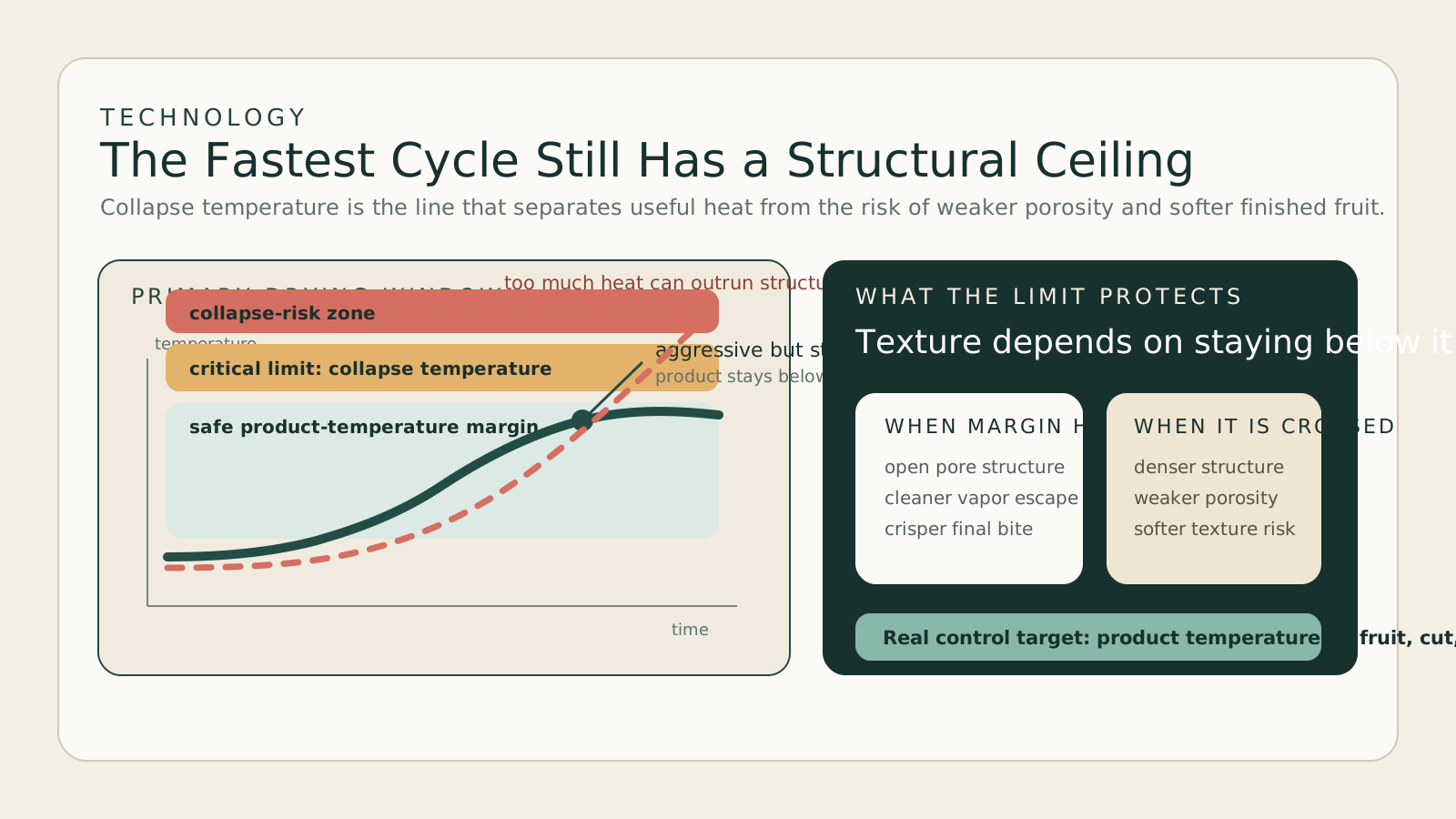
- Collapse temperature is the structural limit above which the product risks losing the porous architecture that makes freeze-dried fruit crisp.
- The useful control target is product temperature, not shelf temperature alone, because the fruit itself has to stay below the collapse-risk line during primary drying.
- Trying to shorten cycles by pushing heat too aggressively can backfire through shrinkage, denser structure, slower vapor escape, and weaker final texture.
- Sugar level, fruit composition, piece geometry, and loading pattern all influence how much temperature margin a processor really has.
Freeze-drying always tempts operators with the same question: if time is money, why not push more heat and finish the batch sooner?
For fruit, collapse temperature is one of the clearest answers.
The direct answer
Collapse temperature limits freeze-dried fruit cycle speed because it marks the approximate point where the drying fruit stops holding its porous structure cleanly during primary drying. A processor can often shorten a cycle by adding more heat only up to the point where product temperature remains safely below that structural limit. Push past it, and the result can be a weaker, denser, less crisp product even if the batch appears to finish faster.
That is why the real ceiling in freeze-drying is not the shelf setpoint by itself. It is the temperature the fruit actually reaches.
What collapse temperature is really describing
Freeze-dried fruit feels crisp because freezing and sublimation leave behind a porous internal network.
That network is not infinitely stable. During primary drying, ice is leaving the product while heat is being fed into the load. If product temperature rises too far, the partially dried structure can start to lose its shape instead of holding the open architecture the final bite depends on.
In practical terms, collapse temperature is the warning line for that structural failure risk.
The point is not that every fruit has one magical number that solves everything. The point is that every fruit family, cut geometry, and solids system has a limited safe zone. Inside that zone, added heat can accelerate drying. Outside it, the cycle may begin trading speed for damage.
Why fruit processors care more than the chart suggests
For fruit, collapse is not only a laboratory idea.
It shows up later as commercial quality:
- weaker crunch
- denser bite
- less open porosity
- stickier or less elegant structure
- harder final moisture cleanup
That matters because the market does not reward a technically shorter cycle if the pouch opens with a duller eating experience.
Reviews on plant-based freeze-drying make this point indirectly. Primary drying is typically managed with product temperature held below collapse risk. Food-focused freeze-drying reviews also connect aggressive drying conditions to physical-property losses such as structure damage, poorer porosity, and texture deterioration.
The buyer never sees the temperature profile. They taste the consequence.
Why shelf temperature is not the same thing as the real limit
Teams sometimes speak as if the control decision is simply whether the shelf is set at one temperature or another.
That is too crude.
Shelf temperature is only the machine-side input. The real risk sits at product temperature inside the fruit. A shelf can be raised while the product still stays safe if sublimation is carrying heat away effectively. The same shelf setpoint can become risky later in the cycle when the dry layer thickens, heat transfer changes, and the fruit stops buffering itself the same way.
That is why collapse temperature is really about margin, not only about a single setting.
Useful questions are:
- how close is the product running to the structural limit
- how evenly is that margin holding across the load
- what changes when the fruit geometry or solids profile changes
Those questions are far more useful than asking for the shelf recipe alone.
Why sweeter or thicker fruit gets harder to push
Not every fruit gives the same operating room.
The usable margin can shift with:
- sugar concentration
- acid and solids composition
- piece thickness
- cut shape
- loading density
- fruit tissue structure
That is why one process window for thin apple slices cannot simply be copied onto mango cubes or berry-heavy blends.
Higher-solids or slower-drying fruit may reach the practical limit sooner. Thick pieces may also carry more internal temperature variation, so the hottest zones become the real constraint. In those cases, a more aggressive cycle can save time in theory while increasing the risk of local structural loss in practice.
Why crossing the line can make drying less efficient, not more
It is tempting to think that even if collapse hurts appearance slightly, the cycle might still win on throughput.
Often the trade is worse than that.
Once the structure begins to densify or shrink, vapor movement can become less graceful. The product may lose the very pore network that helps water escape cleanly. That can leave the operator with a load that ran hotter but did not become commercially easier to finish.
This is the part many non-specialists miss:
- good porosity supports clean drying
- damaged porosity can undermine both texture and process efficiency
So collapse temperature is not only a quality guardrail. It is also part of why some overly aggressive cycles fail to deliver the throughput gain they promised.
Why a conservative cycle is not automatically the answer either
The opposite mistake is treating collapse risk as an excuse to dry everything slowly forever.
That wastes capacity.
The goal is not maximum caution for its own sake. The goal is enough validated margin to run as fast as the fruit can tolerate without compromising structure. If the collapse estimate is too conservative, the cycle may end up longer than necessary. If it is too optimistic, the batch can outrun its own structure.
Strong processors do not solve that tension with slogans. They solve it with product-specific validation:
- fruit family by fruit family
- cut by cut
- loading pattern by loading pattern
That is where operational discipline lives.
What buyers should infer from this
Most buyers will never review freeze-dry microscopy or critical-temperature data. They can still ask better questions.
Useful signals include:
- whether the supplier talks about product temperature instead of only shelf settings
- whether cycle logic changes by fruit and format
- whether thicker or sweeter SKUs are validated separately
- whether texture complaints are investigated as process-window issues instead of only packaging issues
A supplier that cannot explain the structural limit behind the cycle is often asking the recipe clock to do more work than process understanding.
Bottom line
Collapse temperature limits freeze-dried fruit cycle speed because the batch can only be pushed as fast as the fruit structure can tolerate during primary drying. More heat is helpful only while product temperature stays below the point where the porous matrix begins to lose integrity.
That is the real commercial lesson: faster drying is valuable, but only if the fruit still leaves the chamber with the open structure that makes it feel crisp, light, and stable in the bag.
Frequently Asked Questions
What is collapse temperature in freeze-drying?
Collapse temperature is the approximate structural limit above which an amorphous freeze-drying product can start losing the porous structure created during freezing and sublimation. In plain terms, it is the point where the dried matrix begins to lose shape instead of holding a crisp open network.
Why does collapse temperature matter for freeze-dried fruit?
Because freeze-dried fruit quality depends on that porous structure. When product temperature gets too close to or above collapse risk during primary drying, the fruit can lose the brittle, open texture that makes it read as crisp and premium.
Is collapse temperature the same thing as shelf temperature?
No. Shelf temperature is a machine setting. Collapse temperature is a product property or structural limit. The real control problem is whether the fruit itself stays safely below that limit during drying.
Does a hotter cycle always mean faster drying?
Not always in a commercially useful way. More heat can speed sublimation up to a point, but crossing the structural limit can damage pore structure, create denser regions, and leave the product with worse texture or harder final moisture cleanup.
What should buyers ask suppliers about this topic?
Ask how product temperature is controlled relative to critical product limits, how the supplier validates cycle settings for each fruit family, and what changes when piece thickness or sugar level changes.
Primary sources & further reading
- Freeze-Drying of Plant-Based Foods Foods / PubMed Central Referenced for the plant-food freeze-drying review describing primary drying with product temperature held below collapse temperature and for the discussion of fruit-specific collapse and glass-transition behavior.
- The Freeze-Drying of Foods—The Characteristic of the Process Course and the Effect of Its Parameters on the Physical Properties of Food Materials Foods / PubMed Central Referenced for the food-focused discussion of shelf temperature, structure collapse, porosity, stickiness, and other physical-property consequences of aggressive drying conditions.
- Freeze-Dry Microscopy: Impact of Nucleation Temperature and Excipient Concentration on Collapse Temperature Data AAPS PharmSciTech / PubMed Central Referenced for the general lyophilization definition of collapse temperature as a critical primary-drying limit and for the explanation that product temperature must stay just below the critical formulation temperature.
External links open in a new tab. We do not receive compensation from any organization listed; sources are referenced because they are primary, current, and publicly verifiable.