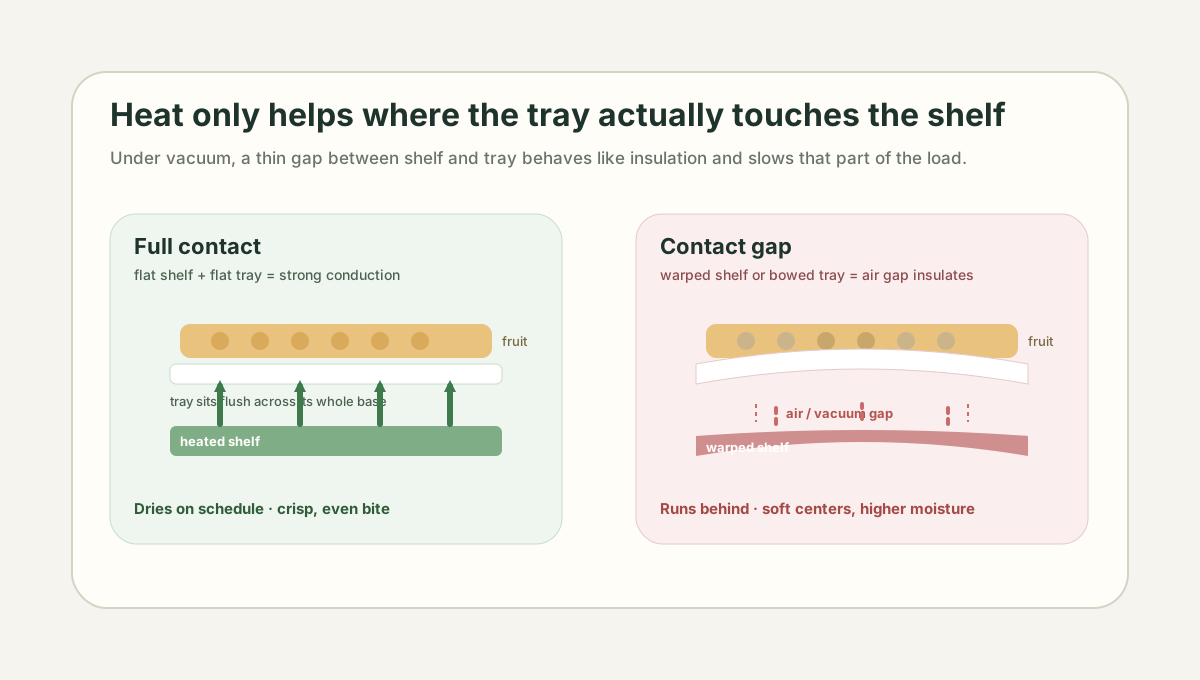
- In a freeze dryer, most useful heat reaches the fruit by conduction through the shelf and tray, so any air gap between them acts as insulation.
- Warped shelves, bowed trays, debris, and ice bridges create uneven contact, so some trays get more effective heat than others in the same cycle.
- Trays that run colder dry slower and can leave soft centers or higher residual moisture, even when the recipe and endpoint look fine on the controller.
- Flatness, tray condition, and consistent loading are cheap process controls that reduce lot-to-lot texture and moisture swings.
Ask an operator why two trays from the same batch came out differently and the first answers are usually about the fruit: ripeness, cut size, how wet the incoming lot was. Those matter. But sometimes the fruit was fine and the machine settings were identical. The difference came from something duller: how well each tray was touching the shelf underneath it.
The direct answer
Shelf flatness and contact gaps change how much heat reaches the fruit. In a freeze dryer, the shelf is the heat source, and most of the useful heat crosses into the product by conduction through solid contact between shelf, tray, and the frozen layer above it. Wherever that contact is broken by a warped shelf, a bowed tray, debris, or a bridge of ice, a thin air or vacuum gap opens. Under freeze-drying pressures that gap behaves like insulation, so the fruit above it warms more slowly, sublimes more slowly, and finishes later than fruit sitting over good contact.
The controller still reports the shelf setpoint you asked for. It just cannot tell you that some of that heat never made it into the tray.
Why the gap matters more under vacuum
At normal atmospheric pressure, a small air gap is a mediocre insulator but still carries some heat. The gas molecules bump along and move energy across. Inside a freeze dryer during primary drying, the chamber is held at very low pressure, so there are far fewer gas molecules in any gap to carry heat. That makes conduction through direct solid contact the efficient path and makes any break in that contact disproportionately costly.
So the same 2 mm gap that would barely matter on a kitchen counter becomes a meaningful thermal barrier inside the chamber. The heat that should have flowed shelf to tray to fruit instead has to find another, weaker route.
Where contact actually breaks
Uneven contact rarely comes from one dramatic defect. It usually comes from an accumulation of small ones:
- Warped or bowed shelves. Heating and cooling cycles, mechanical stress, and age can leave a shelf slightly convex or concave. A tray then rests on a ridge or on its edges instead of flat.
- Deformed trays. Dented bases, bowed sheet trays, and trays that flex under a heavy fruit load all reduce their footprint of real contact to a few high spots.
- Debris and residue. Dried fruit fragments, sugar residue, or packaging bits left between shelf and tray act as tiny stilts that lift the rest of the tray off the surface.
- Ice bridges and frost. Frost that forms on a shelf between runs, or ice that builds where product spilled, can hold a tray slightly proud of the shelf.
- Inconsistent loading. A tray placed a little skewed, overhanging an edge, or stacked with uneven product depth changes both contact and the effective heat path.
Each of these is individually minor. Together, across a full chamber, they explain why "identical" trays are not really identical.
If the same tray positions come out wetter or softer batch after batch, suspect contact and hardware before you suspect the recipe. Recipe errors move the whole load; contact errors move specific positions.
What uneven contact does to the fruit
A tray that receives less effective heat spends longer in primary drying. If the cycle ends on a fixed schedule rather than on a true endpoint check, that lagging tray can come out with a soft center or higher residual moisture while its neighbors are fully dry. Those are exactly the pieces that later feel chewy instead of crisp, or that pull moisture in during storage and lose crunch faster.
There is a second-order effect too. If an operator responds to a few wet trays by simply raising shelf temperature, the well-contacted trays now run hotter and edge toward collapse or color loss, while the starved trays still lag. The spread between best and worst tray can actually widen. The fix for a contact problem is contact, not more heat.
Diagnosing it on the floor
You do not need lab instrumentation to start narrowing this down. A few practical checks help:
- Map the misses. Record which tray positions come out wet or soft. A repeating pattern by position points to hardware, not fruit.
- Look at the trays. Set them on a known flat surface and check for rocking, bowing, or dents. Replace or reflatten the bad ones.
- Inspect and clean shelves. Wipe shelves between runs, check for frost buildup, and look for visible warp along the shelf edge.
- Standardize loading. Consistent product depth, squared-up placement, and no overhang give every tray the same starting geometry.
- Confirm the real endpoint. Endpoint checks such as pressure-rise or comparative temperature readings catch a lagging tray before it becomes an out-of-spec lot.
Why this is a quality-control lever, not a machine detail
It is tempting to file shelf flatness under maintenance and move on. But for freeze-dried fruit, texture and residual moisture consistency are the product. A processor who keeps shelves flat, trays undamaged, and loading uniform is quietly removing one of the most common sources of within-lot variation. A processor who ignores it can pass an average spec while shipping a bag that is crisp in some handfuls and chewy in others.
For buyers, that is worth a question during a plant visit or audit: how are shelves and trays maintained, how is loading standardized, and how is endpoint confirmed across the whole chamber rather than at one probe. The answers say a lot about whether the supplier's consistency comes from control or from luck.
Bottom line
Shelf temperature is a promise; contact is whether the promise is kept. Warped shelves, bowed trays, debris, and ice all open small gaps that insulate the fruit from the heat it needs, and under vacuum those gaps punch above their size. Keeping the contact clean, flat, and consistent is one of the cheapest ways to make freeze-dried fruit finish evenly, tray after tray and lot after lot.
Frequently Asked Questions
Why does a small air gap matter so much under vacuum?
Because at freeze-drying pressures there is very little gas to carry heat across a gap. Conduction through solid contact is the efficient path; once a thin air or vacuum gap opens between shelf and tray, heat transfer across it drops sharply and that spot of the load warms more slowly.
How would an operator notice a contact problem instead of a recipe problem?
A recipe problem tends to affect the whole load the same way. A contact problem tends to show up as position-dependent variation: the same trays or the same corners run wetter or softer batch after batch, while others are fine.
Can you just raise shelf temperature to compensate?
Raising shelf temperature pushes the well-contacted trays hotter, which risks collapse or scorch there, while the poorly contacted trays still lag. It treats a symptom and can widen the spread rather than close it.
Do flexible or thin trays make this worse?
They can. A tray that bows under load, or one with a dented or warped base, sits on the shelf at a few high points instead of across its whole footprint, leaving gaps elsewhere. Flat, rigid, undamaged trays contact more evenly.
Why should a buyer care about shelf flatness?
Because it affects consistency. A processor with warped shelves or worn trays may ship lots that vary in texture and residual moisture by tray position, even when the average looks in spec. It is one hidden source of the lot-to-lot swings buyers complain about.
Primary sources & further reading
- Freeze-Drying of Plant-Based Foods Foods / PubMed Central Referenced for the review's description of heat transfer to the product during primary drying and the roles of conduction, contact, and shelf heating.
- The Freeze-Drying of Foods—The Characteristic of the Process Course and the Effect of Its Parameters on the Physical Properties of Food Materials Foods / PubMed Central Referenced for the general treatment of process parameters, heat supply, and how they affect drying behavior and product properties.
- Freeze Drying: A Review PubMed Central Referenced for the general discussion of heat transfer mechanisms and uniformity considerations in lyophilization.
External links open in a new tab. We do not receive compensation from any organization listed; sources are referenced because they are primary, current, and publicly verifiable.