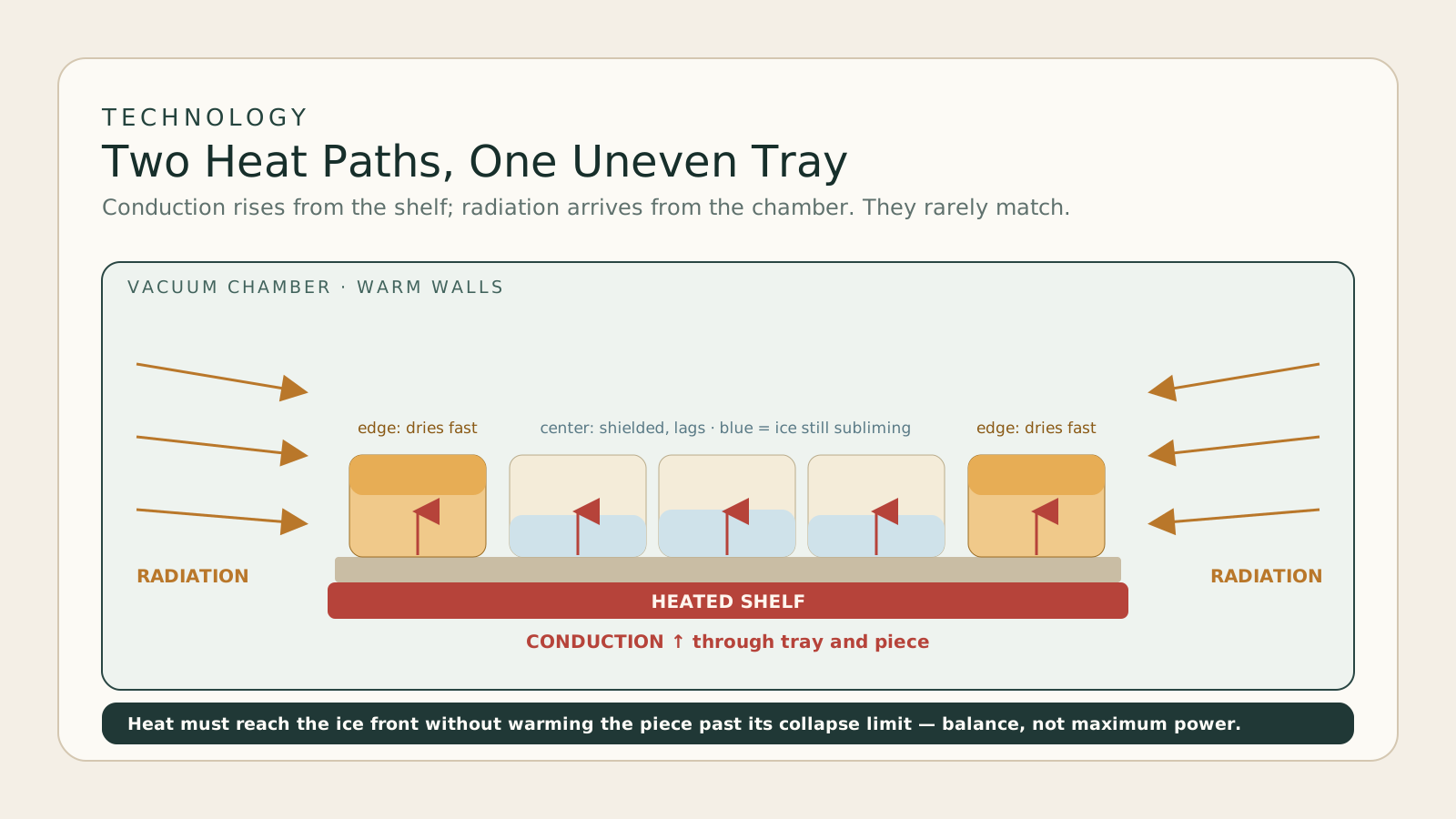
- Primary drying needs heat to sublime ice, and that heat reaches the fruit mainly by conduction from the shelf and radiation from chamber surfaces.
- Because the two paths are not equal across a loaded shelf, edge and corner pieces often dry faster than the center.
- Pushing heat too hard to speed sublimation risks crossing the collapse temperature, so the useful question is balance, not maximum power.
It is tempting to think of a freeze-dryer as a machine that pulls water out of fruit. That picture is missing half the story. Water leaves only because energy arrives to push it out, and how that energy reaches each piece of fruit decides how evenly the batch dries.
The direct answer
During primary drying, frozen fruit gives up water by sublimation, where ice turns straight into vapor without melting. Sublimation consumes energy, so the cycle has to deliver heat to the ice front at the same time the vacuum carries vapor away. That heat reaches the fruit mainly two ways: conduction, through the shelf and tray into the bottom of each piece, and radiation, from warmer chamber walls and shelves onto the exposed surfaces.
Because those two paths do not load every piece equally, a single tray can finish unevenly even when the shelf temperature reads perfectly steady.
Why frozen fruit still needs heat
Sublimation is not free. Turning a gram of ice directly into vapor takes a specific amount of energy, the latent heat of sublimation. If nothing supplies that energy, the ice front cools itself as it sublimes, the local vapor pressure drops, and drying slows down.
So the dryer has to walk a line. It must add enough heat to keep sublimation moving, but not so much that the product warms past the temperature where its dried structure can no longer hold shape. For fruit, crossing that line tends to show up as collapse: denser, harder, shrunken, or glassy pieces instead of the open, crisp matrix buyers expect.
That balance is why heat delivery, not raw heating power, is the real design question.
Conduction: heat through contact
Conduction is the path most operators picture first. The heated shelf warms the tray, the tray warms the bottom layer of fruit, and heat moves upward through each piece toward the retreating ice front.
Conductive heat flow depends on a few practical things:
- how good the contact is between tray and shelf
- how good the contact is between fruit and tray
- the temperature difference between shelf and product
- the area actually touching
This is where loading habits matter. A warped tray, an air gap, or pieces that barely touch the surface all weaken the conductive path. Fruit is also a poor conductor once a dry, porous layer forms on top, because that spent layer insulates the ice still below it. As primary drying proceeds, the dried zone grows and the conductive route to the ice front gets harder, which is part of why the back half of a cycle often feels slow.
Radiation: heat across the gap
Radiation needs no contact. Any surface warmer than the product, including chamber walls, the door, and the underside of the shelf above, sends radiant heat toward the fruit it can "see."
That sounds minor, but in a low-pressure chamber where gas conduction is weak, radiation can carry a meaningful share of the load, especially to the top and outer pieces. The catch is that radiation is profoundly uneven. A piece on the open edge of a tray faces warm chamber walls directly. A piece buried in the center is largely shadowed by its neighbors and the tray walls, so it sees far less radiant heat.
Edge and corner positions get a double advantage: more direct radiant heat from surrounding warm surfaces and less shadowing from neighboring pieces. They often reach endpoint first, while shielded center pieces lag. The cycle is only truly finished when the slowest piece is done.
The two paths rarely match
The reason uniformity is hard is that conduction and radiation peak in different places.
Conduction favors the pieces with the best shelf contact, usually the bottom layer sitting flat. Radiation favors the pieces with the clearest view of warm surfaces, usually the outer ring and the top. A piece that is both well-seated and exposed can race ahead, while a poorly seated, shadowed center piece falls behind on both counts.
This is the mechanism underneath several familiar freeze-dried fruit problems:
- soft or under-dried centers in an otherwise finished tray
- crispier, sometimes scorched-looking edges
- batch-to-batch variation when loading patterns change
- endpoint readings that look fine at one probe location but not across the whole shelf
None of these are mysterious once the heat map is understood. They are the predictable result of two unequal heat paths acting on a crowded shelf.
What operators actually do about it
The goal is not to eliminate radiation or to flood the shelf with conduction. It is to keep both paths consistent batch to batch so the cycle endpoint means the same thing every time.
Practical levers include:
- Consistent tray flatness and shelf contact, so conduction does not drift run to run.
- Repeatable loading density and piece arrangement, so shadowing stays the same.
- Shelf temperature ramps that respect the product's collapse limit rather than chasing speed.
- Endpoint checks that account for the slowest position, not just a convenient probe spot.
- Awareness that edge and center pieces may genuinely differ, and grading or screening afterward if the spec is tight.
Heat delivery is also why two dryers running the "same" recipe can produce different fruit. Chamber geometry, wall temperature, shelf spacing, and load pattern change the conduction-to-radiation mix, and the fruit records the difference.
Bottom line
Freeze-drying fruit is a heat-delivery problem wearing a moisture-removal disguise. Ice leaves as vapor only when energy reaches the sublimation front, and that energy arrives by conduction through the shelf and radiation across the chamber. Because those two paths load a tray unevenly, drying is uneven by default. Operators who think in terms of where the heat is going, not just how hot the shelf is set, are the ones who get consistent crunch from one batch to the next.
Frequently Asked Questions
Why does freeze-drying need heat if the product is frozen?
Sublimation is an energy-consuming change of state. To turn solid ice directly into vapor, the system has to supply the latent heat of sublimation. Without heat input, the ice front cools and drying slows or stalls. The trick is supplying that heat while keeping the product cold enough to stay below its collapse temperature.
Which matters more for freeze-dried fruit, conduction or radiation?
It depends on the dryer and the load. Conduction from the shelf usually does much of the work for pieces sitting flat in a tray, while radiation from warmer chamber walls and shelves adds heat unevenly, especially at edges and corners. Most real cycles are a mix of both, which is exactly why uniformity is hard.
Does more heat always mean faster drying?
Up to a point. More heat speeds sublimation, but if the product warms past its collapse temperature the dried structure can slump, shrink, or go glassy, which shows up as denser, harder, or discolored pieces. The practical goal is the most heat the product can take without crossing that limit.
Why are edge pieces often crispier or more done than center pieces?
Edge and corner positions see more radiant heat from the surrounding warm surfaces and less shadowing from neighbors, so they tend to reach endpoint sooner. Center pieces are partly shielded and rely more on conduction, so a single tray can finish unevenly.
Primary sources & further reading
- Freeze-drying Wikipedia Referenced for the general description of primary and secondary drying and the role of sublimation in the freeze-drying cycle.
- Conductive Heat Transfer The Engineering ToolBox Referenced for the basic relationship that conductive heat flow depends on contact, area, and temperature difference.
- Radiation Heat Transfer The Engineering ToolBox Referenced for the basic description of radiant heat exchange between surfaces at different temperatures.
External links open in a new tab. We do not receive compensation from any organization listed; sources are referenced because they are primary, current, and publicly verifiable.