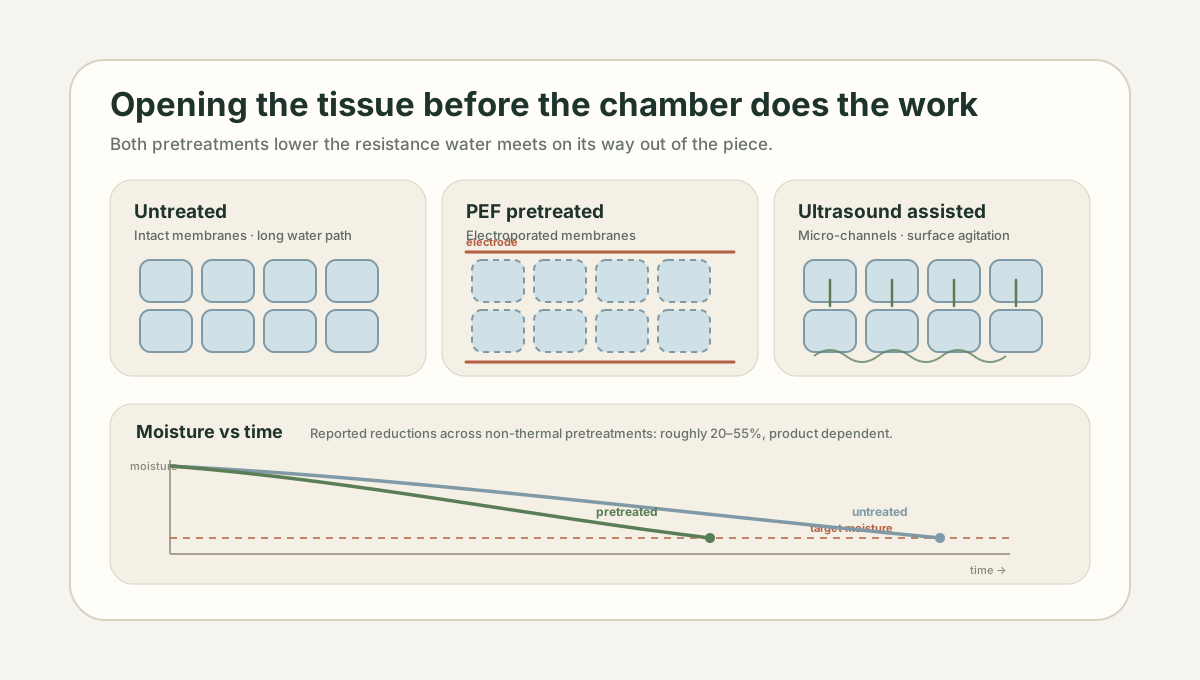
- Pulsed electric field (PEF) applies short high-voltage pulses that permeabilise cell membranes, giving water an easier path out of the tissue before drying begins.
- Ultrasound works mechanically, creating micro-channels and agitation that improve mass transfer, and it is often applied during drying rather than only before it.
- Published reductions in drying time are real but highly variable — roughly 20 to 55 percent across studies, with the best results usually from PEF and ultrasound combined rather than either alone.
- Buyers evaluating a supplier's speed claims should ask which fruit, which drying method, and against what untreated control the reduction was measured.
Almost every lever a processor pulls to shorten a freeze-drying cycle acts inside the chamber: shelf temperature, chamber pressure, tray depth, condenser capacity. Two techniques work from a different direction. Pulsed electric field treatment and ultrasound both change the fruit itself before or during drying, so that water has a shorter, easier path out.
The published results are interesting enough to take seriously and variable enough to treat carefully. This is a case where the mechanism is well understood, the average benefit is real, and the specific number a supplier quotes you deserves a follow-up question.
The direct answer
PEF and ultrasound shorten drying time by increasing the permeability of fruit tissue. PEF does it electrically, by disrupting cell membranes with short high-voltage pulses. Ultrasound does it mechanically, through cavitation and micro-channel formation that improve mass transfer. Both reduce the resistance water encounters on its way out of the piece.
Across the literature on non-thermal pretreatments, reported processing-time reductions cluster in the region of 20 to 55 percent, with better retention of heat-sensitive compounds than thermal pretreatments. The largest effects generally come from combining the two rather than using either alone.
How PEF actually works on fruit
Fruit is a collection of cells, each holding water behind a membrane. In an untreated piece, water leaving the tissue has to negotiate those intact membranes and cell walls. That resistance is part of why interior pieces finish last.
PEF places the fruit between electrodes and applies pulses lasting microseconds at high field strength. The pulses induce pores in the cell membranes — a phenomenon usually called electroporation or permeabilisation. The membranes stop being effective barriers. Water, and the soluble compounds dissolved in it, can move more freely.
Because the pulses are so short, the process is classed as non-thermal. That matters for fruit, where colour and volatile aroma compounds are exactly the things a long, warm process degrades.
Opening up cell membranes helps water leave. It does not change how much water was there to begin with, and it does not change the thermodynamics of sublimation. PEF reduces resistance in the tissue; it does not overcome a shortage of condenser capacity or a chamber pressure that is wrong for the load.
How ultrasound differs
Ultrasound acts mechanically rather than electrically. High-frequency sound waves passing through the product produce rapid compressions and expansions, plus cavitation effects, that create micro-channels in the tissue and agitate the boundary layer at the product surface.
The practical difference from PEF is timing. PEF is almost always a pretreatment applied before freezing. Ultrasound can be a pretreatment too, but it is also applied during drying — ultrasound-assisted atmospheric freeze-drying is an active line of research, where the energy input helps move vapour away from the product surface continuously rather than just preparing the tissue in advance.
Why the two together beat either alone
The most consistent finding across recent work is complementarity. Work on PEF pretreatment ahead of ultrasound-assisted atmospheric freeze-drying found that PEF significantly affected drying rate on its own, but the effect was largest when combined with ultrasound applied during drying. PEF lowers the internal resistance of the tissue; ultrasound helps move the released vapour away. Fixing one bottleneck exposes the other.
That same work also found the optimal PEF intensity was product-dependent — a moderate treatment worked best for one product, a more intense treatment for another. This is the detail that should temper any universal claim.
Reading a speed claim critically
If a supplier or an equipment vendor quotes a drying-time reduction, the number is meaningless without four qualifiers:
- Which fruit. Tissue structure, sugar content, and skin all change how much permeabilisation helps. A figure from squash or turnip does not transfer to mango.
- Which drying method. Much of the published work uses atmospheric freeze-drying, convective drying, or vacuum drying. Conventional shelf freeze-drying behaves differently.
- Against what control. A 50 percent reduction against a deliberately conservative baseline cycle is not the same as 50 percent against a well-optimised one.
- What happened to quality. Time saved is only useful if colour, texture, and breakage hold. Cell permeabilisation is not neutral for structure, and softened tissue can mean a more fragile finished piece.
Where this sits on a processor's priority list
For most fruit operations, PEF and ultrasound are not the first thing to fix. The cheaper wins are almost always upstream in the basics: consistent piece thickness, controlled bed depth, validated fill weight per tray, a condenser that is not the limiting factor, and an endpoint check that reflects the whole load rather than the top layer.
These pretreatments become worth evaluating when those variables are already under control and throughput is still the constraint — or when a specific quality outcome, like better retention of a heat-sensitive compound, justifies the capital on its own terms rather than on cycle time alone.
What buyers should take from this
You are unlikely to see "PEF pretreated" on a retail bag, and it would not mean much to a consumer if you did. But if you are sourcing at ingredient scale and a supplier is pitching unusually short cycles or unusually good pigment retention, it is fair to ask what the pretreatment step is, whether it is validated for your specific fruit and cut, and whether the finished-product spec — moisture, water activity, breakage, colour — is being held to the same limits as the untreated process it replaced.
A faster cycle that quietly widens the breakage spec is not a saving. It is a cost that moved.
Frequently Asked Questions
What is PEF pretreatment?
Pulsed electric field treatment passes short, high-voltage electrical pulses through fruit placed between electrodes. The pulses increase the permeability of cell membranes without heating the fruit meaningfully, which makes it easier for water to move out of the tissue during freezing and drying.
Does PEF cook or heat the fruit?
It is classed as a non-thermal technology. The pulses are extremely short, so the intent is to modify cell membranes rather than raise product temperature. That is the main reason it is studied for products where colour, aroma, and heat-sensitive compounds matter.
How much faster does the cycle actually get?
It depends heavily on the fruit and the drying method. Reviews of non-thermal pretreatments report processing-time reductions in the range of 20 to 55 percent, and individual studies have reported larger figures for specific combinations. A single headline percentage should not be treated as transferable to another fruit or another dryer.
Is ultrasound used before drying or during it?
Both. Ultrasound can be applied as a pretreatment bath before freezing, or applied during drying itself — ultrasound-assisted atmospheric freeze-drying is an active research area. Several studies find the effect of PEF is largest when it is paired with ultrasound applied during drying.
Should a small processor invest in this?
Rarely as a first move. Bed depth, tray loading, piece thickness, condenser capacity, and endpoint control usually offer larger and cheaper gains. PEF and ultrasound become interesting when the obvious cycle variables are already tightly controlled and throughput is still the binding constraint.
Primary sources & further reading
- Nonthermal Pretreatment Technologies to Improve Drying Efficiency and Quality in Fresh-Cut Fruits and Vegetables: A Comprehensive Review PubMed Central Referenced for the reported range of processing-time reduction and bioactive retention across non-thermal pretreatment methods.
- Pulsed electric field (PEF) pretreatment impact on the freezing and ultrasound-assisted atmospheric freeze-drying of butternut squash and yellow turnip Journal of Food Engineering Referenced for the finding that PEF effects on atmospheric freeze-drying were largest when combined with ultrasound-assisted drying, and that optimal PEF intensity varied by product.
- Evaluation of the quality and stability of freeze-dried fruits and vegetables pre-treated by pulsed electric fields (PEF) LWT — Food Science and Technology Referenced for PEF as a pretreatment applied ahead of freeze-drying and its effect on cell permeabilisation.
External links open in a new tab. We do not receive compensation from any organization listed; sources are referenced because they are primary, current, and publicly verifiable.