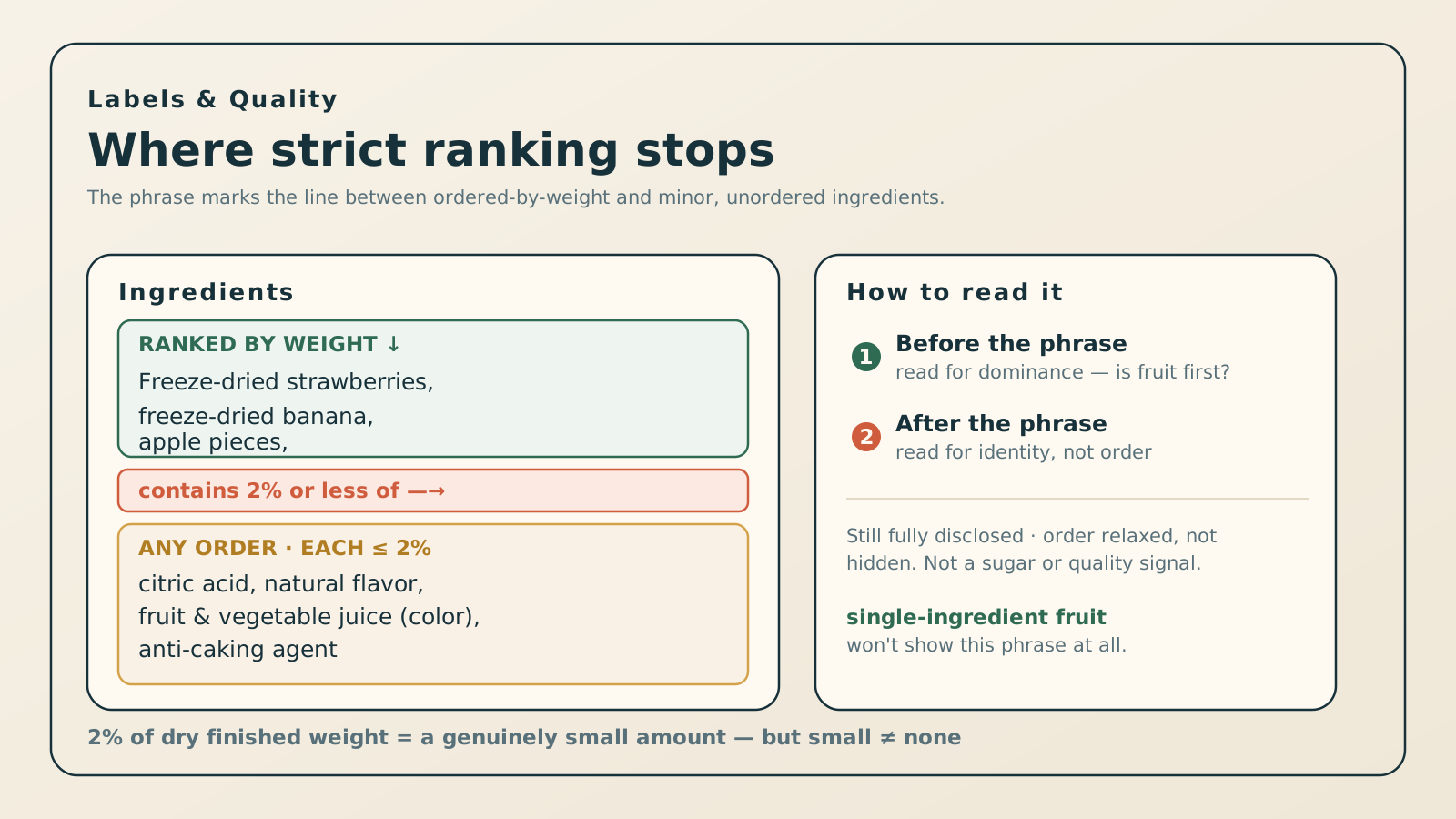
- Ingredients before the phrase are listed by weight, most to least; ingredients after it are all minor and may appear in any order, not by weight.
- The phrase is a normal, permitted labeling convention — it does not hide added sugar or signal low quality by itself, but it does mean you can't rank the trailing ingredients by amount.
- For freeze-dried fruit, the trailing group is where you'll often find anti-caking agents, acids, natural flavors, and colors — small by weight but worth reading.
- Judge the product on what the ingredients are and where the main fruit sits, not on the presence of the '2% or less' line.
Read enough freeze-dried fruit labels and you will hit a line that seems to interrupt the ingredient list: "contains 2% or less of," followed by a short tail of ingredients. It looks like legal boilerplate, and shoppers tend to either ignore it or assume it is hiding something.
It is neither. The phrase is a specific, permitted labeling convention, and once you know what it does, it actually makes the ingredient list easier to read — because it tells you exactly where you can stop trusting the order.
The direct answer
Ingredient lists are normally written in descending order by weight: the ingredient there is most of, listed first, down to the least. The "contains 2% or less of" statement marks a break in that rule. Everything before the phrase is still ranked by weight. Everything after it is a group of minor ingredients — each present at 2% or less of the finished product — that may be listed in any order the manufacturer chooses.
So the phrase is not a claim about sugar, quality, or processing. It is a signpost that says: strict ranking ends here; what follows is small and unordered.
Why the rule exists
Ranking ingredients precisely by weight is useful at the top of the list, where the difference between the first and second ingredient is meaningful. It becomes almost meaningless at the bottom, where several ingredients might each make up a fraction of a percent. Forcing an exact order on quantities that tiny would add complexity without adding information, and would require constant relabeling for trivial recipe adjustments.
The "2% or less" grouping solves that. It lets manufacturers disclose every minor ingredient honestly while acknowledging that their exact ranking among one another does not tell a shopper anything worth knowing. Crucially, the ingredients are still disclosed — nothing is omitted. Only their internal order is relaxed.
The single most common misreading is treating the phrase as a way to hide ingredients. It does the opposite: every ingredient after it is still fully listed by name. What you lose is only the ability to rank those trailing ingredients against each other by amount.
What usually sits after the phrase in freeze-dried fruit
For plain, single-ingredient freeze-dried fruit, you should not see this phrase at all — there is nothing minor to group. When it appears, you are looking at a blend or a formulated fruit crisp, and the trailing group is typically where the functional and finishing ingredients live:
- Acids such as citric or ascorbic acid, used for tartness or color protection.
- Anti-caking or free-flow agents, more common in powders and small pieces than in whole slices.
- Natural flavors, sometimes added to standardize aroma across seasons.
- Colors, whether fruit- or vegetable-derived or added color additives.
- Sweeteners or sugars when the product is a sweetened crisp rather than plain fruit.
None of these are inherently problematic, and all are small by weight — that is the whole point of the grouping. But because they are exactly the ingredients a careful buyer wants to see, the trailing section is worth reading closely rather than skipping.
How to read a list with the phrase
The phrase actually gives you a clean two-part reading method.
Before the phrase: read for dominance. These ingredients are ranked. The first should be the fruit (or fruits) you are buying. If a sugar or a coating ingredient appears before the phrase, it is present in a meaningful amount, and the product is more of a confection than plain fruit.
After the phrase: read for identity, not order. Do not try to rank these. Instead, ask what they are. Are they simple acids and fruit-derived colors, or a longer list of flavors and additives? Is there a sweetener here, and does its presence match how the front of the pack describes the product? The order tells you nothing; the names tell you everything.
Common misreadings to avoid
- "2% or less means it's basically not there." It means each listed ingredient is at or below 2% of the finished weight. That is small, but not zero — an allergen or an ingredient you avoid still counts even if it sits in this group.
- "The phrase signals a cheap product." It signals a formulated product with minor ingredients. Many high-quality blends use it. Quality is in the ingredients, not the convention.
- "Everything after the phrase is added sugar." The group is mixed. Sugar may or may not be present; you have to actually read the names.
- "Single-ingredient fruit should still show it." If the label is just the fruit, there is nothing minor to group. Seeing the phrase means it is not a single-ingredient product.
The practical takeaway
The "contains 2% or less of" statement is one of the more honest things on a label, once you know what it does. It draws a line: to the left, ingredients ranked by how much there is; to the right, minor ingredients disclosed by name but not by amount. For freeze-dried fruit, that right-hand group is where the acids, flavors, colors, and any sweeteners tend to appear — small in quantity, but often the difference between plain fruit and a formulated crisp.
Read the list in two parts, judge the trailing ingredients on what they are rather than where they fall, and the phrase stops looking like fine print and starts working as a guide.
Frequently Asked Questions
Does 'contains 2% or less of' mean there's hidden sugar?
No. It only means the ingredients that follow are each present at 2% or less of the product and may be listed in any order rather than strictly by weight. If sugar appears after the phrase, it is a minor ingredient by weight — but you should still read whether it is there at all, since 'minor' is not 'none.'
Why are some ingredients allowed out of order?
Standard labeling lists ingredients in descending order by weight. A recognized exception lets ingredients present at 2% or less be grouped after a statement like 'contains 2% or less of' and listed in any order, because ranking tiny quantities precisely adds little useful information.
Is the 2% measured on the fruit or the finished product?
It refers to the ingredient's share of the finished labeled product by weight. For freeze-dried fruit, the water is already gone, so 2% of the dry finished weight is a genuinely small amount of that ingredient.
Does the phrase mean the product is low quality?
Not by itself. Plenty of well-made blends use it simply because they contain small amounts of acids, anti-caking agents, or flavors. Quality is about what those minor ingredients are and whether the main fruit dominates the list, not about whether the phrase appears.
Should single-ingredient freeze-dried fruit have this phrase?
Usually not. A true single-ingredient product — just the fruit — has nothing minor to group, so there is no reason for the phrase. Seeing it tells you the product is a blend or formulated crisp rather than plain fruit.