- A quality agreement is the written contract that defines acceptance criteria, testing, documentation, and responsibilities, separate from the commercial terms on the purchase order.
- It should pin down specifications, certificates of analysis, allergen and origin handling, lot coding, sampling, and what happens when a lot fails, so disputes are resolved by reference rather than argument.
- The most valuable clauses are the unglamorous ones: change notification, retained samples, complaint handling, and clear hold-and-reject procedures.
- Buyers who operate without a quality agreement tend to discover the gaps only during a rejection, recall, or audit, when it is most expensive to negotiate them.
Most buyers focus their attention on the purchase order, and that is understandable. The purchase order is where price, quantity, and delivery date live, and those are the numbers that show up in a budget. But the purchase order says almost nothing about what happens when a lot of freeze-dried mango arrives slightly off-color, fails a moisture check, or turns out to have been made on a line that also runs tree nuts.
That is the job of a quality agreement. It is the document that defines what acceptable means and who is responsible when a delivery is not. When buyers and suppliers fall into disputes, it is usually because this document was never written, or was written so vaguely that both sides can read it in their own favor.
What a quality agreement is
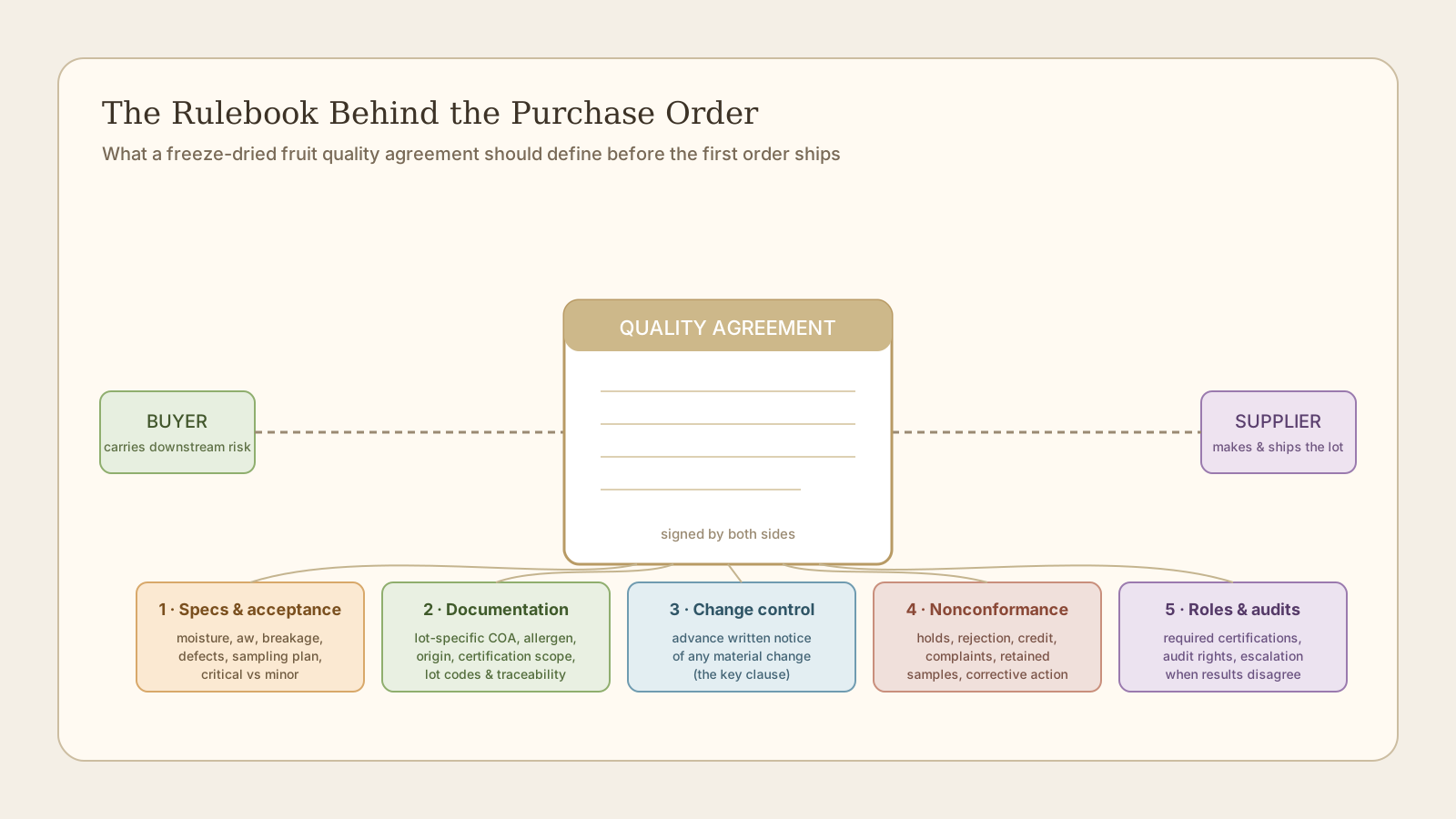
A quality agreement is a signed document, separate from the commercial contract, that sets the quality rules between a buyer and a supplier. The purchase order handles the deal. The specification sheet describes the product. The quality agreement governs the relationship: how conformance is judged, how it is documented, who does what, and what happens when something fails.
Think of it as the rulebook both sides agree to before play starts. Without it, every problem becomes a fresh negotiation conducted under pressure, usually after a bad lot has already arrived. With it, most problems are resolved by pointing to a clause both parties already signed.
Purchase orders change with every transaction. The quality framework should be stable across many orders. Keeping the quality agreement as its own document means the rules do not have to be renegotiated every time a new PO is cut, and it survives staff turnover on both sides.
Specifications and acceptance criteria
The core of the agreement is the specification it points to, and the acceptance criteria built around it. The spec should cover the attributes that actually matter for freeze-dried fruit: moisture and water activity limits, piece size and breakage tolerances, color and appearance, foreign material limits, microbiological limits, and any added ingredients or processing aids.
Just as important is what happens at the edges. The agreement should state the sampling plan used to judge a lot, the tolerance for minor deviations, and which attributes are critical, meaning a single failure rejects the lot, versus which are graded on a defect count. A spec without an agreed sampling and acceptance method is an argument waiting to happen, because both sides can test different pieces and reach different conclusions.
For how the underlying specs are read, the spec-sheet guides are a useful companion.
Documentation: the COA and beyond
The agreement should define what paperwork ships with each lot and what it must contain. The certificate of analysis is central: the agreement should state which results it must report, against which limits, and that it must reference the specific lot delivered rather than a generic typical analysis.
Beyond the COA, the agreement should address allergen statements, country-of-origin information, organic or other certification scope where relevant, and lot coding and traceability marks that let the buyer tie a case in their warehouse back to a production run. The point is that documentation is not an afterthought; it is the evidence the buyer relies on to release product and to defend themselves in their own audits.
Change control: the clause that prevents surprises
If a quality agreement does only one thing well, it should require advance written notice of material change. Suppliers change things: a sub-ingredient, an anti-caking carrier, a packaging film, a processing aid, even the origin of the raw fruit when a crop comes up short. Many of these changes are reasonable from the supplier's side and invisible until they cause a problem on the buyer's side.
A change-notification clause requires the supplier to tell the buyer, in advance and in writing, before making changes that affect the product, its ingredients, its origin, its allergen profile, or its processing. This single clause prevents a large share of real-world incidents, because it converts a silent change into a decision the buyer gets to make.
Nonconformance, holds, and complaints
The agreement should spell out the unglamorous mechanics of when something goes wrong. That includes how nonconforming lots are identified and segregated, who decides on disposition, whether the buyer can place a lot on hold and for how long, and how rejected product is handled and credited.
It should also define complaint handling: how the buyer reports a problem, how quickly the supplier must respond, what investigation is expected, and how corrective actions are documented and verified. Retained samples belong here too. Both sides keeping representative samples from each lot means a later dispute can be investigated against physical evidence rather than memory.
Responsibilities, audits, and certifications
Finally, the agreement should make responsibilities explicit. Which certifications the supplier must hold and maintain, what audit rights the buyer has, how incoming inspection interacts with the supplier's own testing, and what the escalation path is when results disagree. None of this replaces actually verifying the supplier; it defines the terms under which that verification happens.
A practical agreement scales to the relationship. A high-volume, sole-source ingredient deserves a detailed document. A small recurring order may need only a short one. The mistake is having none at all, because the absence of an agreement is itself a choice, and it is the supplier, not the buyer, who usually benefits from ambiguity.
Bottom line
A purchase order buys product. A quality agreement defines what acceptable product is and who owns the problem when a lot misses. For freeze-dried fruit, the document should pin down specifications and acceptance criteria, required documentation, change notification, nonconformance and complaint handling, retained samples, and the division of responsibility for testing and audits.
The clauses that prevent the most pain are the quiet ones, especially change control and retained samples. Put them in writing before the first order, and most quality disputes turn from arguments into lookups.
Frequently Asked Questions
How is a quality agreement different from a purchase order or a spec sheet?
A purchase order handles the commercial deal: product, quantity, price, delivery. A specification sheet defines the technical attributes of the product. A quality agreement is the layer that ties them together and adds the rules of engagement: how conformance is tested and documented, who is responsible for what, how changes are communicated, and what happens when something goes wrong. You can have a spec without a quality agreement, but then the spec has no agreed enforcement mechanism.
Do small buyers really need one, or is it just for large companies?
Even a small buyer benefits, because the agreement is what turns 'the last batch was different' into a defined, resolvable claim. It does not have to be long. A short, clear document that both sides sign is far more useful than a detailed one that exists only in the buyer's drawer. The size of the agreement should match the risk and volume, not the size of the company.
Who should write the quality agreement, the buyer or the supplier?
Either can draft it, but the buyer usually drives it because the buyer carries the downstream risk to their own customers. Many established suppliers have a template they will offer. The important thing is that both parties actually read, negotiate, and sign it, rather than one side imposing a document the other never engages with.
What is the single most overlooked clause?
Change notification. A supplier can quietly change a sub-ingredient, a processing aid, a packaging film, or even the country of origin of the raw fruit, and a buyer may not notice until a customer complains or a label becomes wrong. A clause requiring advance written notice of any material change prevents a large share of real-world problems.
Does a quality agreement replace auditing the supplier?
No. The agreement sets the rules; auditing and incoming inspection verify that the rules are being followed. They work together. A signed agreement with no verification is a promise; verification with no agreement gives you nothing to hold the supplier to. Buyers need both, scaled to the risk.
Primary sources & further reading
- Hazard Analysis and Risk-Based Preventive Controls for Human Food (Preventive Controls rule) U.S. Food & Drug Administration Referenced for the concept of supply-chain programs and supplier verification responsibilities that a quality agreement helps document.
- Foreign Supplier Verification Programs (FSVP) U.S. Food & Drug Administration Referenced for importer verification obligations that a quality agreement can help satisfy and document for imported freeze-dried fruit.
- GFSI Benchmarking Requirements Global Food Safety Initiative Referenced for the role of recognized certification schemes that a quality agreement typically requires a supplier to hold and maintain.
External links open in a new tab. We do not receive compensation from any organization listed; sources are referenced because they are primary, current, and publicly verifiable.