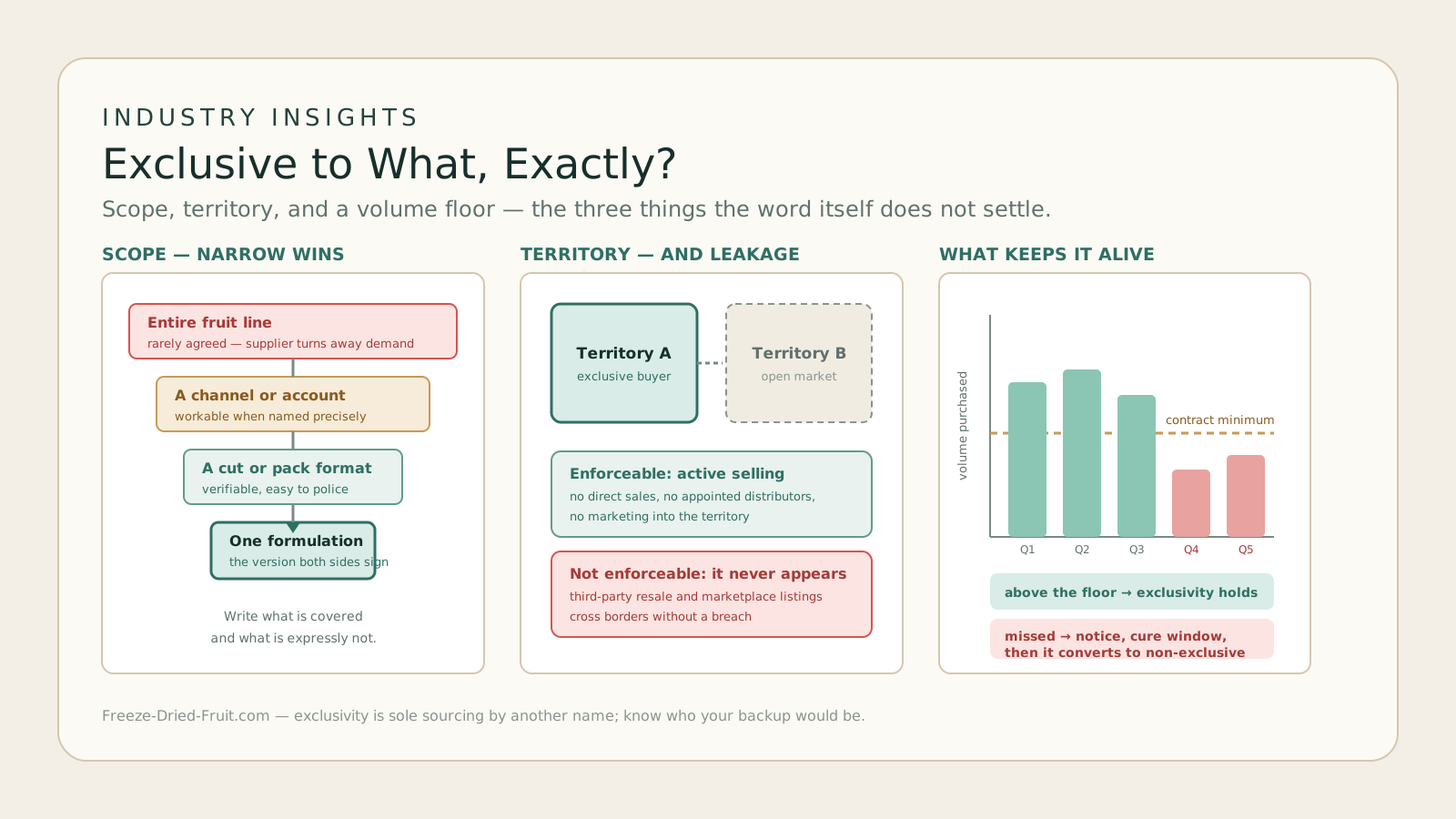
- Exclusivity is not one thing: it can cover a formulation, a cut or pack format, a customer channel, or a geography, and the narrower the definition the more likely both parties can actually live with it.
- Almost every workable exclusivity clause is conditional — it survives only while the buyer hits minimum volumes and the supplier hits quality and delivery commitments — so the real negotiation is over the trigger levels and the cure period, not the word itself.
- Exclusivity has a price on both sides: a buyer who locks a supplier out of other customers is asking that supplier to carry idle capacity risk, and a buyer who accepts sole sourcing gives up leverage and a second qualified source.
Exclusivity is one of the few terms in a supply agreement that both sides routinely ask for and neither side reliably defines. A snack brand asks a freeze-dried fruit supplier for exclusivity on a blend it helped develop. A supplier asks a distributor for exclusivity in a region. Both requests sound simple. Both contain at least four separate decisions that the word itself does not resolve.
The direct answer
An exclusivity clause in freeze-dried fruit supply defines four things: what is exclusive, where it applies, for how long, and what keeps it alive. Scope can be a formulation, a cut or pack format, a channel, or a geography. Territory sets the geographic boundary. Term sets the duration. And a volume threshold — the minimum the buyer must actually purchase — is what converts an open-ended obligation into a conditional one. Agreements that name all four tend to work. Agreements that use the word without them tend to end in a dispute about what was meant.
What is actually exclusive
The most common failure is a mismatch in scope. The buyer means "nobody else gets this specific blend we developed together." The supplier heard "we cannot sell freeze-dried strawberry to anyone else." Those are wildly different commitments, and the difference is worth an entire afternoon of drafting.
Useful scopes tend to be narrow and concrete:
- a named formulation or blend ratio developed for the buyer
- a specific cut, dice size, or piece specification
- a particular pack format or private-label presentation
- a named end customer or retail account
- a defined channel, such as club or foodservice
Broad scopes — an entire fruit, an entire product line — are harder to agree and harder to keep. A supplier who makes freeze-dried mango for a dozen customers is not going to stop; a supplier who developed a specific mango-and-passion-fruit ratio with a particular piece spec can reasonably agree not to sell that exact item elsewhere.
Why suppliers price exclusivity
Freeze-drying is capital-intensive, and the economics depend heavily on keeping dryers full. An exclusivity commitment asks the supplier to decline other demand for a defined product or region. If the exclusive buyer's volume shows up, that is fine. If it does not, the supplier has carried idle capacity risk on the buyer's forecast.
That is why exclusivity is rarely free. Suppliers typically want one or more of the following in exchange: a firm minimum volume commitment, a take-or-pay element covering some portion of that minimum, a modest price premium, a longer term, or a development fee if the supplier invested in trials and pilot runs. A buyer who expects exclusivity as a courtesy is usually negotiating against the supplier's cost structure without realizing it.
Whatever else it does, an exclusivity arrangement usually means one qualified source for that item. That is a supply-continuity exposure: a plant issue, an audit finding, a crop failure, or a capacity conflict now has no fallback. Buyers who accept exclusivity should still know who their backup would be and what qualification would take, even if they are not currently buying from them.
Volume thresholds and cure periods
Almost every workable exclusivity clause is conditional. The condition is usually a volume floor: the buyer must purchase at least a stated quantity within a stated period, or exclusivity converts to ordinary non-exclusive supply.
Two details matter more than the number itself.
The first is how the threshold is measured. Purchase orders placed, product shipped, or product invoiced are not the same, and a buyer whose forecast slips into the next quarter can miss a threshold on one measure while hitting it on another.
The second is what happens on a miss. Immediate loss of exclusivity is harsh and tends to produce fights over one soft quarter. A notice-and-cure structure — the supplier notifies, the buyer has a defined window to make up the shortfall, exclusivity lapses only if it is not cured — is more durable.
The same logic runs in the other direction. If the supplier misses quality or delivery commitments, the buyer typically wants the right to source that item elsewhere for a period without terminating the whole relationship. An exclusivity clause with obligations flowing only one way is a clause one side will eventually try to escape.
Territory clauses and the leakage problem
Territorial restrictions look tidy on a map and behave messily in practice. Product sold legitimately in one market gets resold, listed on cross-border marketplaces, or bought by a trader and moved. A supplier can honor a territorial commitment completely and still see its product appear where the agreement said it would not.
Practical territory language handles this by separating what a party actively does from what happens downstream. Committing not to sell into a territory, not to appoint distributors there, and not to market there is enforceable and verifiable. Committing that the product will never appear there is not.
Territorial restrictions can also touch competition and distribution law, which varies by jurisdiction and is well outside what a purchasing team should decide alone. This is one of the places in a supply agreement where qualified legal review earns its cost.
The end state
A surprising number of exclusivity clauses say nothing about what happens when the relationship ends. That leaves the most valuable questions open at exactly the moment goodwill is lowest.
Worth settling in advance: who owns a jointly developed formulation or specification; whether the supplier may sell that item to others after termination, and after how long; whether the buyer may take the spec to another plant; and whether any exclusivity obligations survive the term at all.
Is it worth asking for
The honest test is whether the thing being protected is distinctive. Exclusivity on a jointly developed blend, a custom cut, or a specification that took real trial work is often worth committing volume for, because a competitor copying it quickly would cost the buyer something real. Exclusivity on a standard item that a dozen plants can produce buys very little and costs flexibility, a backup source, and pricing leverage.
The clause is a tool, not a trophy. Define the scope narrowly, tie it to a volume floor you can actually hit, make the obligations run both directions, and write down what happens at the end. Most exclusivity disputes trace back to skipping one of those four.
Frequently Asked Questions
What is actually being made exclusive in a freeze-dried fruit agreement?
That is the first question to settle and the one most often left vague. Exclusivity can attach to a specific developed formulation or blend, to a particular cut or pack format, to a named end customer or retail account, to a sales channel, or to a geography. A buyer asking for exclusivity usually pictures the narrow version — nobody else gets our blend — while a supplier hearing the word often pictures the broad version, in which an entire fruit line is off-limits to other customers. Those two readings have very different commercial consequences, and the gap between them is where disputes start. Writing the scope in concrete terms, listing what is covered and what is expressly not, resolves most of the risk before it becomes an argument.
Why do suppliers resist exclusivity even when it means guaranteed business?
Because exclusivity transfers risk without necessarily transferring reward. A supplier who agrees not to sell a product or serve a region is agreeing to turn away demand, which means capacity that would otherwise be filled may sit idle if the exclusive buyer's forecast does not materialize. Freeze-drying is capital-intensive and capacity utilization drives cost, so unused dryer time is expensive. Suppliers will generally accept exclusivity when it is paired with something that compensates for that risk — a firm minimum volume commitment, a price premium, a take-or-pay structure, or a development fee — and will resist it when it is presented as a free concession.
What is a volume threshold and why is it in almost every exclusivity clause?
A volume threshold is the minimum quantity the buyer must actually purchase within a defined period for exclusivity to continue. It exists because exclusivity without a floor is an open-ended obligation for the supplier and a costless option for the buyer. A typical structure states an annual or quarterly minimum, defines how it is measured, and states what happens when it is missed: usually exclusivity converts to non-exclusive supply, either automatically or after notice. Buyers should negotiate the threshold against a realistic forecast rather than an optimistic one, because a floor set at ambitious volumes tends to lapse in the first soft quarter.
How do territory clauses differ from product exclusivity?
A territory clause restricts where a product can be sold rather than what is being sold. It might prevent the supplier from selling the same item into a defined country or region, or prevent the buyer from reselling outside an agreed market. Territory language deserves careful drafting because modern distribution leaks: a product sold legitimately in one market can end up listed on a global marketplace and appear to violate a territorial restriction that neither party breached directly. Practical agreements address this by distinguishing between active selling into a territory and passive or third-party resale, and by specifying what enforcement, if any, is expected. Territorial restrictions can also carry competition-law implications in some jurisdictions, which is a point for qualified legal counsel rather than a purchasing decision.
What should a buyer give up in exchange for exclusivity, and is it worth it?
In practice a buyer pays for exclusivity with commitment: a volume floor, a longer term, a take-or-pay element, or a higher unit price. The question is whether what is being protected justifies that commitment. Protecting a genuinely distinctive developed product — a specific blend, a custom cut, a jointly developed spec — often justifies it. Protecting a commodity item that several plants can make does not, because exclusivity on a widely available product buys very little while costing real flexibility. It is also worth remembering that exclusivity is a form of sole sourcing, which means no qualified backup, and that is a supply-continuity exposure a buyer must consciously accept.
What happens to exclusivity when the agreement ends or is breached?
The agreement should say, and many do not. Key questions include whether exclusivity survives termination for any period, who owns a jointly developed formulation or spec, whether the supplier may sell that formulation to others after the term, and whether the buyer may take the spec to another plant. There should also be a cure mechanism: if the supplier misses quality or delivery commitments, the buyer typically wants the right to source elsewhere without losing the arrangement entirely, and if the buyer misses volume, the supplier typically wants exclusivity to lapse after notice rather than immediately. Clear end-state language prevents the common situation where both parties believe they are free and only one of them is.