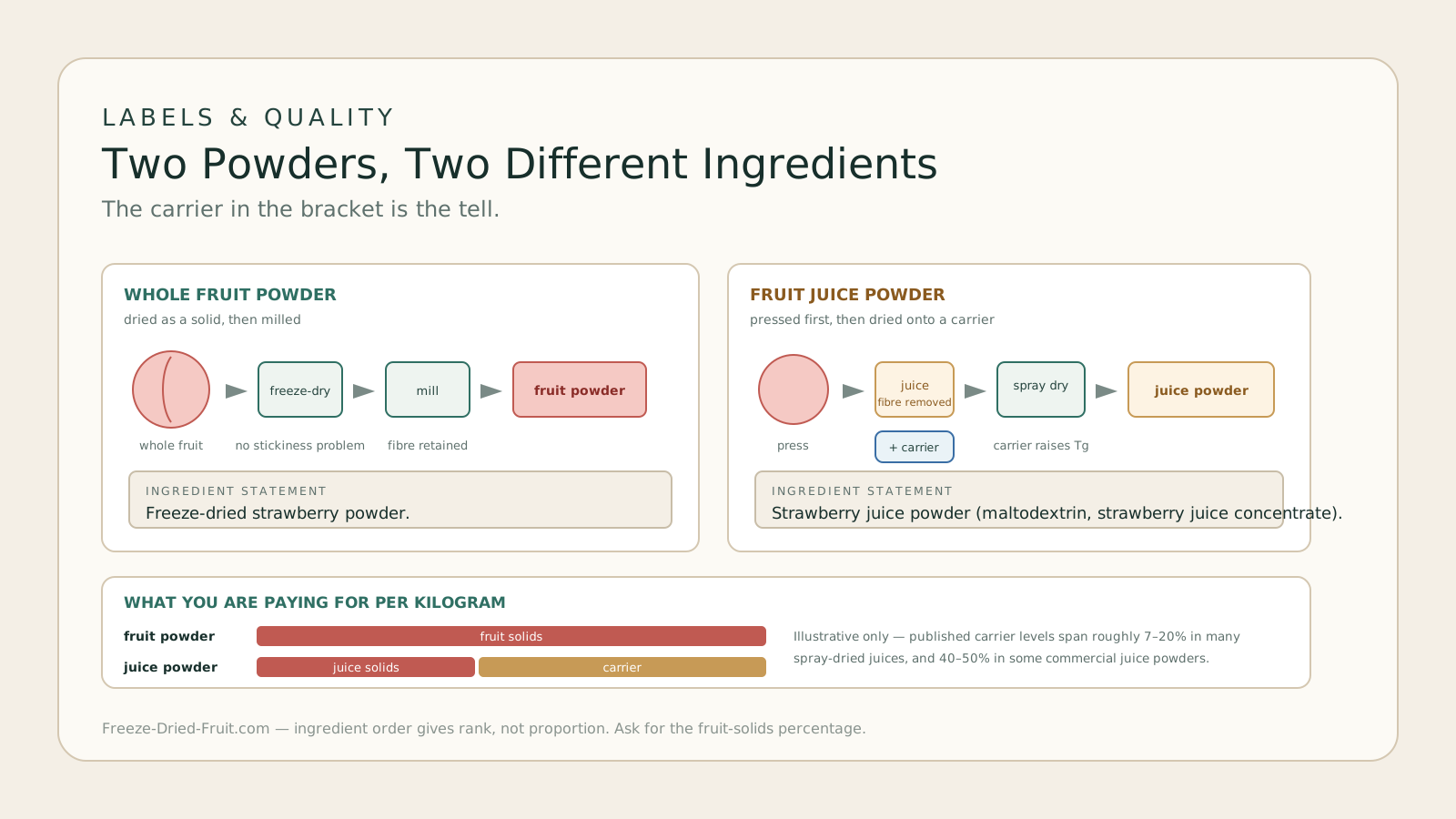
- Whole fruit powder is the whole edible fruit dried and milled: pulp, fibre, skin where retained. Juice powder is the liquid fraction only, usually dried onto a carrier because juice solids will not dry into a free-flowing powder on their own.
- The carrier is the tell. Maltodextrin, gum arabic or modified starch appearing next to the fruit name means you are looking at a juice or extract powder, not milled fruit — and carrier levels commonly run from around 7 to 20 percent, and considerably higher in some juice powders.
- Freeze-dried whole fruit powder generally carries no carrier at all, because the fruit is dried as a solid first and milled afterwards, avoiding the stickiness problem entirely.
- Ask for the fruit-solids percentage in writing rather than reading it off the ingredient order. Ingredient order tells you rank, not proportion, unless a quantitative declaration is required.
Two ingredient statements, from two products on the same shelf.
Ingredients: freeze-dried strawberry powder.
Ingredients: strawberry juice powder (maltodextrin, strawberry juice concentrate).
Both will be described in marketing copy as "real strawberry." They are not the same ingredient, they do not cost the same, and they do not behave the same in a formula.
The direct answer
The distinction is what part of the fruit went in, and what had to be added to get it out as a powder.
Fruit powder starts from the fruit as a solid — pulp, fibre, and skin where it has been retained. The fruit is dried first, then milled. Because the drying happens to a solid rather than a liquid, there is no stickiness problem to engineer around, and a well-made freeze-dried fruit powder can be a genuine single-ingredient product with nothing added.
Fruit juice powder starts from pressed juice. The insoluble fibre has already been separated out at the press. What remains is a solution of sugars, acids, soluble pigments and aroma compounds. That solution is then dried — usually by spray drying — and it almost always needs help.
The help is a carrier.
Why juice cannot be dried alone
Fruit juice solids are dominated by low-molecular-weight sugars — glucose, fructose, sucrose — and organic acids such as citric and malic. These have low glass transition temperatures, which is the technical way of saying they turn rubbery and sticky at modest temperatures and modest moisture levels.
Spray-dry that on its own and it does not form a powder. It forms a syrupy film on the dryer wall, recovery collapses, and whatever does come out is hygroscopic enough to cake in the drum. This is a well-documented and unglamorous engineering problem: stickiness, moisture absorption and lumping are the standard failure modes for fruit juice drying.
The fix is to add a high-molecular-weight carrier that raises the glass transition temperature of the mixture as a whole. Maltodextrin — a starch hydrolysis product — is the default because it is cheap, effective and largely flavourless. Gum arabic and modified starches are used for the same purpose, sometimes with better encapsulation of aroma and pigment.
The carrier does real work beyond flow. It contributes volume and physical stability, improves solubility and dispersibility, and encapsulates the sensitive aromatics, polyphenols and colour compounds that are the reason the fruit was worth using. It is not filler in the pejorative sense. It is also not fruit.
Published ranges vary a lot with fruit and process. Reviews of juice drying commonly describe carrier additions around 7 to 20 percent of the formulation, while some commercial fruit juice powder preparations are described as using 40 to 50 percent maltodextrin to obtain a free-flowing product. That spread is too wide to guess. Get the number on a specification sheet.
Reading the label
A few patterns do most of the work.
A carrier name next to a fruit name. Maltodextrin, dextrin, tapioca dextrin, gum arabic, acacia gum, modified food starch, silicon dioxide. Any of these in the immediate vicinity of the fruit tells you the powder was engineered to flow, which points to a liquid-origin process.
Parenthetical sub-ingredients. "Strawberry juice powder (maltodextrin, strawberry juice concentrate)" is doing exactly what a parenthetical is supposed to do: disclosing the components of a compound ingredient. The order inside the bracket is by weight, so maltodextrin appearing first means there is more carrier than juice solids in that ingredient.
The word "juice." It is easy to skim past, but "apple juice powder" and "apple powder" are different declarations. The first has had the fibre removed by definition.
A single-ingredient statement. "Freeze-dried raspberry powder" with nothing else listed is the strongest signal that you are looking at milled whole fruit. Note that anti-caking agents can be permitted at low levels in some markets and may still appear; a genuinely bare statement is bare.
"Fruit powder blend." This is where the ambiguity lives. A blend can be mostly carrier with a functional dose of fruit, and the name alone will not tell you.
What the label will not tell you, in most jurisdictions, is proportion. Ingredient order gives rank, not percentage. Unless a quantitative ingredient declaration applies — as it does in some markets when the fruit is named or pictured prominently — you are reading a sequence, not a recipe.
What actually differs in the finished powder
Fibre. Whole fruit powder retains the insoluble fibre that the press removed from juice powder. This changes both nutrition panel and mouthfeel, and it is why fruit powder tends to sediment in a clear beverage while juice powder dissolves cleanly.
Colour. Whole fruit powder carries pigment bound in cell material as well as in solution, which usually reads as a deeper, more opaque colour. Juice powder colour is diluted by the carrier, though the carrier also protects the pigment during drying and storage.
Flavour. Juice powder tends to be brighter and more acidic — it is the soluble fraction, after all. Whole fruit powder carries more of the rounded, pulpy character and often more perceived astringency where skin is included.
Sugar concentration. Juice powder concentrates the fruit's sugars while removing its fibre. Whether that matters depends on the application and how the nutrition panel is going to read.
Price per kilogram of actual fruit. This is the one buyers get wrong most often. A cheaper juice powder can be more expensive per gram of fruit solids once the carrier is subtracted. Comparing headline prices between a whole fruit powder and a carrier-added juice powder is comparing two different things.
The questions that settle it
Rather than inferring from the label, ask the supplier directly and get answers on the specification, not in an email:
- Is this powder made from whole fruit or from juice, and by which drying method?
- What percentage of the powder is fruit solids, and what percentage is carrier?
- Which carrier, and at what declared level?
- What is the fresh-fruit-to-powder ratio?
- Is there dietary fibre in the nutritional analysis, and how much?
- What is the water activity and the recommended storage condition? Carrier-added powders and carrier-free powders behave very differently in a humid packing room.
If you buy a compound ingredient, its components generally have to be disclosed. Choosing a juice powder because it is cheaper and then writing "strawberry powder" on your own pack is not a shortcut you can take. Whatever the carrier is, it is in your product and belongs in your statement.
Neither is the villain
It would be easy to read this as an argument that juice powder is the inferior product. It is not. For a clear beverage, a fast-dissolving stick pack or a coating where sediment is a defect, juice powder is often the correct functional choice and the carrier is doing something useful. Freeze-dried whole fruit powder wins where fibre, colour depth and a clean single-ingredient statement matter — and it wins on the label story precisely because the process never needed a carrier in the first place.
The failure mode is not choosing one. It is paying for one and receiving the other.
Frequently Asked Questions
What is the actual difference between fruit powder and fruit juice powder?
Fruit powder is made from the fruit as a solid — pulp, fibre and often skin — dried and then milled. Juice powder starts from pressed juice, which means the insoluble fibre has already been removed, and it is then dried, usually with an added carrier. The two differ in fibre, colour intensity, flavour profile, sugar concentration and price per kilogram of fruit.
Why does juice powder need maltodextrin?
Fruit juice is dominated by low-molecular-weight sugars and organic acids with a low glass transition temperature. Dried on their own they form a sticky, hygroscopic mass that sticks to dryer walls rather than falling as a powder. A carrier raises the glass transition temperature of the mixture, improves recovery and reduces caking.
How much carrier is typical?
It varies widely by fruit and process. Published work on spray-dried juices commonly describes carrier additions in the range of roughly 7 to 20 percent, while some commercial juice powders are described as carrying 40 to 50 percent maltodextrin. Because the range is that wide, the only reliable answer is the one your supplier puts in writing.
Does a carrier-free juice powder exist?
Yes, some suppliers offer carrier-free or self-carrying juice powders produced by process routes that avoid added maltodextrin. They tend to be more expensive and more hygroscopic in handling. Verify the claim against a specification rather than a marketing page.
Which one should I buy?
It depends on what you need the powder to do. If you want fibre, natural colour body and a whole-fruit label story, milled fruit powder is the closer match. If you need clean solubility in a beverage with no sediment, juice powder is often the more functional choice. Neither is inherently better; they are different ingredients.
Primary sources & further reading
- Carrier-Free vs. Carrier-Added Juice Powders: What 'Maltodextrin-Free' Really Means for Your Label Liquadry Referenced for the labelling contrast between carrier-added juice powders and single-ingredient whole fruit powders.
- Influence of carrier agents on nutritional, chemical, and antioxidant profiles of fruit juices during drying processes: a comprehensive review Discover Food (Springer) Referenced for typical carrier addition ranges and the role of maltodextrin, gum arabic and modified starch in juice drying.
- Effect of Carrier Agents on the Physicochemical and Technofunctional Properties and Antioxidant Capacity of Freeze-Dried Pomegranate Juice Powder PMC / Foods Referenced for how carrier type and level change the physical and functional properties of a freeze-dried juice powder.
- A fruit juice powder mix and process for making the same Google Patents Referenced for the description of maltodextrin being added at high proportions as a carrier to obtain a free-flowing fruit juice powder.
External links open in a new tab. We do not receive compensation from any organization listed; sources are referenced because they are primary, current, and publicly verifiable.