- Film minimums are usually set by press economics, not by your demand. Rotogravure runs commonly start around 10,000 pouches per SKU and rise for simpler film structures; digital print typically starts lower.
- Gravure adds one engraved cylinder per colour as a one-off tooling charge, often in the low hundreds of dollars each, so an eight-colour design carries a four-figure setup before a single pouch exists.
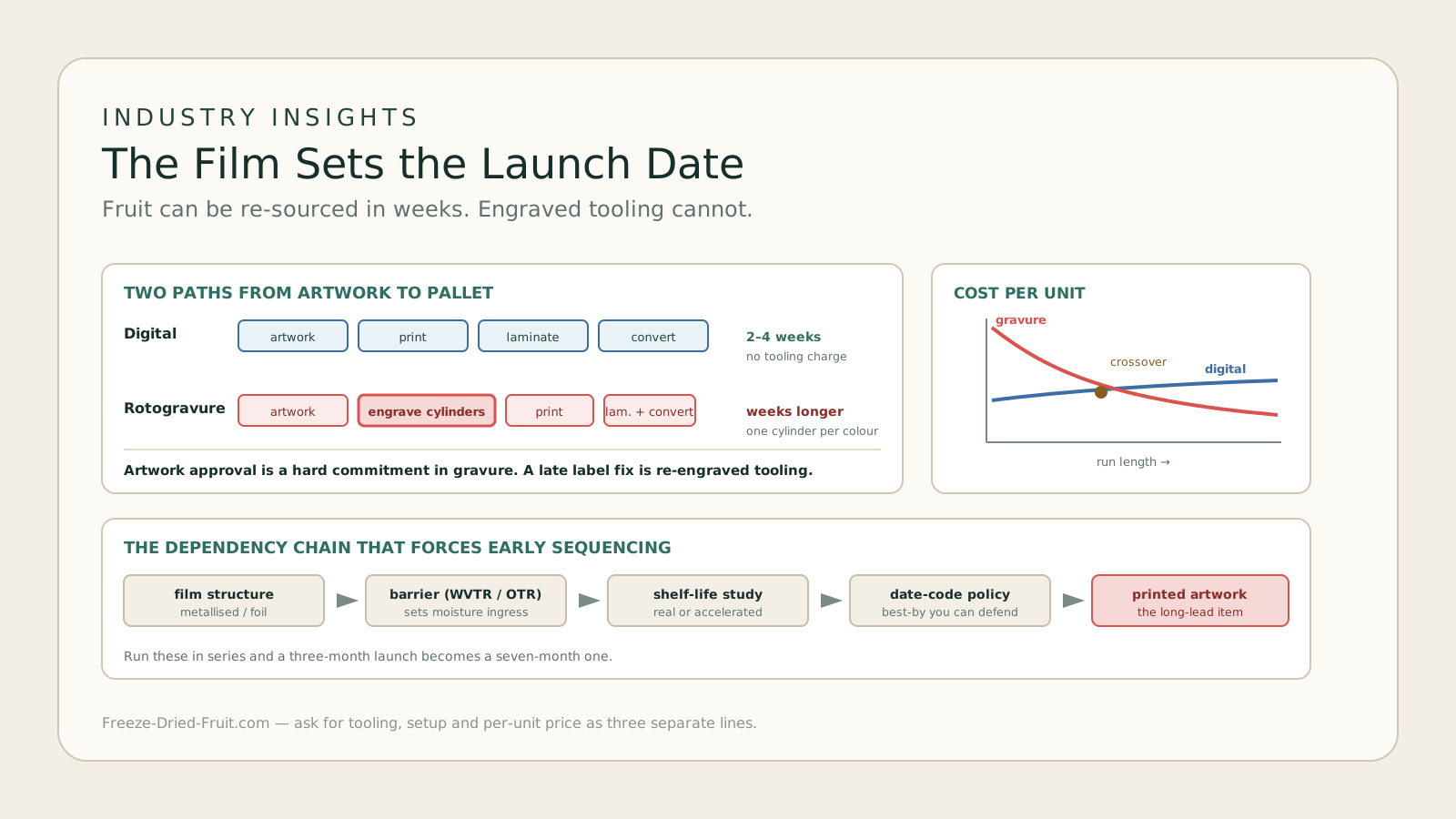
- Cylinder engraving is the lead-time item. Digital and short-run flexo skip it; gravure does not, and artwork changes after engraving mean paying for tooling twice.
- Sequence the packaging decision ahead of the fruit decision. Film structure has to be fixed before shelf-life testing is meaningful, and shelf-life testing has to finish before you can print a best-by policy.
A snack founder finishes supplier qualification on a freeze-dried mango. Samples are approved, the price is agreed, the co-packer has a slot. Then the packaging quote arrives: 10,000 pouches minimum, six colours, cylinder charges before production, eight weeks from approved artwork.
The fruit programme was never the bottleneck. The film was.
The direct answer
Printed flexible packaging is manufactured on a press that has to be set up before it can produce anything saleable. Threading the web, mounting tooling, achieving colour registration and matching a proof all consume material and time that do not vary with run length. A converter recovers that fixed cost by imposing a minimum order quantity, and the minimum moves with the print method.
Indicative figures from converters put laminate pouch formats — stand-up, flat-bottom, spouted — around 6,000 units for digital print and around 10,000 for rotogravure, with simpler film formats such as mailer and poly bags starting higher still, near 10,000 digital and 20,000 gravure. Treat these as the shape of the market rather than a quote; they move with region, substrate, size and how badly the converter wants the account.
For a freeze-dried fruit brand, 10,000 pouches is often a year or more of a single SKU's demand. That is the collision.
Where the money actually sits
Three cost buckets behave very differently and are worth separating in any quote comparison.
Tooling. Rotogravure engraves one copper cylinder per colour. Published ranges put this in the region of $120 to $200 per cylinder, so an eight-colour design lands somewhere near $1,000 to $1,600 in tooling before a single metre of film is printed. This is one-off, it belongs to your artwork, and it is the single easiest number to reduce: every colour you remove from the design removes a cylinder. A four-colour design that reads well on shelf is materially cheaper to tool than a six-colour design that reads slightly better.
Digital printing carries no cylinder charge at all. That is its structural advantage at low volume and the reason first runs so often go digital even when the long-term plan is gravure.
Setup waste. The film consumed getting to acceptable registration and colour is charged, either explicitly or inside the unit price. It is roughly constant per run, which means it is invisible at 100,000 units and painful at 6,000.
Per-unit print and material. Once running, gravure is fast, consistent and cheap per metre, and the cylinders themselves are durable — capable of very high linear-metre volumes before quality degrades. The commonly cited crossover, where gravure's lower running cost outweighs its tooling, sits somewhere in the couple-of-hundred-thousand linear metres range for typical flexible SKUs, though the real crossover depends heavily on colour count, substrate and how often you reprint.
Two converters can quote the same 10,000-unit minimum and produce wildly different total first-year costs once tooling, setup and per-unit price are combined. Ask for the quote broken into those three lines. A converter unwilling to break it out is telling you something.
Lead time is mostly one item
The long pole in gravure is cylinder engraving. It is a specialised operation, frequently subcontracted offsite, and it sits between your artwork approval and any press time. Digital printing skips it entirely, which is why digital jobs are commonly described as moving from approved artwork to finished packaging in days rather than weeks, with total turnarounds in the two-to-four-week band.
Three practical consequences follow.
First, artwork approval is a hard commitment in gravure, not a soft one. A regulatory correction discovered after engraving — a missed allergen statement, a corrected net weight, a country-of-origin change — means re-engraving the affected cylinders and paying for them again. Get the label reviewed before tooling, not before printing.
Second, lamination and pouch conversion sit downstream of printing and add their own queue. The quoted "eight weeks" is usually engraving plus print plus lamination plus conversion plus transit, and each of those has its own slippage.
Third, film structure changes are not artwork changes. Moving from a metallised polyester structure to a foil structure because a shelf-life test came back badly is a new material qualification, potentially a new supplier, and a restart of the whole clock.
Why this bites freeze-dried fruit harder than most categories
Several category-specific factors compound the general problem.
Barrier requirements are not negotiable. Freeze-dried fruit is hygroscopic and oxygen-sensitive. The film choice is driven by water-vapour and oxygen transmission targets, which pushes toward higher-barrier structures — metallised or foil-containing laminates — rather than the cheaper transparent films a converter might default to. That narrows the substrate menu and can raise the minimum.
Low density inflates pouch size. A freeze-dried product occupies far more volume per gram than its fresh or conventionally dried equivalent. The pouch that holds 30 g of freeze-dried strawberry is physically large, which means more film per unit and a slot-fill conversation with retailers that can force a format change mid-project.
SKU proliferation multiplies minimums. A five-fruit line is not one 10,000-unit order; it is five of them. This is where many launches quietly break. The usual mitigation is a shared "base" film printed once with a common design, differentiated by a variant panel or an applied label — but that only works if the design was built for it from the start.
Shelf-life data depends on the film. You cannot run a defensible accelerated shelf-life study until you know the structure you are shipping in, and you cannot print a best-by date policy until that study reports. The dependency chain runs packaging → barrier → shelf-life test → date code → printed artwork, and the artwork is the thing with the eight-week tooling lead time. Run it in the wrong order and you wait twice.
How small programmes actually get around it
Stock pouches with applied labels. Zero tooling, minimums in the hundreds, and a realistic path for a first thousand units. Verify the barrier specification of the stock pouch rather than assuming it — "foil-look" is not foil. Expect labelling labour to become the constraint above a few thousand units.
Digital print for launch, gravure at reorder. Accept a higher unit cost for run one in exchange for no tooling and a short clock. Design the artwork so it can be moved to gravure later without a redraw, and confirm the converter can colour-match across methods before you rely on it.
Consolidate SKUs behind one film. Print a single generic barrier pouch across the range and vary a small label or sticker. Less premium on shelf, dramatically better cash position.
Buy the film once, convert in stages. Some converters will print and laminate a full roll and convert it into finished pouches in tranches, which spreads the cash outlay without repeating setup. Ask specifically; it is rarely offered unprompted.
Reduce colour count. The most underrated lever. Every colour removed is a cylinder not engraved and a registration step not tuned.
The sequencing rule
If there is one operational conclusion, it is that packaging should be started earlier than instinct suggests — usually before the fruit supplier is finally selected. The fruit can be re-sourced in weeks. Printed barrier film with engraved tooling cannot.
Frequently Asked Questions
Why is the pouch minimum higher than the fruit minimum?
Because the economics sit in different places. A freeze-dryer can run a partial batch at a yield penalty. A printing press has to be threaded, registered and colour-matched before the first saleable metre comes off, and that setup waste is fixed regardless of run length. Converters recover it by setting a minimum.
What is a cylinder charge?
In rotogravure printing, each colour in the design needs its own engraved copper cylinder. That engraving is one-off tooling, commonly quoted in the low hundreds of dollars per cylinder, and it belongs to your artwork. Change the artwork and the affected cylinders are re-engraved at cost.
Is digital printing always better for a small launch?
Not always, but often for a first run. Digital removes tooling cost and the engraving lead time, and usually carries a lower minimum. The trade is a higher per-unit price that stops being competitive as volume grows, and a narrower set of available substrates at some converters.
Can I use stock pouches instead?
Yes, and for a pilot it is frequently the right call. Stock foil or metallised pouches with a label avoid tooling entirely. The limits are barrier performance you did not specify, a shelf presence that reads as small-batch, and a labelling workflow that does not scale past a few thousand units.
How far ahead should packaging be started?
Before the fruit spec is locked, in practice. The film structure determines your barrier, the barrier determines your shelf-life test conditions, and the shelf-life result determines the date code you are allowed to print. Running these in series is what turns a three-month launch into a seven-month one.
Primary sources & further reading
- Minimum Order Quantities for Custom Packaging: What They Are and How to Plan for Them Grounded Packaging Referenced for indicative minimum order quantities by print method and pouch format, including the gap between digital and rotogravure minimums.
- Rotogravure vs Digital Printing for Flexible Packaging: What's Right for Your Brand? Grounded Packaging Referenced for per-cylinder tooling cost ranges, colour-count effects, and the absence of cylinder lead time in digital printing.
- Printing machines: Rotogravure for Flexible Packaging Shinko Machinery Referenced for cylinder durability in linear metres and the volume range at which gravure typically becomes the more economical method.
- Rotogravure Printing for Custom Packaging: MOQ & Cost Anacotte Packaging Referenced for converter-side framing of rotogravure minimums and setup requirements for custom flexible packaging.
External links open in a new tab. We do not receive compensation from any organization listed; sources are referenced because they are primary, current, and publicly verifiable.