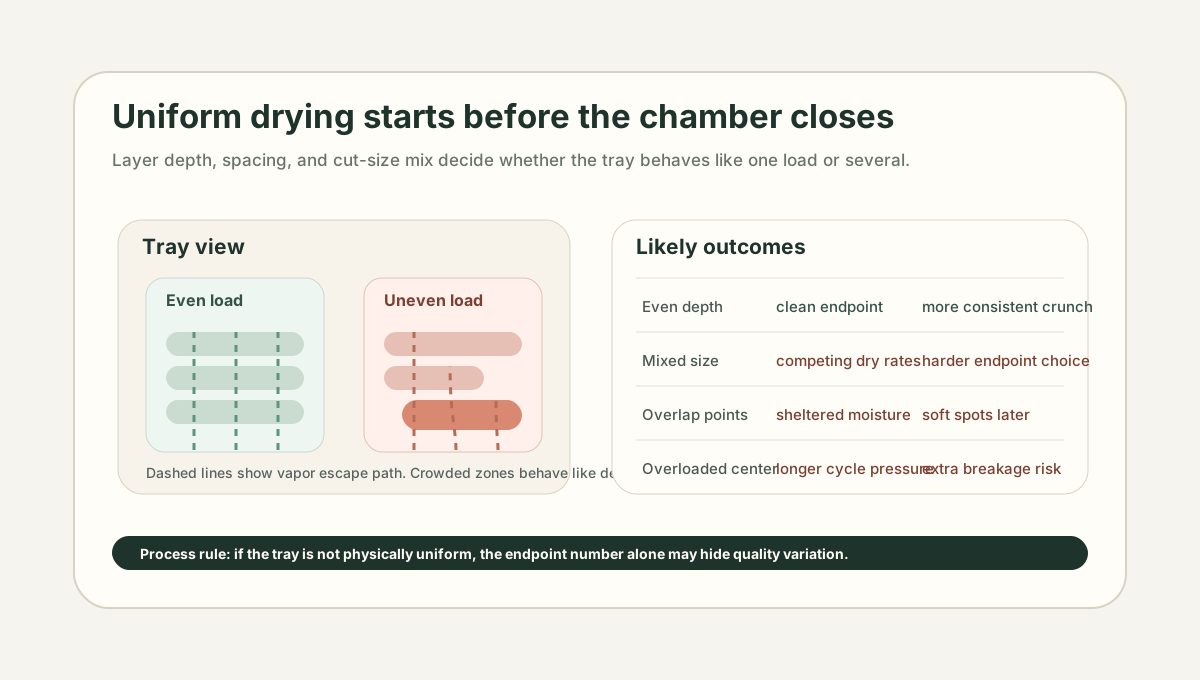
- Uneven layer depth changes how vapor escapes, so overloaded areas often finish later than the rest of the tray.
- Mixed piece size on one tray creates competing drying behavior and makes one endpoint harder to trust.
- Center-vs-edge differences, piled fruit, and shadowed contact points often show up later as softness, collapse, or extra breakage.
- Processors and buyers should treat tray loading as part of process control, not only as labor setup.
Many drying problems blamed on the machine actually begin with how the fruit was spread across the tray.
That sounds basic, but freeze-dried fruit is sensitive to geometry. The machine can only remove water vapor from the arrangement it is given. If one part of the tray carries a shallow, open layer and another part holds piled or crowded fruit, those two areas are not really drying under the same conditions.
The direct answer
Tray loading affects freeze-dried fruit drying uniformity because it controls layer depth, piece exposure, contact points, and vapor escape. Overloaded or unevenly spread trays create wet zones that finish later, while easy-drying zones can become overexposed by the time the slowest pieces are ready.
The result is not just longer cycle time. It can also show up as inconsistent crunch, higher breakage, or fruit that softens unevenly after packaging.
Why tray loading is a real process variable
Operators sometimes treat tray loading as a setup step before the "real" drying begins. In practice, it is one of the variables that shapes the process from the start.
Tray loading determines:
- how much fruit mass sits in each area
- how much exposed surface each piece has
- whether pieces trap moisture against one another
- how easily sublimated vapor leaves the bed
Those details affect whether the cycle sees a clean, predictable load or a patchwork of different local conditions.
The three loading problems that create uneven drying
1. Uneven layer depth
When one zone of the tray is lightly covered and another is mounded, the deeper zone behaves like a slower-drying bed. Interior pieces have less open exposure, and vapor has a longer path out.
The shallow zone may already be dry enough while the piled zone still needs time. If the process is extended to protect the deepest spot, the rest of the tray keeps seeing heat and vacuum even though it was ready earlier.
2. Mixed cut size on the same tray
Large mango cubes, thin strawberry slices, and berry fragments do not dry at the same rate. Even within one fruit, broad size spread creates competing endpoints.
This matters because a single batch target has to represent the whole tray. If thin pieces finish far ahead of thick ones, the endpoint decision becomes a compromise rather than a true match.
3. Contact-point shading
Where pieces touch or overlap, they create small sheltered zones. These points can retain moisture longer than the exposed surfaces around them.
The finished lot may still look dry at first glance, yet those hidden contact areas can produce:
- denser bite in some pieces
- local collapse
- uneven crispness
- faster softness after the pack is opened
What uneven drying looks like later
Not every uniformity problem appears as an obvious wet piece.
Often the defect pattern is subtler:
- some pieces crush cleanly while others bend first
- fruit at the bottom of a sample feels denser than fruit at the top
- color is slightly less even in thicker zones
- breakage rises because part of the tray became too fragile while waiting on the slowest area
This is one reason suppliers should evaluate more than a single lab number. A passing moisture result does not always mean the tray dried evenly.
Why longer cycle time is not the best first fix
When a load finishes unevenly, the simplest reaction is to extend the cycle. That can be necessary in the short term, but it is rarely the cleanest correction.
A longer cycle may:
- protect the wettest zone
- reduce the risk of obvious soft pieces
- lower confidence problems at release
But it may also:
- reduce throughput
- expose easy-drying pieces to more process stress than needed
- hide a loading discipline problem that returns on later runs
The better question is whether the slow area came from the fruit or from the way the tray was built.
Practical loading rules that usually improve consistency
Most processors already know the broad principles. The challenge is applying them consistently under production pressure.
Useful rules include:
- keep cut size as tight as the product brief allows
- spread fruit to a defined depth rather than "by eye"
- avoid overlap where appearance and structure matter
- separate unusually small fragments from whole-piece trays when possible
- compare center and edge tray positions during validation
These are not glamorous interventions, but they often do more for consistency than a nominal machine adjustment.
What buyers should ask suppliers
Commercial buyers usually do not see the trays, but the signs of good or poor loading still reach the bag.
Questions worth asking include:
- Is the cut size standardized before drying?
- Is tray fill depth written into the process?
- How is endpoint checked across multiple tray positions?
- What does the supplier do with off-size fragments before loading?
- Which fruits are most sensitive to loading variation in their system?
Those questions push the conversation past "we control quality" and toward the physical reasons a lot behaves well.
Bottom line
Tray loading affects freeze-dried fruit drying uniformity because it shapes the local drying conditions long before the operator checks the endpoint. Uneven depth, overlap, and mixed cut size can create a lot that is technically dry enough in aggregate but inconsistent in real eating quality.
When texture varies from piece to piece, the cause is not always the recipe or the dryer. Sometimes it is the tray.
Frequently Asked Questions
Why does tray loading matter in freeze-dried fruit?
Tray loading affects how evenly heat reaches the fruit and how easily ice vapor escapes during drying. If the fruit is piled, packed too tightly, or mixed in size, some areas can finish later than others even when the cycle settings look correct.
What does uneven tray loading look like in the finished product?
It often appears as mixed texture in the same lot: some pieces are crisp and light, while others feel denser, slightly leathery, or more fragile. Breakage and post-pack softness can rise because the pore structure was not created evenly.
Do thicker pieces always dry worse?
Not automatically. Thick pieces can dry well if the cut is intentional and the cycle is designed around it. Problems start when thick and thin pieces are loaded together or when trays are filled so deeply that vapor movement becomes inconsistent.
Can processors solve poor loading with a longer cycle?
Sometimes a longer cycle masks the problem, but it is a costly fix. Extending time can protect the wettest zones while overdrying easier areas, which hurts efficiency and may weaken delicate fruit structure.
What should buyers ask suppliers about drying uniformity?
Ask whether cut size is standardized, whether tray fill depth is controlled, how endpoint is verified across multiple tray positions, and what visible defect pattern the supplier sees when a run dries unevenly.
Primary sources & further reading
- Heat and Mass Transfer During Freeze-Drying Institute of Food Technologists — Journal of Food Science Peer-reviewed reference for how tray load thickness changes the sublimation front and finishing time.
- Scale-Up of Lyophilization Cycles Parenteral Drug Association Industry reference for how shelf temperature, chamber pressure, and load geometry interact at production scale.
- Vacuum Drying Equipment — Process Control USDA Agricultural Research Service USDA-published research on dryer load configuration and uniformity in fruit processing.
External links open in a new tab. We do not receive compensation from any organization listed; sources are referenced because they are primary, current, and publicly verifiable.