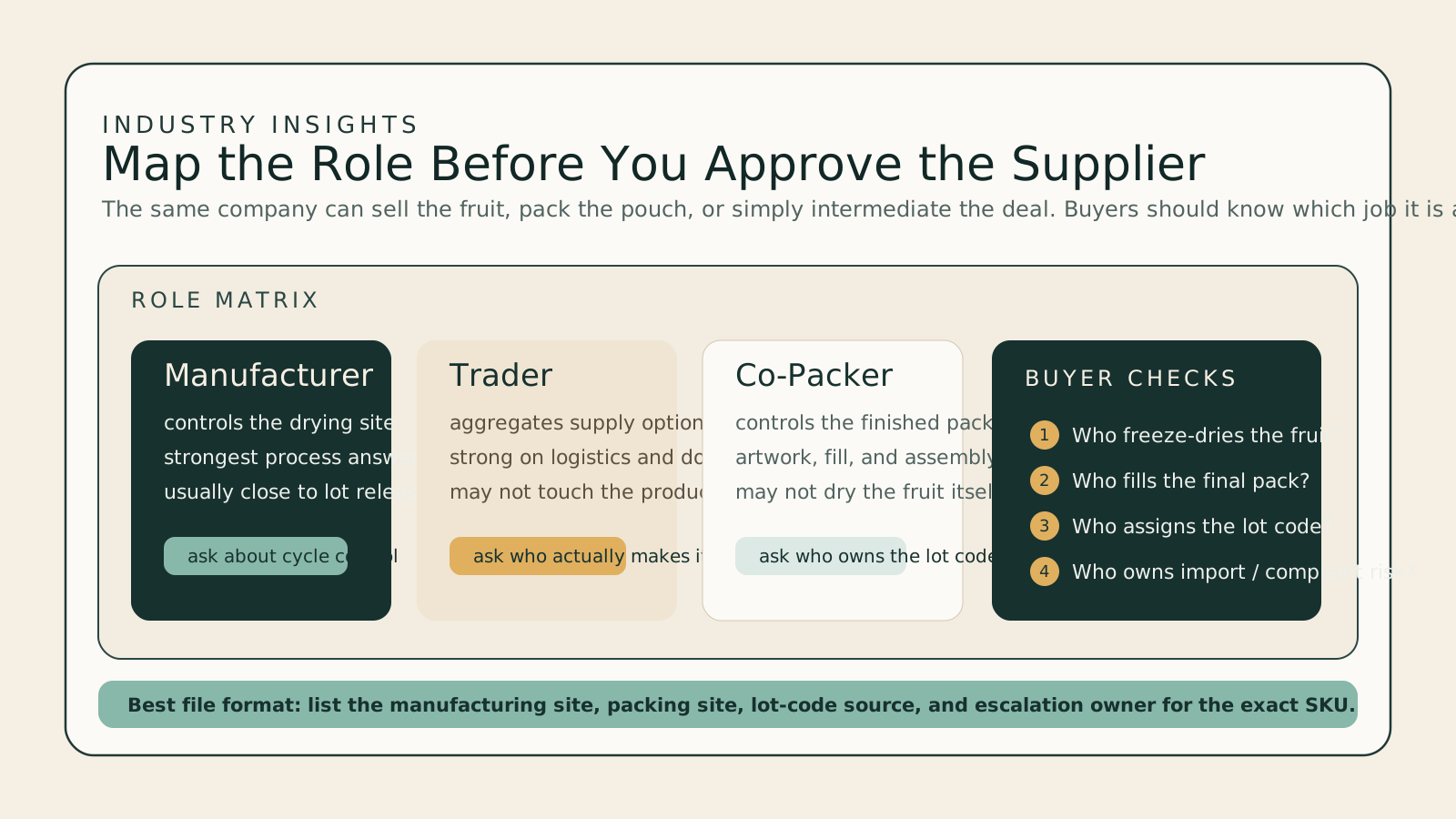
- Manufacturer, trader, and co-packer are different commercial roles even when the same company can wear more than one of them.
- FDA registration, FSVP responsibility, and traceability-lot logic can help reveal where actual physical control sits in the chain.
- A trader is not automatically a weak option, but buyers should know whether the seller ever manufactures, packs, or physically holds the product.
- The supplier file should identify who makes the fruit, who packs the pouch, who assigns lot codes, who imports, and who owns complaint resolution.
Freeze-dried fruit supply chains can be commercially tidy on the surface and structurally messy underneath.
One company sends the sample. Another company runs the chamber. A third company fills the pouch. A fourth company appears on customs paperwork. If the buyer never maps those roles, the approval file may look complete while the real control points remain fuzzy.
The direct answer
To tell whether a freeze-dried fruit supplier is acting as the manufacturer, trader, or co-packer, map who physically makes the fruit, who packs the finished format, who assigns the lot code, who owns the import or FSVP role where relevant, and who investigates complaints. The seller's title matters less than the physical and documentary control behind the product.
That role map should be done for the specific SKU or program, not for the company in the abstract.
Start with physical control, not the sales deck
The easiest mistake is asking, "Are you a manufacturer?" and accepting the first clean answer.
That question is too broad because the company may:
- manufacture bulk fruit for one program
- buy and resell bulk fruit for another
- co-pack finished pouches for private-label customers
- outsource the pouching while keeping commercial ownership
The better opening questions are narrower:
- Who freeze-dries this fruit?
- Who fills the pouch or bulk liner?
- Who warehouses it before shipment?
- Who holds the technical file and release records?
Those questions turn a vague supplier identity into an operational map.
Why the distinction matters in practice
The supplier role changes what the buyer should expect when something goes wrong.
A manufacturer should usually be strongest on:
- process explanation
- cycle logic
- lot-level release context
- root-cause discussion tied to the actual product
A trader may be strongest on:
- multi-origin access
- logistics coordination
- document aggregation
- faster commercial communication across several factories
A co-packer may be strongest on:
- pouch conversion
- artwork execution
- fill-weight control
- finished-goods assembly for branded retail
None of those roles is inherently inferior. The problem begins when a buyer expects manufacturer-level process answers from a trader or assumes a co-packer controlled the raw fruit when it only controlled the finished pouch.
FDA registration is a clue, not the whole answer
FDA's food-facility-registration guidance is useful here because it draws a practical line between entities that physically manufacture, process, pack, or hold food and brokers that do not.
FDA's Q&A says that a broker who does not manufacture, process, pack, or hold food is generally not required to register as a food facility. That does not make the broker illegitimate. It does tell the buyer something important: the broker may not be the physical control point.
That clue helps in freeze-dried fruit because the sales company and the operating site are often different.
Still, registration is only one clue.
A registered site may be:
- the freeze-drying manufacturer
- a warehouse that holds product
- a co-packing site
- a repacking location
So the buyer should treat registration as a role indicator, not a full answer.
Lot-code ownership usually reveals the real control point
Traceability often tells the truth faster than marketing language.
FDA's traceability materials explain that the traceability lot code source is the physical location where the lot code was assigned. FDA also explains that a new traceability lot code is tied to initial packing or transformation, and transformation can include manufacturing, repacking, relabeling, or packaging changes.
For a buyer, that means one question carries unusual value:
Who assigns the lot code on the product I am buying?
If the answer is the freeze-drying plant, the manufacturer likely sits at the center of the file. If the answer is the co-packing site because the bulk fruit is being repacked into retail format, the co-packer now matters more than the bulk seller for traceability and complaint investigation. If the answer stays vague, the chain is probably not yet documented tightly enough.
Import and complaint ownership matter more than the brochure
If the product crosses borders, another role becomes important: who is the importer responsibility point?
FDA's FSVP materials define the FSVP importer as the U.S. owner or consignee of the food at entry, or a U.S. agent/representative when no U.S. owner or consignee exists at that moment. That role carries evaluation duties that do not disappear just because a trader arranged the purchase.
So the buyer should know:
- who is acting as FSVP importer where applicable
- who maintains the hazard and supplier-evaluation file
- who answers if import documentation is questioned
- who must escalate if the lot is held, examined, or rejected
The company taking those responsibilities may not be the same one that sent the quote.
What a manufacturer usually looks like
A manufacturer is normally the strongest answer when the buyer asks about:
- dryer capacity
- cut geometry limits
- endpoint control
- product temperature discipline
- lot-to-lot moisture behavior
That does not mean every manufacturer is strong. It means the manufacturer should be closest to the underlying process reality.
If the company claims to manufacture but cannot explain the actual fruit form, drying site, release logic, or how lot codes map back to production, the role claim deserves pressure.
What a trader usually looks like
A trader often becomes visible when the company is strongest on commercial routing rather than on unit-process detail.
Typical signals:
- several origin options presented at once
- limited discussion of exact operating conditions
- strong document coordination across multiple factories
- flexible substitution talk that depends on outside partners
A good trader can still be valuable, especially when the buyer wants backup supply, freight coordination, or several origins under one commercial contact. The key is to know that process answers may still need to come from upstream facilities rather than from the seller alone.
What a co-packer usually looks like
A co-packer often sits closest to the finished retail SKU rather than the original freeze-drying step.
Typical signals:
- strong control of pouch format and fill weights
- artwork and packaging-line ownership
- ability to combine sourced fruit into a branded finished good
- complaint investigation that starts with finished-pack handling and traceability
For private-label or branded retail, the co-packer can be the most operationally important partner even if it did not freeze-dry the fruit itself.
Put the role map into the supplier file
The cleanest approval habit is to write the role map explicitly:
- manufacturer:
yes/no - trader:
yes/no - co-packer:
yes/no - manufacturing site:
- packing site:
- lot-code source:
- importer / FSVP role:
- complaint escalation owner:
That removes a surprising amount of future confusion.
Bottom line
In freeze-dried fruit, the company selling the product is not always the same company physically making, packing, importing, or tracing it. The smart buyer does not settle for one general supplier label. The smart buyer maps the real role behind the specific SKU.
When the file clearly shows who manufactures, who trades, who co-packs, who assigns the lot code, and who owns the import and complaint risk, the relationship becomes much easier to evaluate honestly.
Frequently Asked Questions
What is the difference between a manufacturer, trader, and co-packer in freeze-dried fruit?
A manufacturer actually freeze-dries or otherwise physically makes the product. A trader mainly buys and resells product sourced from other parties. A co-packer packs finished goods for a brand or customer and may or may not also manufacture the fruit itself.
Is a trader automatically a bad supplier choice?
No. Some traders are strong because they aggregate supply, manage documentation well, and solve logistics problems quickly. The risk is not the role by itself. The risk is failing to understand who physically controls the product and who can answer technical questions when a lot drifts.
How can FDA registration help reveal supplier role?
FDA's facility-registration guidance distinguishes facilities that manufacture, process, pack, or hold food from brokers that do not perform those activities. That helps buyers separate a paper intermediary from a facility that actually touches the product.
Why does lot-code ownership matter?
Because the lot code ties the product back to the place where it was assigned and to the records behind that lot. The party that can explain the lot chain clearly is often much closer to the real physical control point.
Can one company be more than one role?
Yes. A company can manufacture some products, trade others, and co-pack finished pouches for private-label customers. That is why buyers should map the role product by product rather than assuming one label describes the whole business.
Primary sources & further reading
- Final Rule on Foreign Supplier Verification Programs (FSVP) At-A-Glance U.S. Food & Drug Administration Referenced for FDA's explanation of who the FSVP importer is and for the supplier-evaluation duties that sit with the U.S. importer.
- Questions and Answers Regarding Food Facility Registration (Seventh Edition) U.S. Food & Drug Administration Referenced for FDA's distinction between brokers that do not manufacture, process, pack, or hold food and facilities that do.
- Traceability Lot Code U.S. Food & Drug Administration Referenced for FDA's explanation that the traceability lot code source is the physical location where the lot code was assigned.
- FSMA Final Rule on Requirements for Additional Traceability Records for Certain Foods U.S. Food & Drug Administration Referenced for FDA's explanation that transformation can include manufacturing, processing, repacking, relabeling, or packaging changes that affect traceability records.
External links open in a new tab. We do not receive compensation from any organization listed; sources are referenced because they are primary, current, and publicly verifiable.