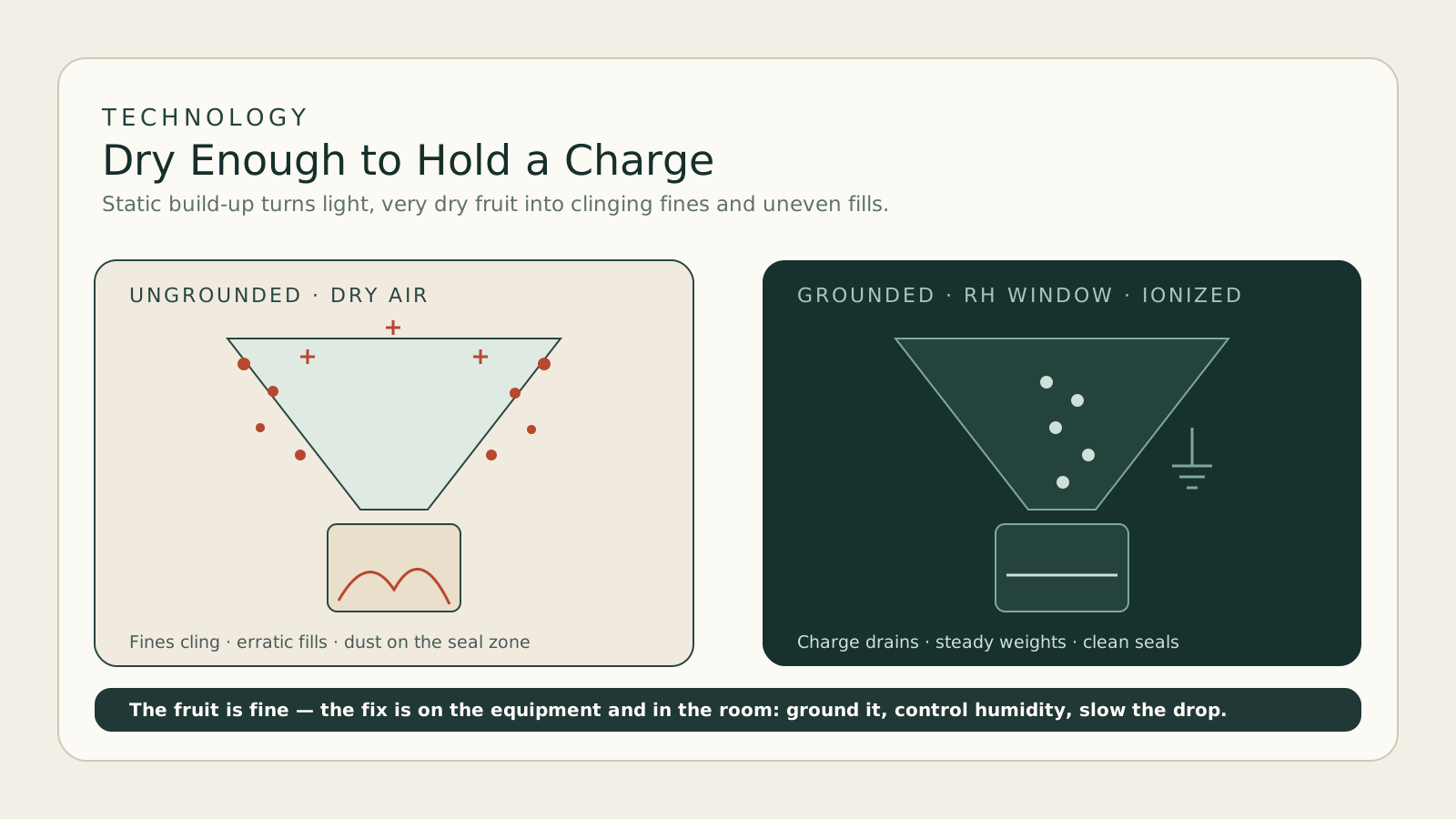
- Static charge builds when dry freeze-dried pieces and fines rub against each other and against equipment during handling, and low humidity lets that charge persist instead of bleeding away.
- The visible symptoms are practical, not exotic: fines clinging to hopper walls, erratic fill weights, dust on sealing surfaces, and pieces jumping out of a scale bucket.
- Grounding equipment, controlling room humidity, and slowing transfer speeds usually do more than any single fix, because they attack how charge is generated and how it drains.
- Buyers rarely see this directly, but it shows up as fill-weight variation and seal contamination — worth raising with a co-packer if bags run light or leak.
Watch a bag of freeze-dried raspberries being filled and you may notice something odd: a haze of pink dust that clings to the inside of the hopper, a scale that will not settle on a steady number, and pieces that seem to leap toward a plastic chute as if magnetized. None of that is a fruit problem. It is static electricity, and freeze-dried fruit is unusually good at generating it.
This is one of those small physics issues that quietly costs money — in giveaway from overfilled bags, in rejected packs from underfilled ones, and in seals contaminated by dust. It is worth understanding because the fixes are cheap once you know what you are fighting.
The direct answer
Static charge builds up when two surfaces rub together and electrons transfer from one to the other. Every time freeze-dried pieces tumble against each other, slide down a chute, or drop into a scale bucket, they pick up charge. In most foods, a thin film of surface moisture lets that charge leak away almost as fast as it forms. Freeze-dried fruit has almost no surface moisture, so the charge stays put.
The result is a material that both generates charge easily and holds onto it. In a dry packaging room, that combination produces the clinging, jumping, erratic behavior operators associate with "staticky" product.
Why freeze-dried fruit is a worst case
Three properties stack up against you.
First, extreme dryness. Charge dissipates through moisture, and freeze-dried fruit is engineered to have as little water as possible. The same low water activity that gives the product its shelf stability also makes it electrically insulating.
Second, low mass and high surface area. The pieces are light and often thin, with a lot of surface relative to their weight. Light particles are easy to move with small electrostatic forces, and high surface area means more contact — and more charge — per gram during handling.
Third, the environment. Packaging rooms for dry snacks are deliberately kept at low humidity to protect the product. Low relative humidity is exactly the condition in which static persists, because there is little airborne moisture to help charge bleed off surfaces.
The dust and fines that break off during handling carry the most charge per unit weight, because they have the highest surface-area-to-mass ratio. They are the particles most likely to cling to walls, float, and settle onto seal surfaces — which is why a line that produces a lot of fines usually also has the worst static symptoms.
What it actually looks like on the line
Static rarely announces itself as "static." It shows up as a set of practical complaints:
- Fines clinging to hopper and chute walls. Product coats surfaces instead of flowing, so hoppers need frequent cleaning and flow becomes inconsistent.
- Erratic fill weights. A scale-based filler depends on product dropping cleanly and settling fast. Charged pieces bridge, stick, and release unpredictably, so bags run heavy on one cycle and light on the next.
- Dust on sealing surfaces. Charged fines migrate to the pouch mouth and land in the seal zone. A few particles in the wrong place can create a weak seal or a leak path — a serious problem for a product whose whole shelf life depends on barrier integrity.
- Pieces jumping or repelling. Like-charged pieces push apart, so product scatters instead of nesting neatly into a bucket or pouch.
Each of these has a cost. Overfilling to guarantee a minimum weight is giveaway. Underfills are rejects or complaints. Seal contamination is a leaker waiting to happen.
How to control it
There is no single switch. The reliable approach attacks charge on three fronts: how it is generated, how fast it drains, and how the environment helps or hurts.
Ground the equipment. Metal hoppers, chutes, and scale parts should be electrically bonded and grounded so that charge on the equipment has a path to earth. Ungrounded or isolated plastic components are the classic culprits — they accumulate charge and then dump it onto the product. Where plastic is necessary, static-dissipative grades exist.
Control room humidity within a window. Raising relative humidity even modestly gives charge a path to dissipate through the thin moisture layer it creates on surfaces. The catch is that too much humidity lets the fruit reabsorb water and lose crunch. The aim is a controlled band — humid enough to bleed charge, dry enough to protect the product — not simply a wetter room.
Slow and soften transfers. Charge generation scales with the speed and violence of contact. Gentler drops, shorter fall heights, and slower transfer rates generate less charge in the first place, and also produce fewer fines — which removes the worst-charging particles from the system.
Use ionization where needed. Ionizing bars or air blow a balanced mix of positive and negative ions across the product stream, neutralizing charge directly. This is the targeted tool for the pinch points that grounding and humidity cannot fully solve, such as the moment product enters the pouch.
Manage fines upstream. Because fines carry disproportionate charge and dust, screening or de-dusting the stream before filling reduces both the static and the seal-contamination problem at once.
Why buyers should care
A buyer never sees the ionizer bar or the grounding strap, but they do see the outcomes. Bags that consistently run a little light, packs that occasionally leak, or visible dust inside a pouch can all trace back to uncontrolled static at the filler. If a co-packer's freeze-dried runs show fill-weight variation or seal issues that clean fruit should not cause, static handling is a fair thing to ask about.
It is also a useful reminder that "dry" is not a neutral property. The same dryness that makes freeze-dried fruit shelf-stable makes it electrically lively, and the packaging line has to be set up for that.
The takeaway
Freeze-dried fruit charges easily and holds that charge because it is exceptionally dry, light, and handled in low-humidity rooms. The consequences — clinging fines, erratic fills, contaminated seals — are handling problems, not fruit problems, and they respond to grounding, a controlled humidity window, gentler transfers, and targeted ionization. It is a small piece of physics, but on a filling line it decides whether every bag hits weight and every seal holds.
Frequently Asked Questions
Why does freeze-dried fruit build up static so easily?
Two reasons. It is extremely dry, so there is little surface moisture to conduct charge away, and the pieces are light with a lot of surface area, so friction during handling generates charge faster than it can dissipate. Dry air in the packaging room makes both effects worse.
Does static charge damage the fruit itself?
Not chemically. The fruit is unchanged. The problems are handling problems: uneven fills, clinging fines, and dust landing where it should not — most importantly on the seal area of a pouch, where trapped particles can compromise the seal.
Can raising humidity fix it without hurting the product?
It has to be balanced. A little more relative humidity in the packaging room helps charge drain away, but too much lets the fruit start reabsorbing moisture and losing crunch. The goal is a controlled window, not a humid room.
Is this only a problem for powders?
Powders and fines are the worst offenders, but whole and broken pieces charge too. Light, papery slices can visibly jump and stick. Powders just add a dust component that makes the seal and cleanliness issues more obvious.
Primary sources & further reading
- Current Good Manufacturing Practice, Hazard Analysis, and Risk-Based Preventive Controls for Human Food (21 CFR Part 117) U.S. Electronic Code of Federal Regulations Referenced for the general requirement that equipment and processes be designed and maintained to prevent contamination during handling and packaging.
- Water Activity (aw) in Foods U.S. Food and Drug Administration Referenced for the role of very low residual moisture in dried foods, which is what makes freeze-dried fruit prone to holding charge.
External links open in a new tab. We do not receive compensation from any organization listed; sources are referenced because they are primary, current, and publicly verifiable.