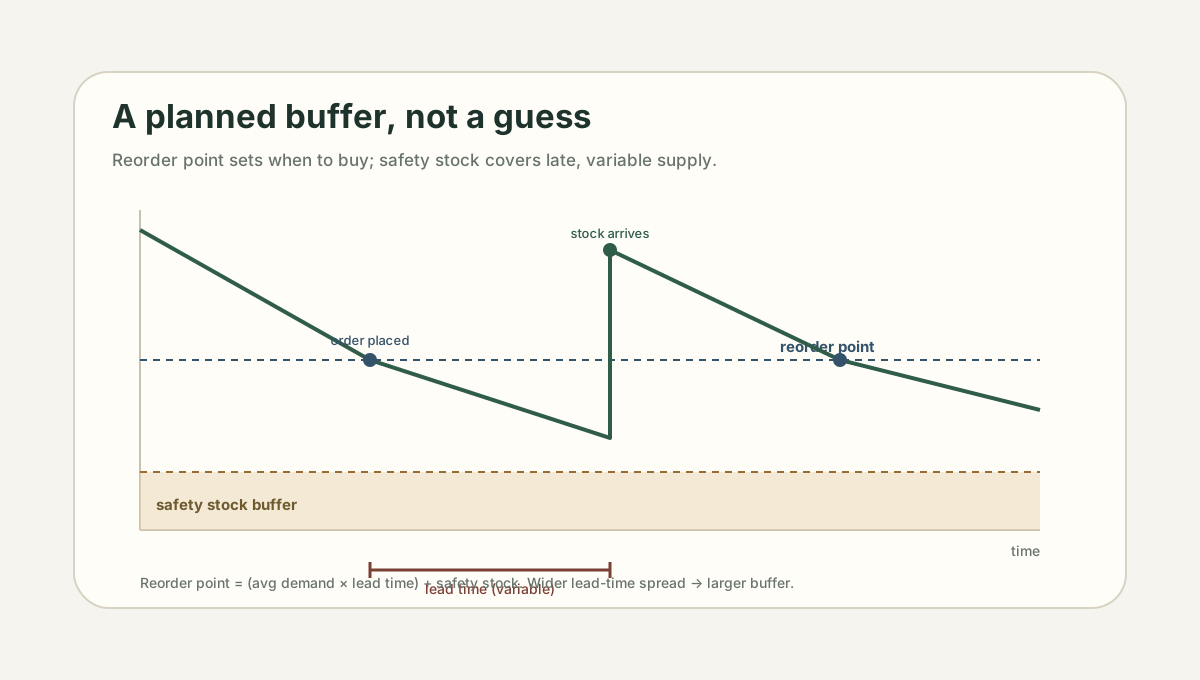
- Safety stock buffers two kinds of variability: demand that swings and supply that arrives late.
- A reorder point tells you when to place an order; safety stock tells you how much cushion to hold underneath it.
- Long, variable lead times for imported freeze-dried fruit make the buffer larger than buyers expect.
- Holding more stock costs money and risks shelf-life loss, so the goal is a defensible buffer, not a maximal one.
Most freeze-dried fruit buyers can place a first order without much trouble. The supplier is chosen, the spec is agreed, the sample is approved, and a container is on the water. The harder skill shows up later: keeping product available month after month without either running dry or burying cash in stock that ages on the rack. That is an inventory problem, and two simple tools, safety stock and the reorder point, do most of the work, provided the numbers behind them reflect how this category actually behaves.
The direct answer
A reorder point is the stock level that triggers a new purchase order. Safety stock is the buffer held underneath it to absorb the two things that go wrong: demand running higher than forecast and supply arriving later than promised. For freeze-dried fruit, the long and often unpredictable replenishment cycle makes both buffers larger than buyers expect, which is exactly why running this category on instinct leads to alternating stockouts and overstock.
The goal is not to never run out. It is to choose, deliberately, how often you are willing to risk running out, and to size the buffer to that choice.
Why this category is prone to stockouts
Freeze-dried fruit sits at an awkward intersection. Demand can be reasonably steady at the shelf, but supply is slow and lumpy. Manufacturing runs in campaigns, fruit is seasonal, and imported product carries long ocean lead times plus the usual import friction: customs exams, port holds, documentation snags, and the occasional missed sailing.
That means the gap between deciding to reorder and actually receiving usable stock can stretch for weeks or months, and the length of that gap is itself uncertain. When a buyer treats lead time as a single tidy number, reality eventually disagrees, and a late container turns a comfortable position into an empty rack.
Reorder point: when to order
The reorder point answers a timing question. Stock falls, and at a certain level the buyer needs to commit to a new order so that fresh product arrives before the current supply is exhausted.
The intuitive version is straightforward. Expected demand during the lead time is how much you will sell while you wait for the replenishment. The reorder point is that expected lead-time demand plus a safety cushion:
- Reorder point = (average demand per week × lead time in weeks) + safety stock
If you sell 400 units a week and the lead time is eight weeks, you will consume roughly 3,200 units while waiting. Order when stock hits that level and, on average, the new shipment arrives just as you run out. The problem with "on average" is that it leaves a coin-flip chance of running dry whenever demand or lead time runs unfavorably. That is what safety stock is for.
Safety stock: how much cushion underneath
Safety stock is the buffer that covers the unfavorable cases. It exists because both demand and lead time vary, and you want to keep selling even when both move against you at once.
Two drivers set its size. The first is variability: how much demand swings week to week, and how widely the lead time spreads around its average. The second is the service level you choose, meaning how often you are willing to accept a stockout during a replenishment cycle. A higher service level demands a larger buffer, and the relationship is non-linear: pushing protection from comfortable to near-certain costs disproportionately more stock.
For imported freeze-dried fruit, lead-time variability usually dominates. Demand at the shelf may wander modestly, but a shipment window that can land anywhere across a month or more forces the buffer to cover the late edge of that window, not its midpoint. Buyers who only buffer demand variability and assume a fixed lead time tend to be the ones surprised by an empty warehouse.
If you improve one input, improve lead-time reliability. Shortening and tightening the replenishment window shrinks the required buffer more effectively than almost any forecasting tweak, because it attacks the variability that safety stock is paying to cover.
The cost of the buffer cuts both ways
It is tempting to treat safety stock as free insurance and simply hold a lot. It is not free. Every extra case carries holding cost: working capital tied up, warehouse space, insurance, and the slow erosion of remaining shelf life.
Freeze-dried fruit is shelf-stable, but it is not exempt from time. The product still has a best-by horizon, and downstream customers frequently impose minimum-remaining-shelf-life clauses, so a pallet that sits too long can become unsellable to the very buyers it was meant to serve. Over-buffering trades a visible risk, the stockout, for a quieter one, the write-off. The discipline is to hold enough to protect service, and no more.
Building a buffer that reflects reality
A defensible policy for this category usually rests on a few honest inputs rather than a single clever formula.
Start with real lead-time history, including the bad shipments, not the supplier's optimistic quote. Capture the spread, not just the average, because the spread is what the buffer is sized against. Track demand variability separately, and be candid about promotions or seasonality that make certain weeks spike. Pick a service level on purpose by weighing the cost of a stockout, lost sales, unhappy accounts, expedited freight, against the cost of holding more stock. Then recompute as conditions change: a new supplier, a route change, a tariff event, or a demand shift all move the inputs.
Two operational habits make the math hold up. Review the reorder point on a schedule rather than setting it once and forgetting it, and watch for chronic early or late arrivals, which signal that the lead-time assumption has drifted. A reorder point built on last year's lead time protects against last year's risk.
What this looks like for a buyer
In practice, the payoff is calmer purchasing. Instead of reacting to a near-empty rack with a panicked expedited order at a worse price, the buyer reorders on a planned trigger with a known cushion. Instead of hoarding to feel safe, the buyer holds a buffer sized to a chosen service level and an honest read of supply variability.
It also sharpens supplier conversations. A buyer who can say "your lead time varies by six weeks and that variability is costing me this much buffer" is negotiating from data, and is better positioned to ask for vendor-managed stock, consignment arrangements, or more reliable scheduling.
Bottom line
Safety stock and reorder points turn freeze-dried fruit replenishment from a guessing game into a planned policy. The reorder point sets when to buy; safety stock sets how much cushion to carry against demand swings and, more importantly here, against late and variable supply. Size the buffer to a deliberate service level using real lead-time history, not optimistic quotes, and revisit it as conditions move. The aim is not zero stockouts at any cost, but a clear-eyed balance between the risk of an empty shelf and the cost of stock that ages before it sells.
Frequently Asked Questions
What is the difference between safety stock and a reorder point?
A reorder point is the inventory level that triggers a new order. Safety stock is the extra cushion held below expected demand during the lead time, sitting underneath the reorder point to absorb surprises. The reorder point is usually expected demand during lead time plus safety stock.
Why does freeze-dried fruit need more safety stock than fresh produce?
Because replenishment is slow and lumpy. Imported freeze-dried fruit can involve long manufacturing and shipping lead times, seasonality, and port variability. The longer and less predictable the lead time, the larger the buffer needed to cover the gap between ordering and receiving.
Can holding too much safety stock be a problem?
Yes. Excess stock ties up cash, occupies warehouse space, and consumes shelf life. Freeze-dried fruit is stable but not immortal, and buyers also face minimum-remaining-shelf-life clauses downstream. Over-buffering trades a stockout risk for a write-off risk.
How does lead-time variability change the calculation?
Variability in lead time often matters more than variability in demand for imported goods. If a shipment can arrive anywhere within a wide window, the buffer must cover the late end of that window, not the average, which pushes safety stock up.
What service level should a buyer target?
It depends on the cost of a stockout versus the cost of holding stock. A higher target service level lowers stockout risk but raises the buffer non-linearly, so the last few percent of protection gets expensive. The right level is a business decision, not a fixed number.
Primary sources & further reading
- Inventory Management and Production Planning and Scheduling Silver, Pyke, and Peterson (Wiley) Referenced for the standard treatment of reorder points, safety stock, and service-level-based inventory policy.
- APICS / ASCM Dictionary: Reorder Point and Safety Stock Definitions Association for Supply Chain Management Referenced for standard supply-chain definitions of reorder point, safety stock, and lead-time demand.
- Principles of Supply Chain Management: A Balanced Approach Wisner, Tan, and Leong (Cengage) Referenced for the relationship between lead-time variability, service level, and inventory buffers.
External links open in a new tab. We do not receive compensation from any organization listed; sources are referenced because they are primary, current, and publicly verifiable.