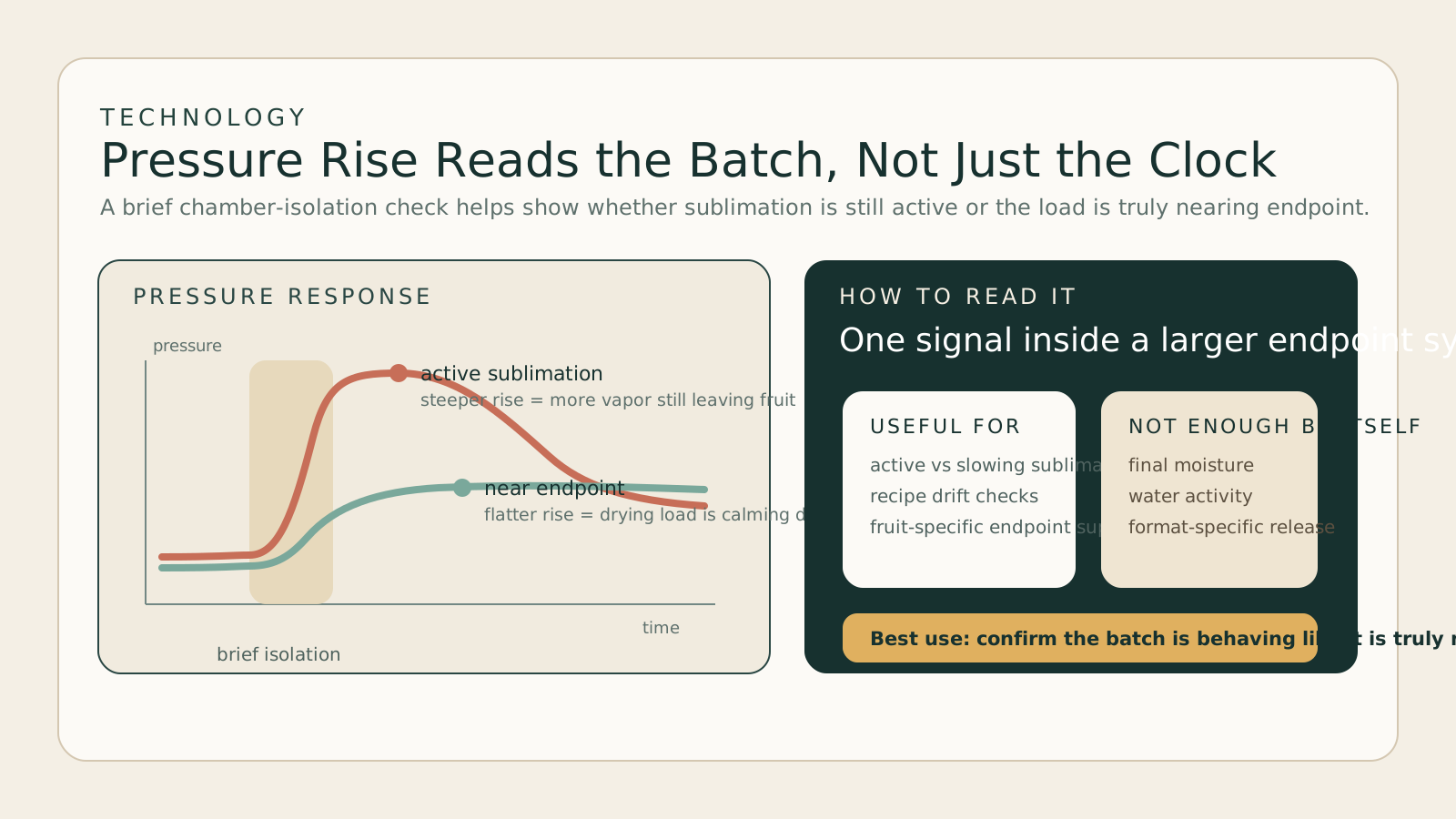
- A pressure-rise test briefly isolates the chamber from the condenser and watches how fast pressure climbs.
- Fast pressure rise usually means sublimation is still active, while a flatter response suggests the batch is closer to the end of primary drying.
- The test is useful because it reads process behavior in real time, not just the clock or one shelf setting.
- It is still a support tool, not a release decision by itself; final moisture, water activity, and product-specific checks still matter.
Freeze-dried fruit teams often talk about endpoint as if it were a time on the recipe.
In practice, endpoint is a judgment about whether the product is still driving meaningful vapor out of the chamber or whether primary drying has truly run its course.
The direct answer
A pressure-rise test helps confirm freeze-dried fruit endpoint by briefly isolating the chamber from the condenser and measuring how quickly pressure climbs. If pressure rises quickly, the batch is usually still generating vapor from ongoing sublimation. If the response is flatter, the load is generally closer to the end of primary drying.
That makes the test valuable because it checks real process behavior instead of trusting:
- cycle time alone
- shelf settings alone
- surface appearance alone
It is most useful when paired with final release checks rather than treated as a magic answer on its own.
What the test is actually reading
During primary drying, ice inside the fruit is still becoming vapor and moving out of the product. If the chamber is briefly isolated from the condenser, that vapor has fewer places to go, so chamber pressure responds.
The practical interpretation is simple:
- a stronger pressure rise usually means the load is still actively drying
- a weaker rise usually means vapor generation has slowed and the batch is nearer endpoint
The value is not that the test produces one universal number for every fruit. The value is that it shows whether the batch still behaves like a load with substantial remaining ice.
That is why pressure-rise logic fits well alongside product-temperature and chamber-behavior monitoring. It gives the team one more view of what the load is doing rather than one more recipe guess.
Why this matters for fruit loads
Freeze-dried fruit is rarely perfectly uniform across the chamber.
Different parts of the load may dry at different speeds because of:
- slice or cube thickness
- sugar concentration
- tray position
- loading density
- fruit structure
That unevenness is the reason a tray can look convincing while one part of the batch is still lagging. Exterior dryness is not the same thing as finished drying through the whole load.
A pressure-rise test is useful here because it reads the chamber response created by the product, not just by the programmed time. It helps operators avoid the common mistake of unloading because the recipe says the batch is probably done.
What the test can and cannot do
Pressure-rise testing is strongest as an in-cycle confirmation tool.
It can help answer questions like:
- Is primary drying still clearly active?
- Is the batch behaving differently from the validated pattern?
- Is the chamber nearing the point where a final endpoint decision is reasonable?
It cannot answer every commercial question by itself.
It does not replace:
- final moisture confirmation
- final water activity confirmation
- product-specific sensory or texture review
- a release routine matched to the fruit and format
FDA's water-activity guidance is useful here because it reinforces the larger point: the product has to leave drying at a suitable stability level and stay there during storage. A promising pressure-rise pattern does not by itself prove that a strawberry slice, mango cube, or berry blend has landed at the right commercial endpoint.
Why one generic rule is not enough
Teams sometimes want one universal trigger: if pressure does X, end the cycle.
That is too blunt for fruit.
The same pressure behavior can mean different commercial risk depending on:
- whether the product is a thin slice or a thick cube
- whether the fruit is sugar-rich and slow to clear bound moisture
- whether the SKU is sold as a premium crisp snack or a more forgiving ingredient format
A fruit processor gets the most value from pressure-rise testing when the interpretation is tied back to a validated product family rather than copied across everything in the room.
That is the real operational standard. Not "Do we run this test?" but "Do we know what this test means for this fruit, this cut, and this selling format?"
What buyers should infer from endpoint discipline
Most buyers will never watch a pressure-rise test happen. They can still ask better questions because the control philosophy behind it matters.
Useful buyer questions include:
- What in-cycle checks support the endpoint decision?
- Are endpoint checks specific to the fruit and format?
- How is final moisture or water activity release confirmed after the cycle?
- What changes when piece size or tray loading changes?
Those questions matter because endpoint discipline usually shows up later as texture discipline. Fruit that leaves the dryer too early often shows the problem later as soft centers, uneven crunch, or faster post-pack quality drift.
Bottom line
Pressure-rise tests help confirm freeze-dried fruit endpoint because they show whether the load is still producing vapor strongly enough to behave like an actively drying batch. That makes them a practical process-control tool, especially when the batch looks finished before the slowest portion actually is.
The right use is disciplined but modest: treat the test as one important signal inside a larger endpoint system, then confirm the commercial endpoint with final moisture, water activity, and product-specific release checks.
Frequently Asked Questions
What is a pressure-rise test in freeze-drying?
It is a short in-cycle check where the path between the drying chamber and condenser is briefly isolated so the team can watch how chamber pressure changes. The pressure pattern helps show whether vapor is still being generated strongly from the product.
Does a pressure-rise test prove the fruit is finished?
No. It is a strong process signal, not a full release decision. Freeze-dried fruit still needs final moisture, water activity, and product-specific quality confirmation.
Why is it useful for freeze-dried fruit?
Because fruit loads are often uneven. Slice thickness, sugar level, tray position, and loading density can leave one part of the batch drier than another. Pressure-rise testing helps teams avoid trusting appearance alone.
Is this the same thing as checking shelf time?
No. Shelf time is only a recipe input. A pressure-rise test looks at how the batch is actually behaving at that moment.
What should buyers ask suppliers about endpoint control?
Ask what in-cycle signals they use to support endpoint decisions, whether those checks are product-specific, and how final moisture or water activity release confirms the lot.
Primary sources & further reading
- Recommended Best Practices for Process Monitoring Instrumentation in Pharmaceutical Freeze Drying—2017 AAPS PharmSciTech Referenced for the plain-language description of the pressure-rise test as a long-used chamber-isolation method for monitoring primary drying behavior.
- On the methods based on the Pressure Rise Test for monitoring a freeze-drying process Politecnico di Torino / Drying Technology Referenced for the technical explanation of how pressure-rise methods are used to estimate drying progress during freeze-drying.
- Water Activity (aw) in Foods U.S. Food & Drug Administration Referenced for FDA's explanation that water activity must be controlled at the end of drying and maintained during storage.
External links open in a new tab. We do not receive compensation from any organization listed; sources are referenced because they are primary, current, and publicly verifiable.