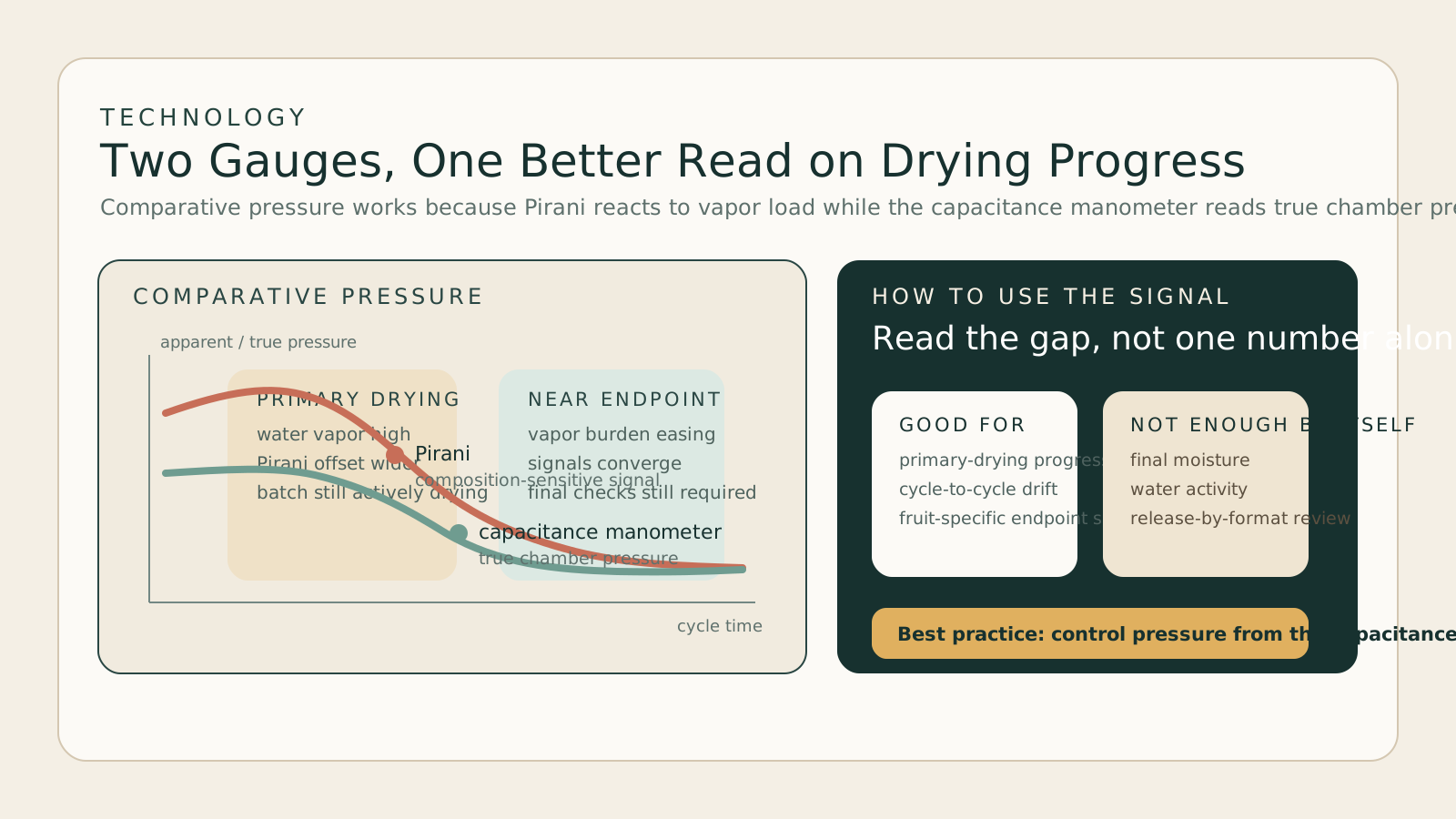
- A capacitance manometer reads true chamber pressure, while a Pirani gauge shifts with gas composition and therefore reacts to water vapor load.
- During primary drying, a wider gap between the two readings usually means substantial sublimation is still happening.
- As the readings move closer together, the batch is generally approaching the end of primary drying, but the signal still needs product-specific interpretation.
- For freeze-dried fruit, comparative pressure is best used with product temperature, load knowledge, and final moisture or water-activity release checks.
Freeze-dried fruit operators often talk about chamber pressure as if it were one clean number.
In practice, two pressure instruments can tell two different stories at the same moment, and that difference is often the useful part.
The direct answer
Pirani and capacitance manometer readings help track freeze-dried fruit drying because they respond differently to the vapor environment inside the chamber. The capacitance manometer reads true chamber pressure. The Pirani gauge is affected by gas composition, so it reads differently when the chamber is carrying substantial water vapor from active sublimation.
That means the gap between the two readings is not random noise. It is often a practical sign of where the batch sits in the drying cycle:
- wider separation usually means stronger vapor load and ongoing primary drying
- narrowing separation usually means the batch is moving closer to the end of primary drying
- near-convergence usually means vapor generation has dropped enough that endpoint checks deserve closer attention
For freeze-dried fruit, the value is not that the gauges replace judgment. The value is that they show whether the load is still behaving like a wet load.
What each instrument is actually reading
The capacitance manometer is the cleaner of the two instruments from a control perspective. It measures absolute pressure and is not materially thrown off by whether the chamber atmosphere is dominated by water vapor or by drier gas.
The Pirani gauge works differently. Because it is a thermal-conductivity instrument, the reading shifts with gas composition. During primary drying, when a great deal of water vapor is still leaving the fruit, the Pirani signal reflects that vapor-heavy environment.
That difference is exactly why comparative pressure monitoring works.
The operator is not asking whether one gauge is correct and the other is wrong. The operator is asking what the difference between them reveals about the state of sublimation.
Why the gap matters during fruit drying
Primary drying is the longest and most operationally sensitive part of most freeze-drying cycles. Fruit makes that sensitivity worse because the load is rarely perfectly uniform.
One tray may dry faster because the pieces are thinner. Another may lag because:
- the fruit is sugar-rich
- the cut geometry is thicker
- the loading density is heavier
- the tray sits in a slower heat-transfer position
That is why fruit can look done before it is actually done through the slowest part of the load.
Comparative pressure helps because it reads chamber behavior created by the batch, not just programmed time. If the Pirani gauge still shows a meaningful offset from the capacitance manometer, the system is usually still seeing enough vapor to suggest active primary drying.
That does not tell you which tray is slowest. It tells you the chamber still has unfinished business.
Why the capacitance manometer should anchor pressure control
One common mistake is treating the Pirani gauge as if it were the right instrument for actual pressure control.
That is risky because the Pirani reading changes with gas composition. Near the end of primary drying, when the chamber atmosphere shifts, controlling from a composition-sensitive signal can distort how the system behaves. The 2017 AAPS instrumentation guidance is clear that the capacitance manometer is the better control instrument because it reads true pressure and is more stable for process consistency.
For fruit, that matters because the commercial risk is not only extended cycle time. It is also heat-transfer behavior near the end of primary drying, where a false sense of stable pressure can coincide with product-temperature risk.
The clean operational split is:
- use the capacitance manometer to understand the real chamber-pressure condition
- use the Pirani-to-capacitance difference as a process-monitoring signal
That is a much stronger setup than using one vague pressure number for both jobs.
What convergence does and does not mean
Teams often summarize the concept this way: when the Pirani reading approaches the capacitance-manometer reading, primary drying is effectively ending.
That is directionally right, but fruit needs a stricter read.
Convergence does not mean:
- every tray is identical
- the fruit has automatically reached the right commercial endpoint
- secondary drying has already done everything needed for the target texture
- the lot is ready to release without final checks
What it usually means is that the water-vapor burden inside the chamber has fallen enough that the system is no longer behaving like a strongly active primary-drying stage.
That is a very useful in-cycle decision point. It is not a replacement for product-specific confirmation.
Why fruit teams still need product context
Most comparative-pressure guidance comes from pharmaceutical freeze-drying literature rather than fruit-processing literature. That is still useful because the instrumentation physics are the same. But the commercial translation must be careful.
Fruit behaves differently from uniform vial loads because of:
- wider variation in piece geometry
- different sugar and acid systems
- structural collapse risk that changes by fruit
- different commercial tolerances for texture and residual moisture
So the best inference is modest:
Comparative pressure is a valid monitoring concept for fruit, but the threshold that matters operationally should be tied back to validated product families, not copied blindly from another dryer or another SKU.
That is especially true if the site runs both thin berry slices and thicker tropical cubes in the same equipment family.
What buyers and operators should ask
Most buyers will never watch these instruments in real time. They can still learn a great deal from the supplier's endpoint discipline.
Useful questions include:
- Do you use both a capacitance manometer and a Pirani gauge?
- Which instrument controls chamber pressure?
- How do you interpret comparative pressure for this fruit and cut style?
- What final checks confirm the lot after the in-cycle signal says primary drying is nearly finished?
Strong answers usually connect the gauges to a broader endpoint system. Weak answers treat the gauges like decorative hardware or fall back on time alone.
Bottom line
Pirani and capacitance manometer readings help track freeze-dried fruit drying because they reveal whether the chamber is still carrying the vapor signature of active sublimation. The capacitance manometer tells you the true pressure. The Pirani gauge tells you something about the chamber atmosphere. The difference between them is often the useful signal.
Used properly, comparative pressure does not replace final release checks. It makes the path to those checks far more informed than trusting the recipe clock by itself.
Frequently Asked Questions
What is the difference between a Pirani gauge and a capacitance manometer in freeze-drying?
A capacitance manometer measures absolute chamber pressure and is largely independent of vapor composition. A Pirani gauge is a thermal-conductivity instrument, so its reading shifts as the gas in the chamber changes from water vapor-rich to drier gas.
Why do the readings differ during primary drying?
Because primary drying is a vapor-rich phase. Water leaving the product changes the gas environment inside the chamber, which affects the Pirani gauge more than the capacitance manometer.
Does convergence prove the fruit is fully finished?
No. It is a strong process signal, not a full release decision. Fruit still needs product-specific endpoint logic plus final moisture, water activity, and quality confirmation.
Which gauge should control chamber pressure?
Best practice is to control chamber pressure from the capacitance manometer because it reads true pressure rather than composition-influenced apparent pressure.
Why does this matter so much for freeze-dried fruit?
Fruit loads are uneven by nature. Sugar level, slice thickness, tray position, and fruit structure can leave one part of the batch still drying while another looks finished. Comparative pressure gives one more in-cycle check against that false confidence.
Primary sources & further reading
- Recommended Best Practices for Process Monitoring Instrumentation in Pharmaceutical Freeze Drying—2017 AAPS PharmSciTech Referenced for the instrumentation distinction between capacitance manometers and Pirani gauges, and for the recommendation to control chamber pressure from the capacitance manometer.
- Best Practices and Guidelines (2022) for Scale-up and Technology Transfer in Freeze Drying Based on Case Studies. Part 2: Past Practices, Current Best Practices, and Recommendations AAPS PharmSciTech Referenced for the case-study evidence that differences between Pirani and capacitance readings are used to identify the end of primary drying.
- Recent trends in pharmaceutical freeze-drying and control strategies observed in human drug applications and manufacturing inspections AAPS Open Referenced for the current process-analytical description of comparative pressure monitoring and its role as a lower-barrier real-time freeze-drying tool. The fruit-specific implications in this article are editorial inferences from that instrumentation logic.
External links open in a new tab. We do not receive compensation from any organization listed; sources are referenced because they are primary, current, and publicly verifiable.