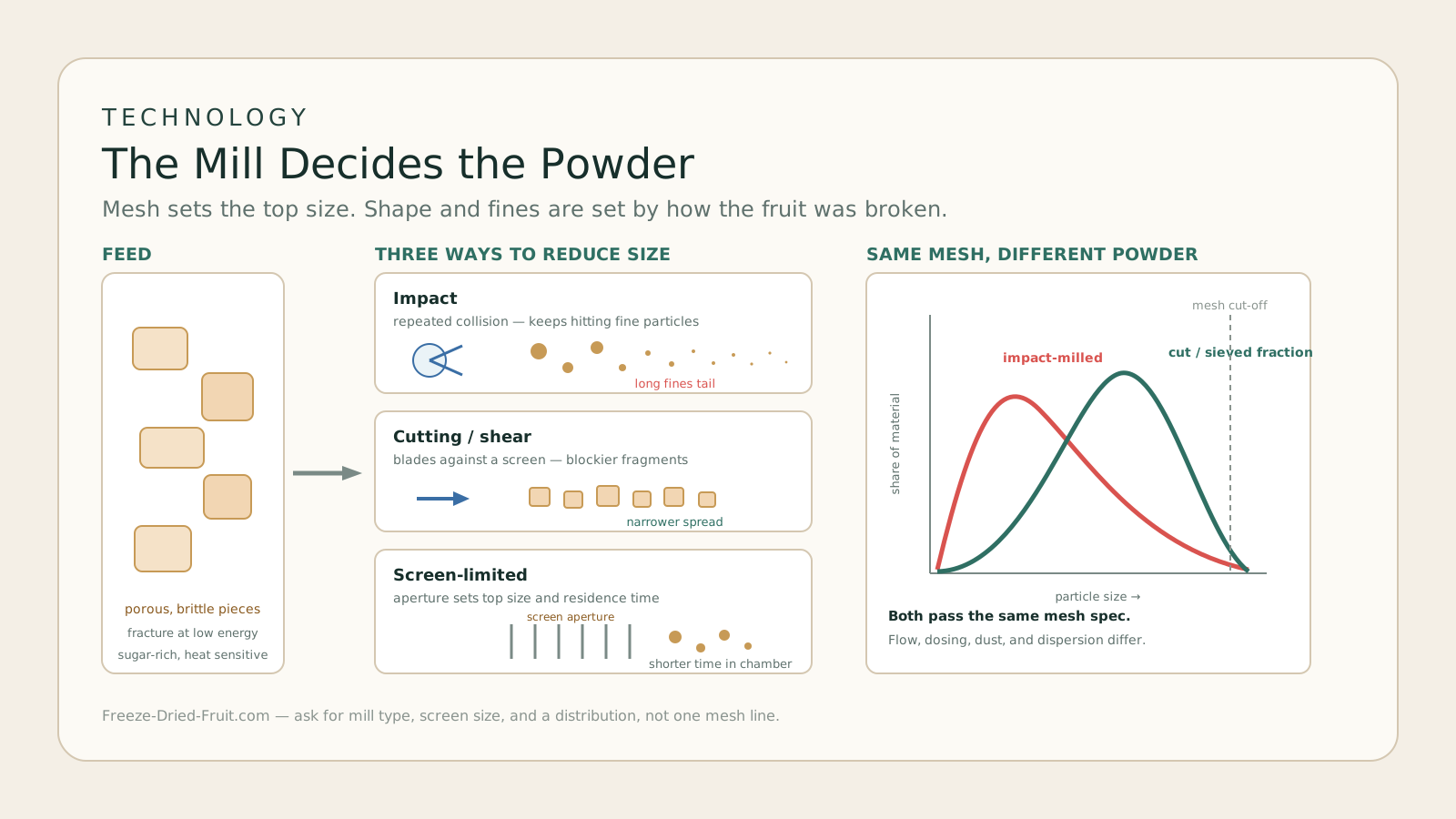
- Milling method — impact, cutting, or screen-limited — sets particle shape and the fraction of ultrafine dust, and those two properties drive flow, dosing, color, and dispersion more than the headline mesh number does.
- Freeze-dried fruit is porous and brittle, so it fractures easily; the practical risk in milling is not failing to break it down but breaking it down too far and generating fines, heat, and exposed surface area.
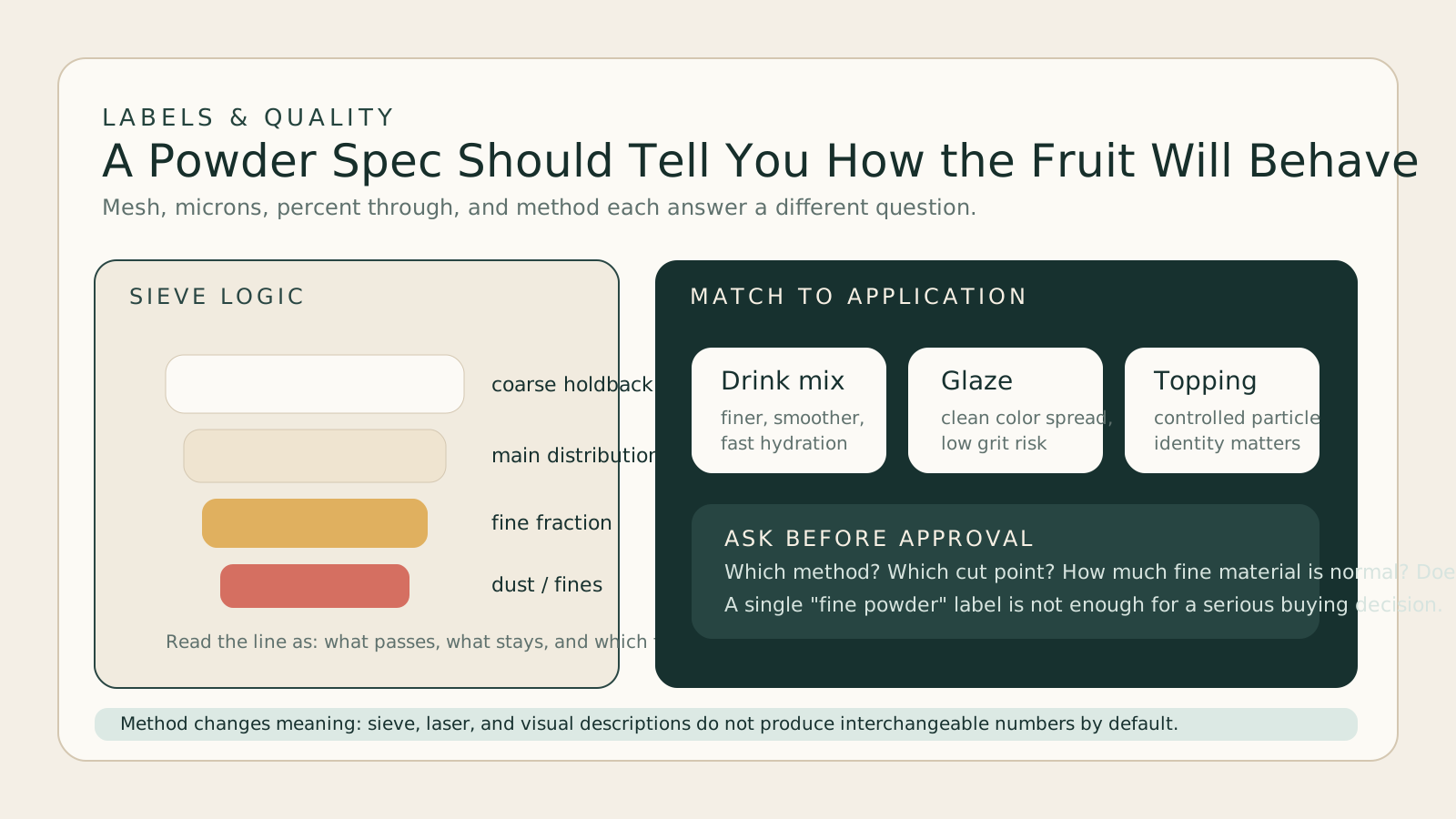
- Ask suppliers to specify mill type, screen size, and whether the powder is a milled cut or a sieved fraction, and pair that with a particle-size distribution rather than a single mesh pass rate.
Freeze-dried fruit powder is one of the easiest ingredients to specify badly. A buyer writes "80 mesh," a supplier confirms it, and both sides assume they have agreed on something precise. They have agreed on the size of the largest particles that will be present. Nearly everything else about how that powder behaves — how it flows, how much dust it throws, how fast it disperses, how consistently it fills — was decided by the mill, not by the mesh line.
The direct answer
Milling method changes freeze-dried fruit powder because it determines how the brittle, porous fruit fractures. Impact-based mills break pieces by repeated collision, which produces rounded, irregular fragments and a long tail of ultrafine dust. Cutting and screen-limited approaches shear or size-restrict the material, which tends to give blockier fragments and a narrower distribution. Since freeze-dried fruit is friable and sugar-rich, the practical challenge is not reducing the size but controlling how far reduction goes and how much heat and exposed surface it creates along the way.
Why freeze-dried fruit mills differently from most dry ingredients
Most milled food ingredients are dense and relatively tough. Freeze-dried fruit is the opposite: the freeze-drying process leaves behind an open, porous matrix where ice crystals used to be, and that matrix is brittle. It fractures with far less energy than a grain or a nut.
That friability has two consequences. First, size reduction is quick, so a mill sized for tougher material can easily over-process fruit. Second, once a particle is small, it does not stop being fractured — it keeps taking hits until it leaves the mill. The result is a distribution that is skewed toward fines unless the equipment and the residence time are chosen with that in mind.
The composition adds a second complication. Freeze-dried fruit powders are dominated by sugars and acids. Sugar-rich amorphous solids soften as they approach their glass transition region, moving from a hard, glassy state toward a stickier one. A mill that adds even mild frictional heat can push local material into that softer behavior, at which point clean fracture turns into smearing on screens and internals.
The three broad approaches
Real plants use many machine types, but for buying purposes the useful distinction is how the machine reduces size.
Impact reduction breaks material through collisions — with rotating elements, with pins, with other particles. It is fast and produces a fine powder efficiently. It also produces the most fines, because the mechanism keeps acting on everything in the chamber regardless of whether a given particle has already reached target size.
Cutting or shearing reduction slices material with blades against a screen. It is gentler on the fine end and tends to give blockier fragments, which is often preferable when flow and fill consistency matter more than ultimate fineness.
Screen-limited reduction is less about the breaking mechanism and more about the exit rule: material stays in the chamber only until it can pass a screen of a given aperture. The screen sets the top size and, indirectly, the residence time. A coarser screen means faster exit and less over-processing.
Most commercial freeze-dried fruit powders are made by some combination of these, then screened. The reason two suppliers' "same" powder behaves differently usually traces back to which mechanism dominated and how long material stayed in the chamber.
The ultrafine fraction is where a lot of practical trouble lives: airborne dust during filling, clumping on contact with liquid, static, and losses to dust collection. A mesh spec is silent about it, because a mesh spec only reports what does not pass. Asking for a particle-size distribution — or at least a statement about the proportion of very fine material — turns an invisible variable into a comparable one.
What changes downstream
Flow and dosing. Blockier, more uniform particles flow more predictably and fill more consistently on volumetric equipment. Irregular, flaky, or heavily fines-laden powders bridge in hoppers and vary fill to fill. If your fill weights drift and nothing about the machine changed, the powder's shape distribution is worth checking.
Dispersion. More fine material means more surface area, which usually means faster color release and faster wetting — up to the point where fines clump on contact with liquid and slow everything down. There is a practical middle rather than a "finer is better" rule.
Color and aroma exposure. Milling creates new surface. Fresh surface means more area available to oxygen and humidity, which is why the interval between milling and packing matters and why powders are typically packed with more barrier attention than pieces.
Moisture pickup. A freshly milled powder sitting open in a room that is not humidity controlled will gain moisture faster than the pieces it came from. That shows up later as caking, and it is a milling-room and packing-room issue as much as a formulation one.
What to ask a supplier
Three questions make powders comparable without requiring you to audit the plant.
Ask what mill type and screen size were used. You do not need proprietary detail; you need to know whether you are comparing an impact-milled powder against a cut one, because that difference explains most of the behavior gap.
Ask whether the material is a milled cut or a sieved fraction. A milled cut carries whatever fines the mill made. A sieved fraction has had the tails removed and will behave more predictably, at a higher price, because the removed material has to be sold elsewhere.
Ask for a particle-size distribution rather than a single mesh pass rate. A few named points across the distribution — the sizes below which roughly 10, 50, and 90 percent of the material falls — describe the powder in a way one mesh line cannot.
The practical takeaway
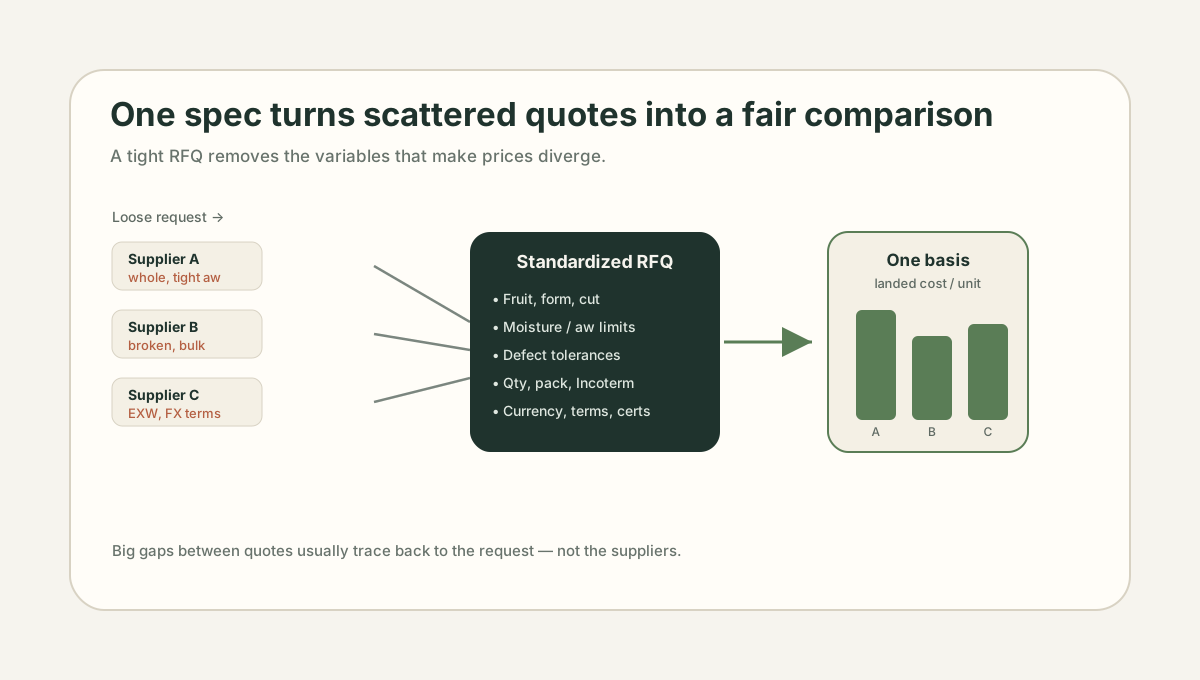
Mesh is a boundary condition, not a description. If a powder that meets your spec keeps behaving differently between lots or between suppliers, the mill is the first place to look: what mechanism reduced the fruit, how long it stayed in the chamber, and how much ultrafine material came out the other side. Specifying those things costs nothing at the RFQ stage and removes a category of surprise that is otherwise very hard to diagnose after the fact.
Frequently Asked Questions
Why does milling method matter if the powder meets the same mesh spec?
Because a mesh spec is a pass/fail gate on the largest particles, not a description of the whole population. Two powders that both pass 80 mesh can differ enormously in the shape of their particles and in how much ultrafine material sits at the bottom of the distribution. Impact milling tends to produce more rounded, fractured fragments with a longer tail of fines; cutting and screen-limited approaches tend to produce blockier fragments with a narrower spread. Those differences show up as different bulk density, flow behavior, dust generation during filling, and dispersion speed in liquid — all while the mesh line on the spec sheet stays identical.
Is freeze-dried fruit hard to mill?
Not in the sense of being tough. Freeze-dried fruit is a porous, brittle solid, so it fractures readily under modest force, which is why size reduction is rarely the difficulty. The difficulty is control. Because the material is so friable, the same energy that reduces oversize pieces keeps acting on the particles that are already fine enough, producing an unwanted dust fraction. Sugar-rich fruits complicate this further: they can soften with even mild heat pickup in the mill, which turns clean fracture into smearing and caking on screens and internals.
What does heat have to do with milling a dry product?
Mills add energy, and some of that energy becomes heat through friction and impact. In most dry ingredients the temperature rise is a minor concern. In freeze-dried fruit it can matter because these powders are dominated by sugars and are sensitive to warming near their glass transition region, where a brittle solid begins to behave in a softer, stickier way. Mild local heating in the mill can be enough to cause smearing, screen blinding, and clumping in the collection bin. It is one reason plants control feed rate, run shorter passes, and pay attention to ambient conditions in the milling room.
Should I ask for a milled powder or a sieved fraction?
It depends on what you need. A milled cut is simply the output of the mill, screened to remove oversize; it will carry whatever fines the mill produced. A sieved fraction is that output further separated, so you might buy the mid-range and leave both the coarse and the ultrafine behind. Sieved fractions give tighter, more predictable behavior in dosing and dispersion, but they cost more because a portion of the batch has to find another home. If your application is sensitive to dust or to fill-weight variation, the sieved fraction is often worth the premium; if you are blending into a wet system where everything dissolves anyway, the milled cut may be fine.
How does particle shape affect how the powder behaves in a product?
Shape governs how particles pack against each other and how quickly liquid can get to them. Blockier, more uniform fragments tend to flow more freely and fill more consistently, which matters on volumetric dosing equipment. Flakier or highly irregular fragments interlock, bridge in hoppers, and vary more from fill to fill. On the dispersion side, finer and more irregular particles have more surface area, so they wet and color faster but are also more prone to clumping on contact with liquid. Neither shape is universally better; the point is that shape is a real variable that a mesh number alone hides.
What should be on a spec sheet to make powders comparable?
At minimum: the mill type and screen size used, whether the material is a milled cut or a sieved fraction, and a particle-size distribution rather than a single pass-through percentage. A distribution with a few named points — for example the sizes below which 10 percent, 50 percent, and 90 percent of the material falls — tells you far more than one mesh line. It is also worth asking about the proportion of ultrafine material, any anti-caking or carrier addition, and the moisture and water-activity result on the finished powder, since milling exposes fresh surface that will pick up humidity if the powder sits before packing.