- Very fine freeze-dried fruit powder often flows poorly, cakes quickly, and disperses badly because its particles are small, cohesive, and highly hygroscopic.
- Agglomeration binds fines into porous granules, which usually improves flow, dosing accuracy, and how the powder wets and sinks in liquid.
- The tradeoff is that agglomerated fruit powder is bulkier, can be more fragile in shipping, and still needs the same moisture and barrier protection as any freeze-dried fruit.
- Buyers should ask whether a powder is milled-only or agglomerated, and request particle-size, bulk-density, and dispersibility data rather than a single 'powder' label.
Grind freeze-dried fruit fine enough and you expose a problem that thicker pieces hide: fine powder is difficult to handle. It bridges in hoppers, cakes in the bag, throws off fill weights, and disperses badly when someone tries to stir it into water, milk, or batter. Making the powder finer usually makes all of that worse, not better.
Agglomeration is the process used to solve those handling problems. It binds fine particles into larger, porous granules that flow, meter, and wet more predictably. It is worth understanding because "fruit powder" on a spec sheet can mean two very different products, and the difference shows up the moment the powder is used.
The direct answer
Agglomeration improves freeze-dried fruit powder by turning a cloud of tiny, cohesive particles into larger granules with open internal structure. Those granules generally flow better, dose more accurately, and disperse into liquid more cleanly because liquid can penetrate the granule instead of being repelled by a surface layer of instantly wetted fines.
It does not make the fruit more shelf-stable, less hygroscopic, or nutritionally different. It changes physical behavior, not the underlying material.
Why fine fruit powder is hard to use
Freeze-dried fruit is already a porous, brittle, low-moisture material. When it is milled to a fine powder, the individual particles become small and light, with a large surface area relative to their mass. Two things follow from that.
First, the powder becomes cohesive. Small particles stick to each other and to equipment through weak surface forces, so the powder resists flowing freely. In a filling line this shows up as bridging, rat-holing, and inconsistent fill weights.
Second, the powder becomes very responsive to moisture. Freeze-dried fruit is hygroscopic, and finer powder has more surface exposed to grab humidity. That accelerates caking, the process where a free-flowing powder fuses into hard clumps as moisture bridges form between particles.
The dispersibility problem
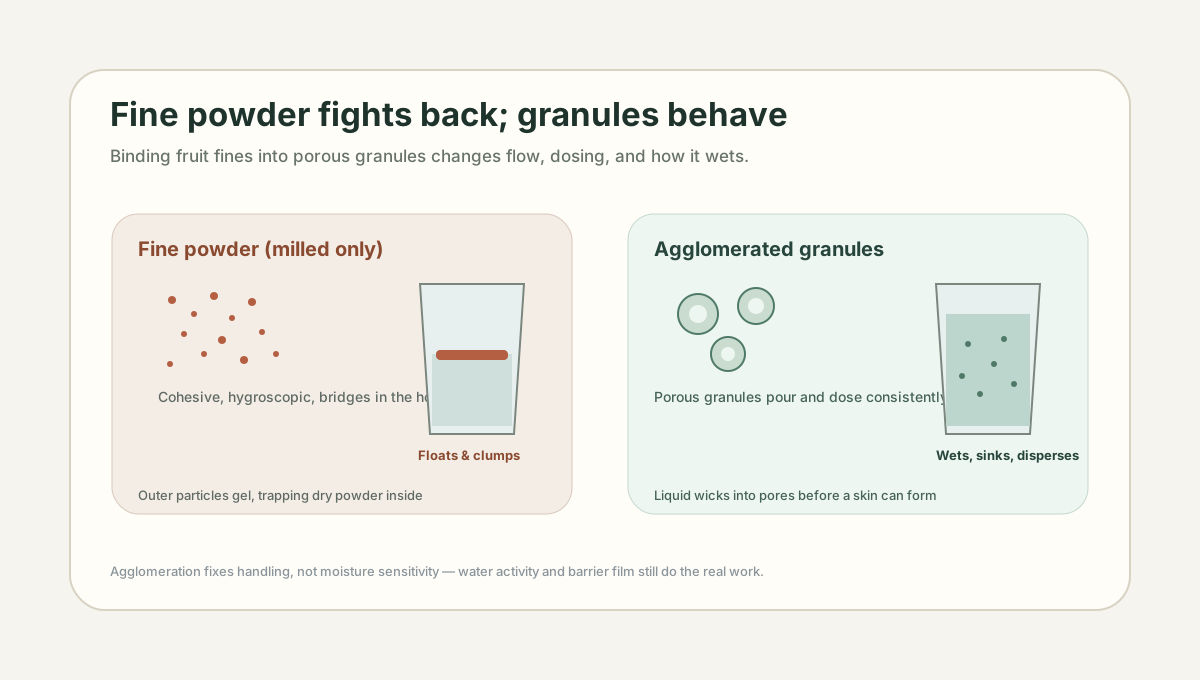
The most visible failure is in the glass. Stir fine fruit powder into a liquid and the outer particles hydrate almost instantly, forming a sticky, gel-like film. That film traps dry powder inside, so the mixture ends up with lumps, or a dry raft floats on top while the surface below stays gummy.
This is a classic wettability and dispersibility problem in food powders, not something unique to fruit. The general principle from powder-technology research is that four behaviors decide whether a powder mixes cleanly: wetting, sinking, dispersing, and dissolving. Fine fruit powder tends to fail at the first two, which is why the rest never gets a fair chance.
What agglomeration actually does
Agglomeration reverses the geometry that causes these problems. Instead of a mass of individual fines, the powder becomes a collection of larger granules, each made of many fine particles loosely bound together with open pore space between them.
Those granules behave differently in three practical ways:
- Flow improves because larger, rounder granules have less surface-to-mass contact and are less cohesive, so they pour and meter more consistently.
- Dosing gets more accurate because a free-flowing granular powder fills a cavity or scoop more reproducibly than a bridging fine powder.
- Dispersibility improves because liquid can wick into the granule's open structure and wet it from the inside before the outer surface can seal over. The granule breaks apart and disperses instead of clumping.
Food-powder literature describes agglomeration precisely for these reasons: it is a standard tool for improving flowability, wettability, and reconstitution of difficult powders.
Methods differ, and so do the labels
There is more than one way to agglomerate a powder, and the method matters for what ends up on the ingredient statement.
Some approaches rewet the powder surface slightly with a fine mist or steam, let particles stick together, then dry them again so the granules set. Done carefully, this can bind fruit fines using only the fruit's own sugars as the binder, keeping the product close to 100 percent fruit.
Other approaches add a food-grade carrier or binder to help the granules form or to protect very hygroscopic, high-sugar fruit. Common carriers include starches, fibers, or other flow agents. There is nothing wrong with that, but it means the powder is no longer pure fruit, and the carrier must appear on the label.
If a fruit powder pours easily, doses cleanly, and disperses without clumping, ask how. The answer is usually either a coarser particle size, an agglomeration step, or an added carrier. All three are legitimate, but they are different products, and the ingredient statement is where the difference is disclosed.
What agglomeration does not fix
It is easy to over-credit agglomeration. It solves handling problems, but it does not change the fruit's fundamental moisture sensitivity.
Agglomerated fruit powder is still hygroscopic. If it is exposed to humid air, it will still pick up moisture, cake, and eventually lose the crisp, free-flowing behavior the agglomeration created. The granules can even accelerate caking if they trap moisture in their pore structure. Water activity and barrier packaging still do the real work of keeping the powder stable over time.
Agglomerated powder is also bulkier and often more fragile. The open granule structure that helps dispersion also means lower bulk density, so the same weight takes more volume, and rough handling can crush granules back into fines. That has consequences for fill volumes, slack fill, and how the product survives shipping.
Why this matters commercially
For a brand or a foodservice buyer, the practical point is that "fruit powder" is underspecified. A milled-only powder and an agglomerated powder can have the same fruit content and the same flavor but behave completely differently on a filling line and in a customer's glass.
That difference decides real outcomes:
- whether a beverage stick pack disperses cleanly or leaves lumps
- whether a dry blend fills to a consistent weight
- whether powder caking generates complaints a few months into shelf life
- whether the bulk density matches the package the brand already designed
None of that is visible from the word "powder" alone.
What buyers should ask
Useful questions are specific to form and behavior, not just fruit type:
- Is this powder simply milled, or is it agglomerated?
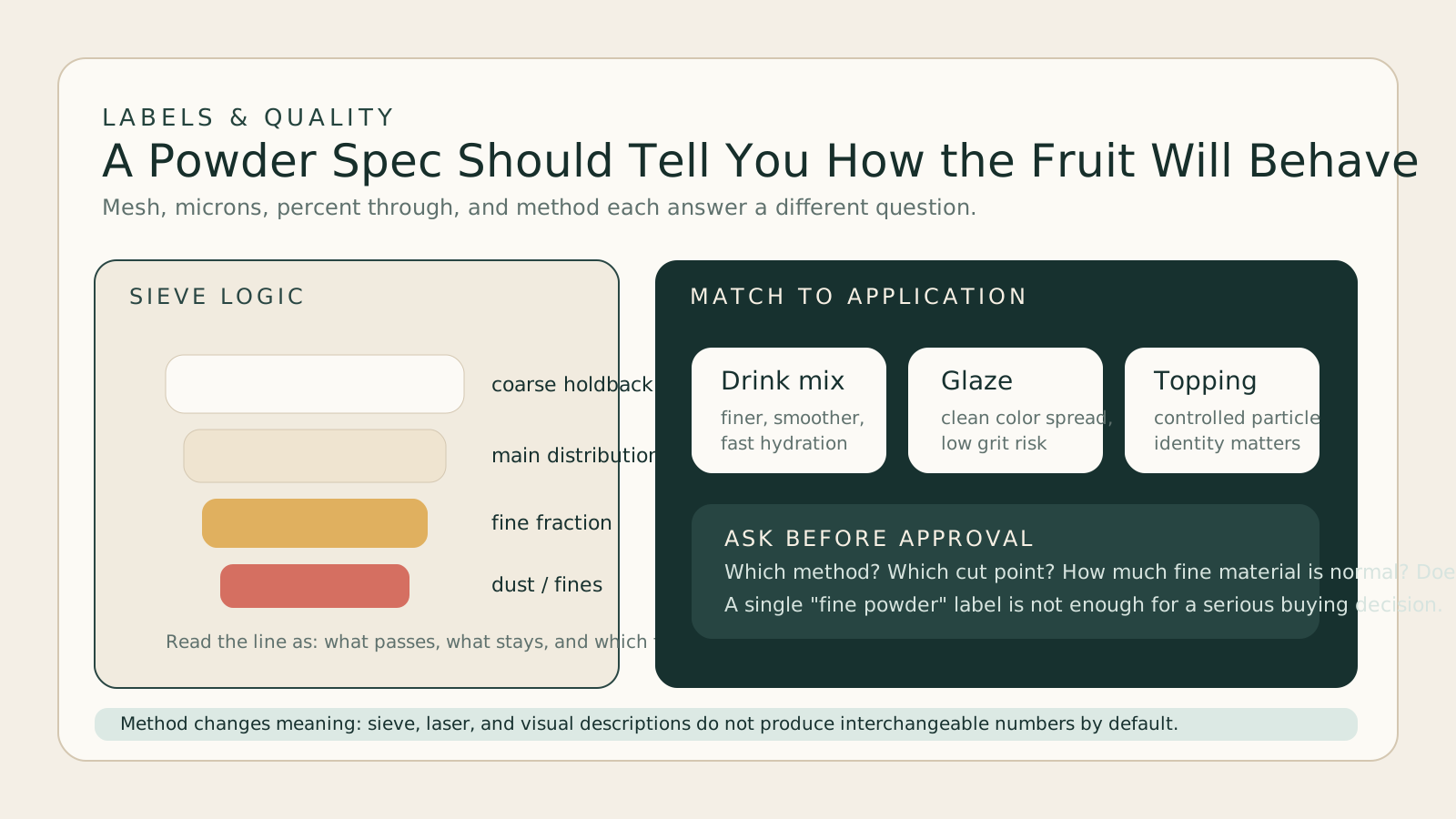
- What is the particle-size distribution and the bulk (and tapped) density?
- Is any carrier or binder used, and if so, what and how much?
- How is dispersibility or wettability measured, and can you share data?
- What water activity and barrier conditions keep this powder free-flowing over its stated shelf life?
Those questions separate a powder that will behave on the line and in the cup from one that merely looks fine in a sample jar.
Bottom line
Agglomeration improves freeze-dried fruit powder by binding cohesive fines into porous granules that flow, dose, and disperse better. It is a physical fix for physical problems, not a shelf-life upgrade or a nutrition change. The powder is still freeze-dried fruit with all the same moisture sensitivity, so the smarter approach is to treat particle form, bulk density, and any added carrier as spec-level details, not afterthoughts hidden behind a single word.
Frequently Asked Questions
What is agglomeration in freeze-dried fruit powder?
It is a process that binds many fine powder particles into larger, porous granules. The goal is not to change the fruit chemically but to change how the powder behaves physically: how it flows, how accurately it doses, and how it wets and disperses in liquid.
Why does fine freeze-dried fruit powder disperse so badly?
Fine fruit powder is cohesive and hygroscopic. When it hits liquid, the outer particles grab water instantly and form a gel-like skin that traps dry powder inside, creating lumps or a floating raft. Larger porous granules let liquid penetrate before that skin forms.
Does agglomeration add heat or ingredients to the fruit?
It depends on the method. Some approaches use only controlled moisture and mechanical action; others use a food-grade binder or carrier. Any added binder should appear on the ingredient label, so read the statement rather than assuming the powder is 100 percent fruit.
Is agglomerated fruit powder more shelf-stable?
Not inherently. Agglomeration changes physical handling, not the moisture sensitivity of the fruit itself. Agglomerated and milled powders both need low water activity and a strong moisture barrier to stay crisp and free-flowing.
What should buyers ask suppliers about fruit powder form?
Ask whether the powder is simply milled or agglomerated, what the particle-size distribution and bulk density are, whether any carrier or binder is used, and how the supplier measures dispersibility or wettability. A single word like 'powder' hides most of what matters.
Primary sources & further reading
- Agglomeration of Food Powder and Applications Critical Reviews in Food Science and Nutrition / PubMed Referenced for the general purpose of agglomeration in food powders: improving flowability, wettability, dispersibility, and dosing by binding fine particles into larger structures.
- Freeze-Drying of Plant-Based Foods Foods / PubMed Central Referenced for the porous, low-moisture structure of freeze-dried plant material and its sensitivity to moisture pickup.
- Water Activity in Foods: Fundamentals and Applications USDA Agricultural Research Service Referenced for the relationship between water activity, caking, and powder stability.
External links open in a new tab. We do not receive compensation from any organization listed; sources are referenced because they are primary, current, and publicly verifiable.