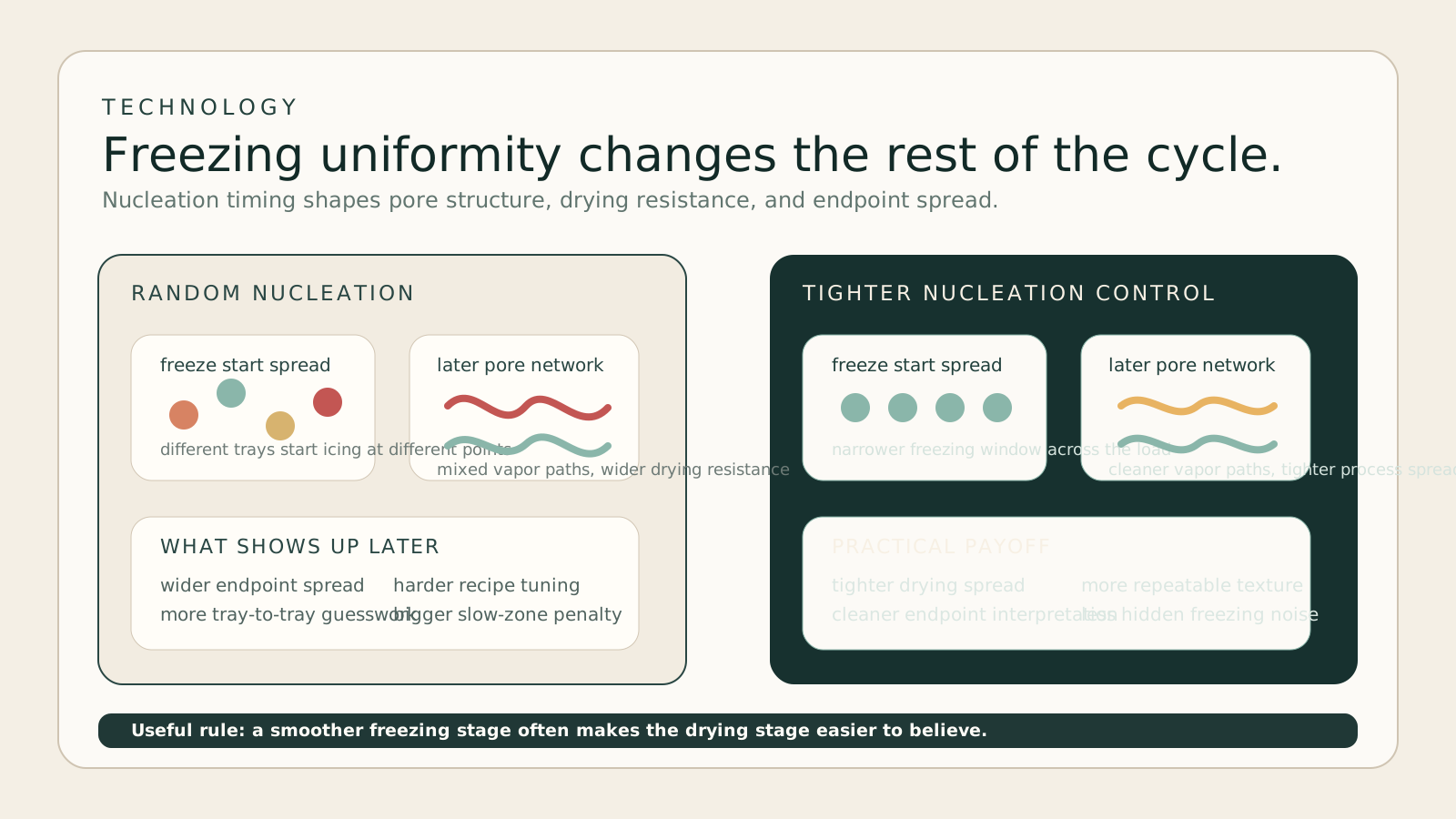
- Ice nucleation is the moment ice first starts forming. When that moment varies too widely across a batch, the dried structure usually varies too.
- More controlled nucleation can reduce load-to-load randomness by narrowing the spread in pore structure and drying resistance.
- The trade-off is not automatic 'better quality.' Fruit structure, sugar level, and the target bite still decide whether a more open frozen network is commercially useful.
- Most published controlled-nucleation data comes from pharmaceutical lyophilization, but the freezing and mass-transfer logic is still useful when thinking about fruit loads.
- Even without specialized hardware, fruit processors can borrow the discipline behind controlled nucleation through tighter loading temperature, freezing profile, and annealing control.
Freeze-drying teams often talk about the cycle as if it begins when vacuum and shelf heat start to matter.
In reality, the load often becomes more or less uniform before primary drying even begins.
The direct answer
Controlled nucleation changes freeze-dried fruit cycle uniformity by making the freezing step less random. When ice starts forming at a more consistent point across the load, the resulting pore network is usually more consistent too. That can narrow the spread in drying resistance, reduce endpoint scatter, and make the batch easier to run predictably.
That does not mean every fruit should be forced into the same freezing behavior. It means the freezing stage deserves to be treated as a process-control variable, not just a prelude to the "real" drying work.
What nucleation is actually doing
Before ice forms, the water inside and around the fruit can supercool below its equilibrium freezing point. Once nucleation starts, ice growth follows.
The important practical point is that this start point is often uneven. One part of the load may nucleate earlier. Another may sit colder for longer and then nucleate abruptly. That changes the ice-crystal pattern and, later, the empty channels left behind when sublimation removes the ice.
Those channels matter because they help decide:
- how easily vapor escapes during primary drying
- how much resistance the slowest zone creates
- how similar one tray, shelf position, or load section is to another
Most food processors already understand the outcome even if they do not use the phrase controlled nucleation: one batch dries cleanly and evenly, another feels patchier even under the same nominal recipe.
Why fruit loads care about this more than teams expect
Freeze-dried fruit is not a uniform pharmaceutical vial matrix. It is a biologically variable material with cell walls, sugars, acids, skins, cut surfaces, and geometry differences.
That makes freezing behavior especially important.
If nucleation timing spreads widely across the load, the frozen structure can spread widely too. In practical terms, that can show up later as:
- different drying speed across trays
- a wider gap between the driest and slowest pieces
- more uncertainty around when the batch is truly near endpoint
- more lot-to-lot texture drift even when the written recipe is unchanged
The food literature on plant-based freeze-drying already shows that freezing rate and ice-crystal behavior affect tissue damage, pore formation, and finished structure. The controlled-nucleation literature, though mostly pharmaceutical, adds a useful process lesson: when freezing becomes less stochastic, later drying behavior often becomes easier to predict.
That transfer from pharma to fruit is an inference from the sources, not a one-to-one published fruit rule. But the mass-transfer logic is the same.
What usually improves when nucleation is more consistent
The main benefit is not a single dramatic quality jump. It is a narrower spread.
More consistent nucleation often supports:
- more uniform pore structure
- less batch-to-batch randomness in primary drying
- cleaner interpretation of endpoint-support signals
- easier cycle tuning because one hidden variable is less chaotic
In plain terms, the dryer is no longer trying to rescue as much freezing randomness.
That matters for fruit because operators frequently fight the slowest region of the load, not the average region. If freezing behavior is inconsistent, the slowest region can become a moving target. If freezing behavior is tighter, recipe decisions around shelf temperature, chamber pressure, and endpoint checks become more meaningful.
Why the trade-off is not "controlled nucleation = always better"
Fruit processors should resist turning controlled nucleation into a slogan.
The same sources that make the case for better uniformity also imply the need for product-specific validation. Ice structure affects pore size, specific surface area, and later drying behavior. A more open structure may help primary drying, but it can also change the final bite and the way bound moisture leaves during secondary drying.
That matters because fruit quality is commercial, not purely physical.
A strawberry slice, mango cube, and blueberry half do not all want the same structure. Sugar-rich fruit, thin cuts, and fragile tissue may respond differently to the same freezing strategy. The operational goal is not merely creating bigger or smaller pores. The goal is building a frozen structure that helps the product reach its intended dried texture predictably.
What food processors can borrow even without specialized hardware
Many fruit plants will never install formal controlled-nucleation systems. The idea is still useful.
The transferable lesson is that freezing should be treated as a designed stage with disciplined inputs:
- loading temperature
- product temperature at entry
- cut-thickness consistency
- tray fill depth
- cooling-rate logic
- hold times or annealing steps when validated
Those controls do not create pharmaceutical-style nucleation control, but they pursue the same practical objective: less random frozen structure and better downstream repeatability.
That is usually the realistic food-industry version of the concept.
What buyers and operators should ask
The useful questions are simple:
- Is the freezing stage treated as a controlled part of the process?
- What does the supplier do to reduce batch-to-batch freezing variability?
- When texture drifts, does the investigation include the freezing step or only the drying recipe?
- Are endpoint differences actually drying problems, or are they frozen-structure problems showing up later?
A supplier who can only discuss shelf temperature and cycle length is leaving out a meaningful part of the story.
Bottom line
Controlled nucleation changes freeze-dried fruit cycle uniformity because it makes the freezing stage less random. That usually means a more consistent pore network, a narrower drying spread, and cleaner process interpretation later in the cycle.
For fruit processors, the bigger lesson is broader than the hardware. Freezing is not just the first stage on the timeline. It is one of the stages that decides whether the rest of the timeline will behave predictably.
Frequently Asked Questions
What is controlled nucleation in freeze-drying?
It is an attempt to make ice start forming at a more deliberate and consistent point in the freezing stage instead of letting every tray or container supercool and nucleate randomly.
Why does nucleation matter for freeze-dried fruit?
Because the way ice forms helps shape the pore network left behind after sublimation. That pore structure influences drying resistance, endpoint spread, and the final texture.
Does controlled nucleation always make freeze-dried fruit better?
No. It often improves process uniformity, but the right structure still depends on the fruit, cut size, sugar level, and the texture target. A more uniform process is not the same thing as a universally better product.
Is controlled nucleation common in food plants?
It is discussed far more often in pharmaceutical lyophilization than in mainstream fruit processing. Food teams more commonly pursue similar goals through disciplined freezing practice rather than specialized nucleation hardware.
What is the main buyer takeaway?
Ask how the supplier controls the freezing step, not only the dryer recipe. A supplier that treats freezing as a controlled variable usually has a better chance of delivering repeatable texture.
Primary sources & further reading
- Freeze-Drying of Plant-Based Foods Foods / PubMed Central Referenced for the food-specific discussion of freezing rate, ice-crystal formation, and the way plant tissue structure responds to freeze-drying.
- Controlled ice nucleation in the field of freeze-drying: Fundamentals and technology review European Journal of Pharmaceutics and Biopharmaceutics Referenced for the review-level explanation of supercooling, controlled nucleation methods, and the process-uniformity logic behind deliberate ice formation.
- Practical Advice on Scientific Design of Freeze-Drying Process: 2023 Update Pharmaceutical Research / PubMed Central Referenced for the current technical discussion of freezing as a stochastic step, the impact of nucleation on downstream drying behavior, and secondary-drying trade-offs.
External links open in a new tab. We do not receive compensation from any organization listed; sources are referenced because they are primary, current, and publicly verifiable.