- Sugar-rich freeze-dried fruit powder is combustible: fine particles suspended in air at the right concentration can ignite, and the worst risk is inside enclosed equipment like mills, sieves, and dust collectors, not in an open bag.
- There is no single fix. Facilities layer controls — remove ignition sources, keep dust from escaping and accumulating, and use engineered protection like venting or isolation on the equipment most likely to confine a cloud.
- A dust hazard analysis and lab data (Kst, Pmax, minimum ignition energy) tell you how reactive a specific powder is, which is why buyers of bulk powder should ask suppliers and co-packers how they handle it rather than assume it is inert.
A bag of freeze-dried strawberry powder is one of the calmer things in a food plant. It pours, it clumps a little, it smells like fruit. Nothing about it suggests a hazard. That impression is correct for the bag and wrong for the equipment that made the powder. Milling, sieving, and moving fine fruit powder through pipes and collectors is where the material stops being an ingredient and briefly becomes a fuel. Understanding why is the difference between treating powder handling as housekeeping and treating it as process safety.
Why fruit powder counts as a combustible dust
A combustible dust is a fine solid that will burn or explode when suspended in air at the right concentration. The category is broad and unglamorous: flour, sugar, powdered milk, cornstarch, spices, and — squarely in the same family — dried fruit powders. What they share is an organic, often carbohydrate-rich composition and a large surface area per unit of mass once they are ground fine.
Freeze-dried fruit fits the profile well. It is low in moisture, brittle, and easy to mill into fine particles, and many fruits are high in natural sugars. Sugar dust is a well-known combustible dust; the fruit matrix around it does not remove that. The finished snack is not the concern. The concern is the intermediate state: a cloud of fine particles inside a mill, a sifter, a bag dump station, or a dust collector.
The five things a dust explosion needs
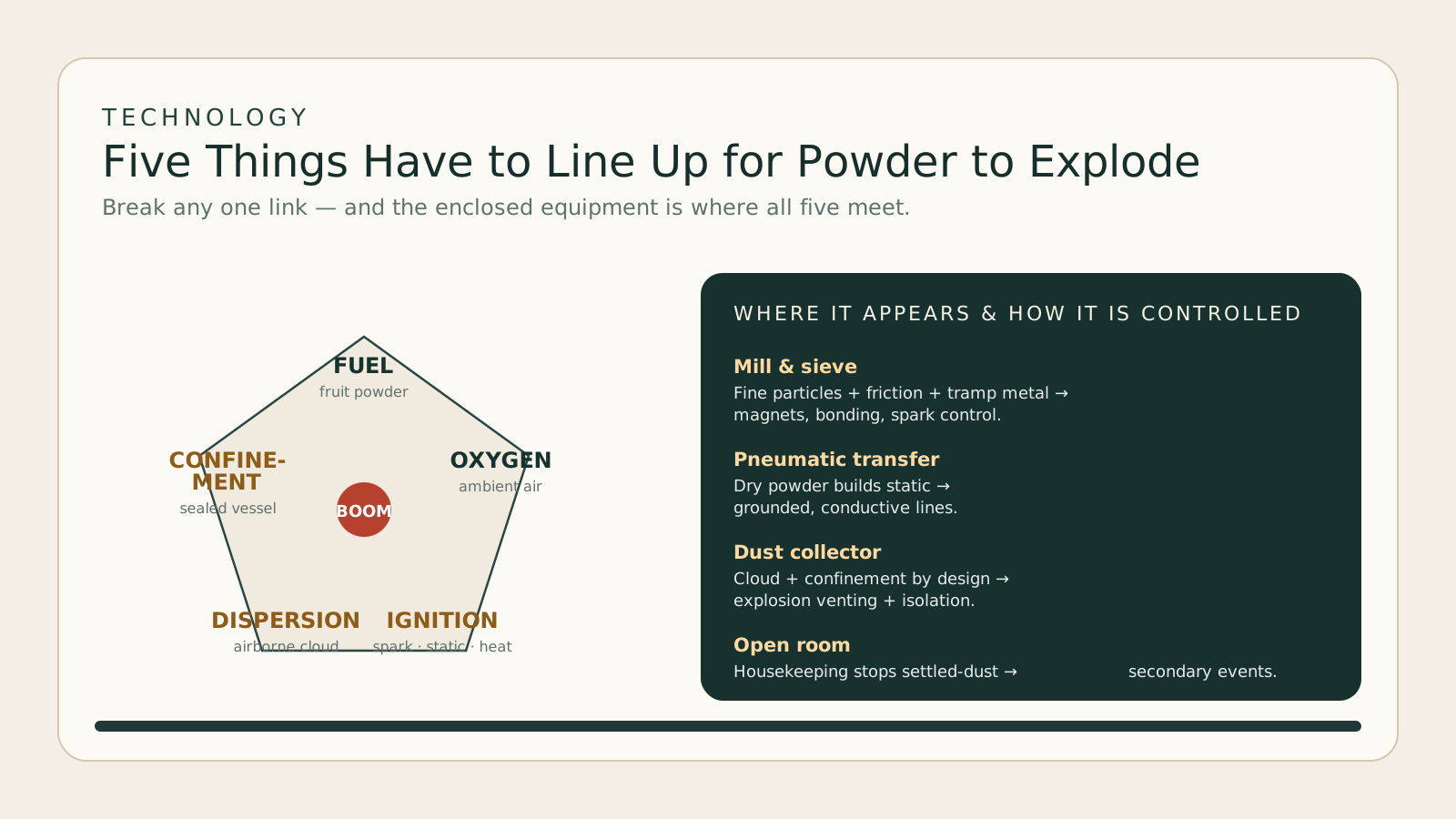
Fire needs three things — fuel, oxygen, and an ignition source. A dust explosion needs two more, which is why it is usually drawn as a pentagon rather than a triangle.
Fuel is the combustible powder itself. Oxygen is ambient air. An ignition source can be a spark, a hot surface, friction, static discharge, or a stray ember from upstream. Those three alone can start a fire. Turning a fire into an explosion also requires dispersion — the powder suspended as a cloud at a burnable concentration — and confinement, an enclosed space where pressure can build instead of dissipating.
The practical lesson lives in the last two. An open pile of fruit powder on a bench has fuel and oxygen but no dispersion and no confinement, so it will not explode. The same powder blown into a cloud inside a closed dust collector has all five. That is why the highest-risk points in a plant are almost always the enclosed pieces of equipment, not the open room.
The dangerous combination — fine powder, airborne, inside a sealed volume — is exactly what mills, sieves, pneumatic conveying lines, and dust collectors create by design. Those are the assets a dust program watches most closely, not the storage bags.
How processors actually control it
Because five elements have to line up, the standard approach is to break the chain in more than one place rather than rely on a single safeguard. The layers fall into three practical groups.
Remove ignition sources. This is the first line and the cheapest. It means bonding and grounding equipment so static cannot discharge into a cloud, keeping tramp metal out with magnets and screens so it cannot spark in a mill, controlling hot surfaces and bearing friction, and using appropriately rated electrical equipment in dusty areas. Static is a particular concern with dry, insulating fruit powder moving through plastic or ungrounded lines.
Control the dust itself. If powder never escapes and never accumulates, a secondary explosion — the far more destructive event, where a small blast lofts settled dust into a larger cloud — has nothing to feed it. This is where housekeeping stops being cosmetic. Enclosed transfer, well-designed dust extraction at pickup points, and regular removal of settled dust from beams, ledges, and equipment tops all reduce the fuel available. Cleaning methods matter too: dry sweeping or compressed air can throw settled dust back into the air, so plants often specify vacuuming with suitable equipment instead.
Engineer protection where confinement is unavoidable. Some enclosed volumes cannot be eliminated — a dust collector has to hold dust. For those, facilities add protection that assumes an event could still occur: explosion venting to direct pressure to a safe location, isolation devices that stop a flame front from propagating back through ductwork into other equipment, and in some cases suppression systems. These are engineered to the reactivity of the specific dust, which is why the powder has to be characterized first.
The role of a dust hazard analysis
None of the above can be sized sensibly without knowing how reactive the powder is. That is the job of a dust hazard analysis, a systematic review of where combustible dust exists in a process and what controls each point needs. It leans on lab testing of the actual material, because "fruit powder" is not one thing — mango, strawberry, and banana powders differ in particle size, sugar, and fat.
A few parameters recur. Kst and Pmax describe how fast and how hard a dust cloud can generate pressure, and they feed directly into venting and isolation design. Minimum ignition energy indicates how easily a cloud ignites, which informs how strictly static and spark sources must be controlled. Minimum explosible concentration marks the leanest cloud that will still propagate. A processor running fruit powders at volume should be able to point to this kind of data and to a documented analysis, not just to a tidy floor.
What this means for buyers and operators
For an operator, the takeaway is that powder handling deserves the same seriousness as any other process hazard, and that the quiet, enclosed equipment is where attention belongs. For a buyer sourcing bulk freeze-dried fruit powder or building a private-label crisp with a powder step, it is a fair and revealing question to ask a supplier or co-packer: have you done a dust hazard analysis on these powders, and how do you control ignition on your mills and collectors? A processor with a real program can answer specifically. That answer is also a proxy for how carefully the rest of the operation is run.
None of this makes freeze-dried fruit powder a dangerous ingredient in the pantry or the production bag. It is a reminder that the hazard is a state, not a substance — fine, airborne, and confined — and that managing it is about keeping those conditions from lining up.
Frequently Asked Questions
Is whole freeze-dried fruit a dust hazard too?
Much less so. The hazard scales with how fine and how airborne the material is. Whole pieces and coarse crumbles are hard to suspend as a cloud. The concern rises sharply once fruit is milled to powder, screened, or moved pneumatically, because those steps create fine particles and put them into the air inside equipment.
Why is sugar content relevant?
Many freeze-dried fruit powders are high in natural sugars, and sugar dusts are known combustible dusts. The organic, carbohydrate-rich composition is what makes the particles a fuel. That does not make the powder dangerous to eat or store normally; it means the airborne, confined form needs engineering controls.
Does low moisture make it worse?
Drier, finer powder generally disperses more easily and can be more readily ignitable than damp material, so the same low moisture that gives freeze-dried fruit its shelf stability also keeps the powder in an easily airborne state. Moisture is one variable among several, not a standalone safety measure.
What should a bulk powder buyer ask a supplier?
Ask whether they have completed a dust hazard analysis for the fruit powders they run, how they control ignition sources on mills and collectors, and whether combustion data such as Kst is available for the specific powder. Credible processors can describe their program; vague answers are a signal to look closer.
Primary sources & further reading
- NFPA 652, Standard on the Fundamentals of Combustible Dust National Fire Protection Association Referenced for the general framework of combustible dust management, including the dust hazard analysis requirement.
- Combustible Dust: An Explosion Hazard U.S. Occupational Safety and Health Administration Referenced for general background on how combustible dusts, including sugars and agricultural products, create explosion hazards in processing.
External links open in a new tab. We do not receive compensation from any organization listed; sources are referenced because they are primary, current, and publicly verifiable.