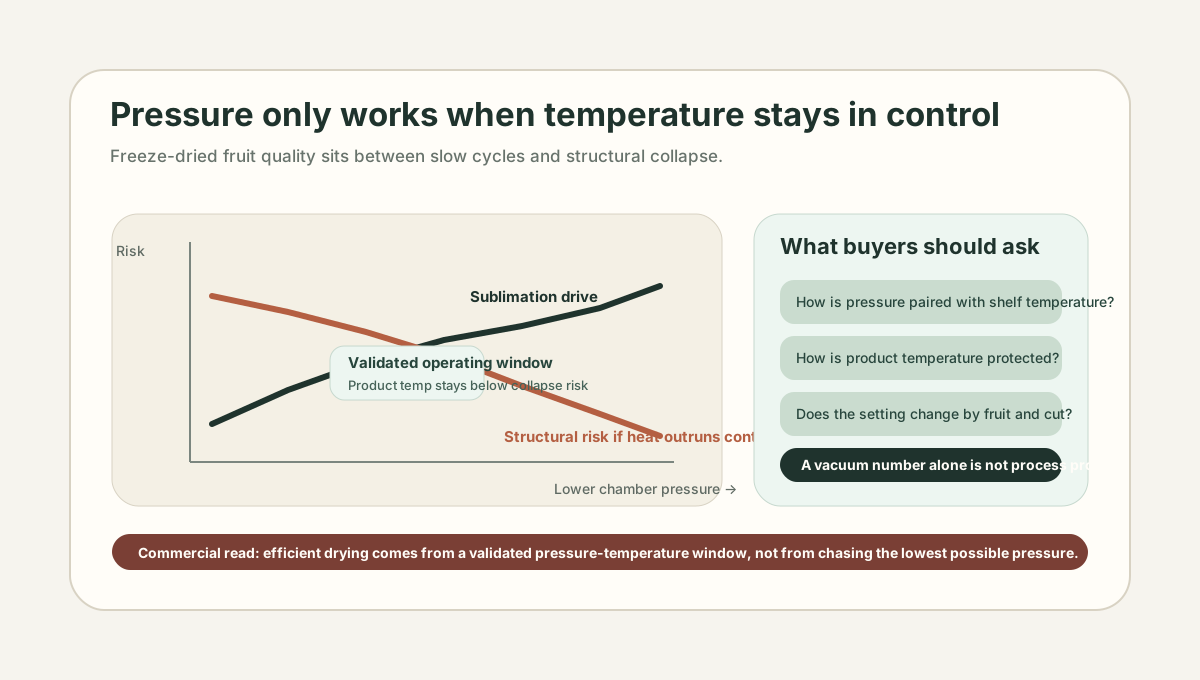
- Chamber pressure helps set the driving force for sublimation, but it cannot be judged separately from shelf temperature and product temperature.
- Pressure that is too conservative slows drying and wastes capacity; pressure that is pushed without enough control can increase the risk of structural loss, uneven drying, or overlong troubleshooting.
- The right pressure window depends on fruit type, piece thickness, sugar load, and how close the product can safely run to its collapse limit.
- Buyers should ask how processors validate pressure control across the full tray load, not just what nominal vacuum number appears on a cycle sheet.
Freeze-dried fruit teams often talk about vacuum as if one lower number automatically means a better process. That is not how the machine behaves in practice. Chamber pressure matters, but it matters as one side of a paired control system with shelf temperature and product temperature.
That distinction is important because the same pressure that looks efficient on a cycle sheet can produce very different outcomes in a thin apple slice, a thick mango chunk, or a mixed berry lot with uneven geometry.
The direct answer
Chamber pressure changes freeze-dried fruit drying speed and texture by helping determine how easily ice can sublimate and how aggressively the process can run without pushing the fruit toward structural loss. Lower pressure is necessary for sublimation, but the useful operating window is not "as low as possible." It is the pressure range that lets the product dry efficiently while keeping product temperature within a safe structural zone.
For buyers and operators, that means chamber pressure is not a bragging number. It is a control choice that has to be validated against the actual fruit and format.
What pressure is really doing
Freeze-drying works by freezing the fruit first, then lowering water-vapor pressure enough for ice to move directly to vapor instead of melting into liquid water. FDA's basic lyophilization guidance frames the process as frozen product plus vacuum plus heat for sublimation. Food-focused freeze-drying reviews describe the same physics from the product side: pressure must move below the water triple-point region, then heat has to be supplied carefully so the ice can leave without destroying the structure that is being preserved.
That means chamber pressure is doing two jobs at once:
- creating the low-pressure environment needed for sublimation
- shaping how the rest of the cycle can deliver heat safely
If either side is treated casually, the fruit pays for it.
Why pressure and shelf temperature cannot be separated
The common operational mistake is to discuss pressure as if it controls drying by itself. It does not.
Pressure and shelf temperature are linked because the product still needs energy to drive sublimation. If the process is pushed harder in one direction, the rest of the cycle usually has to compensate. That is why serious freeze-drying literature treats the process as a temperature-pressure problem rather than a vacuum problem alone.
In practical fruit terms:
- shelf temperature helps supply the energy for sublimation
- chamber pressure affects how the vapor leaves
- product temperature determines whether the fruit keeps its intended structure
The process is only stable when those three stay in balance.
The collapse line is what makes this a quality issue
One of the most useful food-freeze-drying concepts is the collapse temperature. Reviews on plant-based freeze-drying describe primary drying as a stage where product temperature is typically held a few degrees below collapse risk. That is the structural line buyers rarely see but often taste.
If the product temperature rises too close to or above that line before the ice is fully removed, the fruit can lose some of the porous architecture that gives freeze-dried fruit its light, crisp bite. The result may not look like a dramatic factory failure. It may show up instead as:
- denser texture
- weaker crunch
- flatter-looking piece structure
- more lot-to-lot inconsistency
That is why pressure control matters commercially. It changes how much margin the process has before the fruit stops behaving like premium freeze-dried fruit.
Why different fruits respond differently
A uniform, low-sugar, thin-cut format is easier to process cleanly than a high-sugar fruit with broader size variation. That does not mean one fruit needs "high vacuum" and another needs "low vacuum" as a rule. It means the pressure window has to be matched to the product's real structure.
Fruit variables that change the pressure conversation include:
- sugar level and solids concentration
- piece thickness
- slice-to-fragment mix
- ripeness and cell structure
- how uniform the tray load really is
This is why a pressure strategy that works on a controlled pilot batch may drift once the trays are full, the pieces are thicker, or the lot includes more size spread than the development team expected.
What a weak pressure strategy usually looks like
Most buyers will never see the chamber in operation, but the consequences still show up in the bag.
Pressure control problems often surface as:
- pieces that look dry but eat denser than expected
- center softness in thicker cuts
- odd variation from one piece size to another
- fragility or texture drift that does not line up with the nominal spec
- long cycles that suggest the process window is not well understood
None of those symptoms proves pressure alone was the problem. But when a supplier cannot connect texture outcome back to a validated pressure-temperature strategy, the technical explanation is incomplete.
Why cycle validation matters more than a target number
FDA's lyophilization guidance emphasizes scale-up and cycle validation because freeze-drying is full of interacting variables. That lesson applies directly to fruit. A nominal chamber pressure on a worksheet is not enough evidence by itself.
The better question is whether the supplier validated that pressure against:
- the actual fruit
- the actual cut geometry
- the actual tray loading pattern
- the actual endpoint method
If not, the setting may describe machine intent more than product reality.
What buyers should ask
Good technical questions are specific:
- How is chamber pressure chosen relative to shelf temperature?
- How is product temperature kept below structural risk during primary drying?
- Does the pressure strategy change by fruit or cut format?
- How is the primary-drying endpoint confirmed?
- What happens when the lot includes thicker pieces or broader size variation?
Those questions are more revealing than asking for a single vacuum number.
When a supplier describes freeze-drying performance with only cycle time and final moisture, keep asking. Pressure control is one of the process choices that decides whether the fruit got to that moisture cleanly or simply got there eventually.
Bottom line
Chamber pressure changes freeze-dried fruit drying speed and texture because it helps set the conditions for sublimation and determines how tightly the cycle has to be managed around product-temperature limits. Lower pressure is necessary, but it is not automatically better.
The useful technical question is not "how much vacuum?" It is whether pressure, shelf temperature, and product structure were balanced well enough to produce the intended texture without wasting time or losing margin.
Frequently Asked Questions
What does chamber pressure do in freeze-drying?
It helps create the low-pressure conditions needed for ice to leave the frozen fruit by sublimation. In practical terms, chamber pressure influences how easily water vapor can move out of the product and how the rest of the cycle has to be balanced.
Does lower chamber pressure always dry freeze-dried fruit faster?
No. Lower pressure can support sublimation, but only if the rest of the cycle is tuned to it. Pressure, shelf temperature, product temperature, and fruit structure work together. Treating vacuum as a one-number speed lever is too simplistic.
Why does chamber pressure affect texture?
Because it influences how the fruit moves through primary drying and how close the product temperature gets to the structural limits where collapse or other texture damage can begin. Texture is a process outcome, not only a moisture outcome.
Which fruits are most sensitive to pressure settings?
High-sugar, soft, or unevenly cut fruits often show the consequences more clearly because their structure can lose margin faster when the process is pushed. Thick mango pieces, ripe berries, and mixed-size lots usually demand more discipline than a uniform low-sugar format.
What should buyers ask suppliers about vacuum control?
Ask how chamber pressure is set relative to shelf temperature, how product temperature is protected below collapse risk, how endpoints are verified, and whether the same settings are used across different fruits or only after product-specific validation.
Primary sources & further reading
- Lyophilization of Parenteral (7/93) U.S. Food & Drug Administration Referenced for the basic FDA description of freeze-drying as freezing plus vacuum-driven sublimation and for the importance of cycle scale-up and validation.
- Freeze-Drying of Plant-Based Foods Foods / PubMed Central Referenced for the pressure-below-triple-point principle, the relationship between product temperature and collapse temperature, and the role of shelf temperature during primary drying.
- The Freeze-Drying of Foods: The Characteristic of the Process Course and the Effect of Its Parameters on the Physical Properties of Food Materials Foods / PubMed Referenced for the review's emphasis on lyophilization pressure, shelf temperature, sublimation, and the resulting effects on physical properties such as structure and texture.
External links open in a new tab. We do not receive compensation from any organization listed; sources are referenced because they are primary, current, and publicly verifiable.