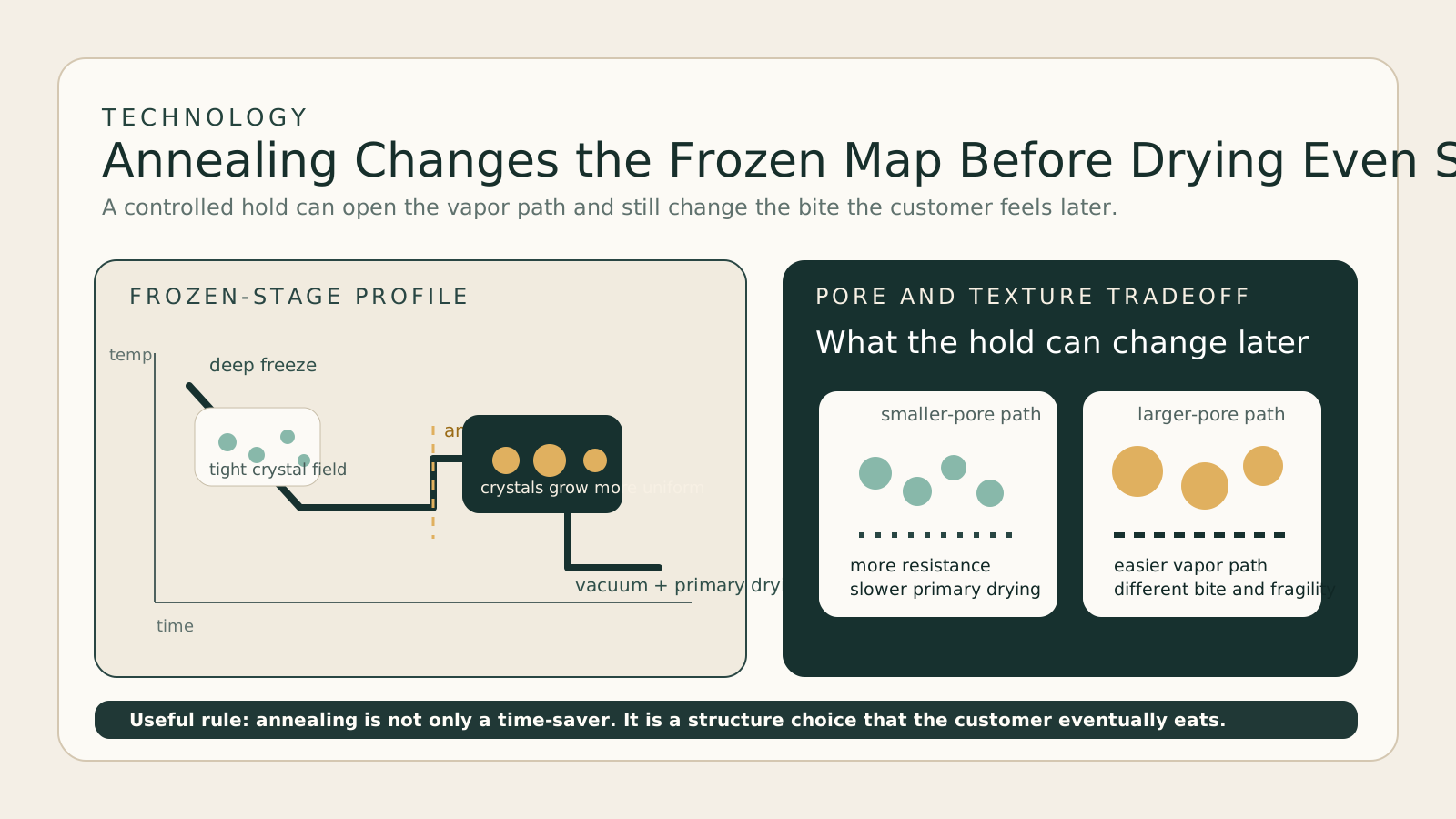
- Annealing is a deliberate frozen hold used to let the ice structure and freeze-concentrated phase become less heterogeneous before primary drying.
- Larger and more uniform ice crystals usually leave larger pores after sublimation, which can lower resistance and speed primary drying.
- For fruit tissue, a faster-drying structure is not automatically a better-eating structure; texture and cell damage still matter.
- The practical question is not whether annealing is 'good' but whether the specific fruit, cut size, and product goal benefit from the tradeoff.
Annealing is one of those freeze-drying terms that sounds more specialized than it really is.
At a practical level, it is simply a choice to hold the product in a controlled frozen state long enough for the frozen structure to change before primary drying begins.
The direct answer
Annealing changes freeze-dried fruit drying speed and texture because it changes the ice structure that later becomes the pore network. A controlled frozen hold can produce larger or more uniform ice crystals, which usually means lower resistance to vapor flow and faster primary drying. But fruit is still plant tissue, so the same structural change can also alter bite, fragility, and perceived quality in the finished piece.
That is why annealing is not just a cycle-time tool. It is a product-definition tool.
What annealing means in plain English
In freeze-drying, the product is first frozen and then dried under vacuum as the ice sublimes away.
Annealing sits between those two ideas. The product is kept frozen, but it is held at a controlled temperature long enough for the frozen system to become less chaotic. In technical terms, the ice phase and the freeze-concentrated phase are given time to reorganize.
For non-specialists, the most useful mental model is this:
- fast or uneven freezing can leave a more heterogeneous crystal pattern
- an annealing hold can let that pattern evolve
- the evolved pattern changes the pore map left behind after sublimation
That pore map matters because it becomes the path water vapor must travel during primary drying.
Why primary drying often gets faster
Food freeze-drying reviews describe a consistent physical rule: smaller ice crystals leave a tighter pore network, while larger crystals leave larger pores. Larger pores usually reduce resistance during sublimation.
That matters operationally because primary drying is often the longest stage in the cycle. If vapor can move through the dry layer more easily, the cycle can become easier to control and sometimes easier to shorten.
This is the main reason annealing gets attention in technical discussions:
- it can reduce heterogeneity
- it can make drying behavior more repeatable
- it can lower the penalty of an overly tight pore network
In other words, annealing is often about making the frozen starting point more cooperative before the expensive part of the cycle begins.
Why faster drying does not automatically mean better fruit
This is where fruit differs from the simplified mental picture many teams inherit from general lyophilization discussions.
Fruit is not just water plus dissolved solids. It is a cellular structure with membranes, air spaces, fibers, sugars, acids, pigments, and natural variability from one lot to the next. A pore network that helps vapor escape may still leave a different eating texture than the brand wants.
Possible effects include:
- a more open and friable bite
- more fragility in thin or delicate pieces
- different rehydration behavior on the tongue
- texture that reads airy rather than crisp-clean
That does not make annealing bad. It means the product goal still decides whether the result is attractive.
For a bulk ingredient that will be milled or blended, the tradeoff may be easy to accept. For a premium whole-piece snack, the same tradeoff may deserve more caution.
Annealing is really a pore-structure decision
The finished dry fruit keeps a physical memory of what happened while it was frozen.
The easiest way to think about the sequence is:
- freezing creates the first crystal pattern
- annealing modifies that pattern
- sublimation removes the crystals and leaves pores behind
- those pores help determine drying behavior and bite
This is why teams sometimes misread the result if they only compare total cycle time. A line may dry more smoothly after an annealing step and still produce fruit that breaks differently, powders more easily, or feels less dense in the mouth.
The real comparison is not only minutes saved. It is minutes saved relative to the texture the customer is paying for.
Where fruit processors should be careful
Annealing is most worth debating when the line is struggling with:
- inconsistent primary-drying behavior
- thicker pieces that dry reluctantly
- large lot-to-lot variation in frozen structure
- a need to trade some texture sharpness for more repeatable throughput
It deserves more skepticism when the product is sold on:
- intact whole pieces
- very delicate geometry
- a specific snap or crunch signature
- minimal breakage through packing and transit
The point is not that annealing only belongs in pharmaceutical discussions. The point is that fruit processors should test it like a product variable, not adopt it as a generic improvement.
The better operator question
Instead of asking, "Should we anneal this fruit?"
Ask:
- What texture are we trying to preserve?
- Is primary drying resistance actually a bottleneck on this SKU?
- Does the hold improve uniformity enough to justify any texture change?
- Are we evaluating the result as a full product, including breakage and bite, not just drying time?
That framing usually leads to better decisions than treating annealing as a technical badge of sophistication.
Annealing is most valuable when the frozen structure is the problem you are trying to solve, not when it is simply the newest parameter available to adjust.
Bottom line
Annealing changes freeze-dried fruit because it changes the frozen architecture that primary drying inherits. Larger or more uniform crystals can create a more open pore network and improve drying behavior, but fruit texture still decides whether that tradeoff is commercially useful.
For freeze-dried fruit, annealing is not just about speed. It is about choosing which structure you want the customer to eat.
Frequently Asked Questions
What is annealing in freeze-drying?
Annealing is a controlled hold during the frozen stage, usually warmer than the deepest freeze point but still below melting, used to let the ice structure and concentrated solids reorganize before primary drying starts.
Why can annealing shorten freeze-drying time?
Because larger and more uniform ice crystals tend to leave larger pores after sublimation, which reduces resistance to vapor flow during primary drying.
Does annealing always improve freeze-dried fruit?
No. It can improve drying uniformity or throughput in some systems, but fruit is a cellular material, not a simple laboratory cake. A setting that helps vapor escape can still change texture in ways a premium snack product may not want.
Is annealing the same as slower freezing?
Not exactly. Slower freezing influences how crystals form during cooldown; annealing is a deliberate hold after freezing that allows the frozen structure to evolve further.
Which products are most likely to show the effect?
Products where pore structure, cut thickness, and primary-drying resistance matter visibly, such as thicker pieces, denser fruit formats, or lines trying to tighten cycle repeatability.
Primary sources & further reading
- The Freeze-Drying of Foods—The Characteristic of the Process Course and the Effect of Its Parameters on the Physical Properties of Food Materials National Library of Medicine / Foods Referenced for the relationship between freezing rate, ice-crystal morphology, mass-transfer resistance, and the physical properties of freeze-dried food materials.
- Observation and Measurement of Ice Morphology in Foods: A Review National Library of Medicine / Foods Referenced for the effect of ice-crystal size and freezing history on food tissue structure and texture.
- Practical Advice on Scientific Design of Freeze-Drying Process: 2023 Update National Library of Medicine / AAPS PharmSciTech Referenced for the role of annealing as a controlled frozen hold that can change crystal structure and drying behavior.
- Freeze-Drying of Plant-Based Foods National Library of Medicine / Foods Referenced for the food-specific explanation that larger crystals can accelerate sublimation while freeze-drying quality still depends on plant-tissue behavior.
External links open in a new tab. We do not receive compensation from any organization listed; sources are referenced because they are primary, current, and publicly verifiable.