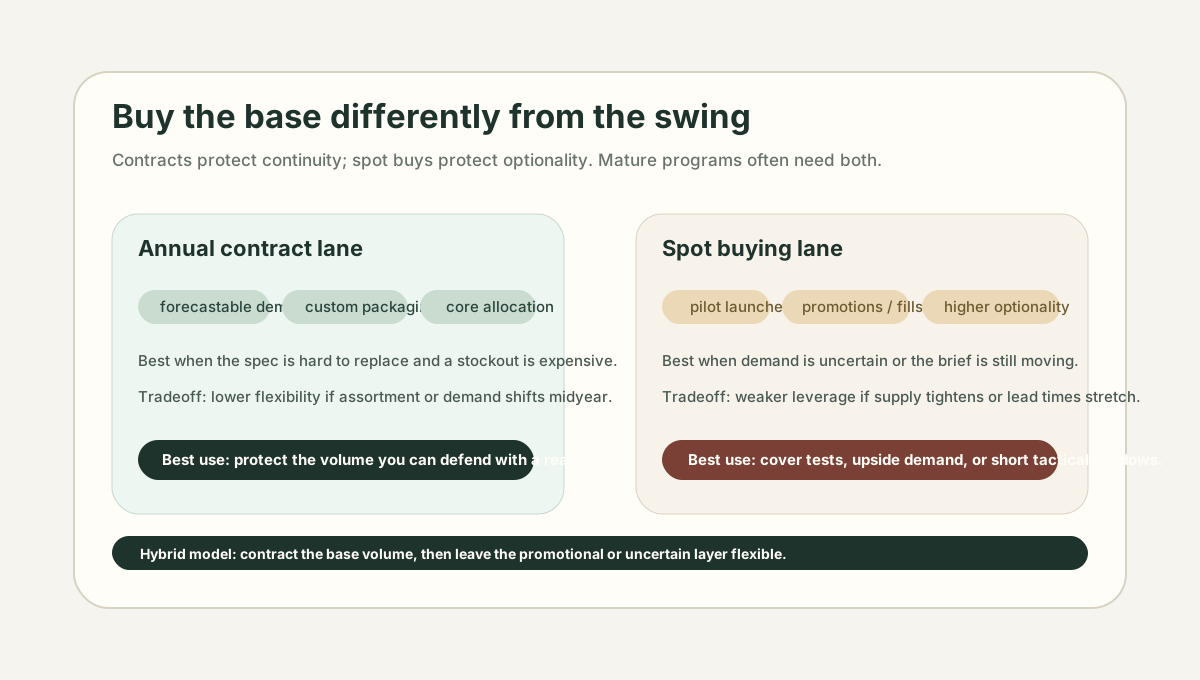
- Annual contracts usually work best when demand is reasonably forecastable and the product spec or packaging setup is hard to replace quickly.
- Spot buying can be useful for tests, opportunistic fills, or programs where demand and format change too often to lock in too early.
- The real comparison is not contract price versus spot price alone. It is continuity, working capital, flexibility, and the cost of supply surprises.
- Many buyers end up with a hybrid model: a contracted base volume plus spot coverage for promotions, trials, or demand swings.
The commercial question is not just what the fruit costs today. It is how much volatility your program can absorb before price, lead time, or availability turns into a bigger operational problem.
That is why the annual-contract versus spot-buy decision matters in freeze-dried fruit. The category is exposed to agricultural variation, processing capacity constraints, packaging lead times, and buyer-specific quality expectations. A purchasing model that looks efficient on paper can break down quickly if it does not match the program behind it.
The direct answer
Annual contracts usually make more sense when a buyer has stable forecasted demand, a well-defined specification, and real downside if supply slips. Spot buying usually makes more sense when demand is uncertain, the program is still being tested, or flexibility is worth more than locked allocation.
For many buyers, the strongest answer is not one or the other. It is a hybrid model that contracts the base and leaves room for tactical buying around the edges.
Why this decision matters more in freeze-dried fruit than it first appears
Freeze-dried fruit is not a simple commodity purchase. The commercial risk sits in several places at once:
- raw fruit seasonality and origin availability
- drying capacity and production-slot access
- customized cut, spec, or breakage requirements
- packaging material lead times
- demand swings by channel or promotion
That means purchasing structure changes more than price. It changes who absorbs the risk when something moves.
When annual contracts are usually the stronger choice
Annual contracts tend to work well when the buyer already knows the product is core to the program.
Typical signs that contracting makes sense:
- the forecast is reasonably stable
- the product is part of a year-round assortment
- the quality spec is narrow or hard to substitute
- custom packaging or private-label materials must be planned in advance
- an out-of-stock event would cost more than a modest pricing premium
In those conditions, the biggest value of a contract is often not just price. It is production visibility.
The supplier can plan raw material, drying capacity, and packaging around a clearer demand picture. The buyer gets a stronger claim on allocation and fewer last-minute surprises. That becomes especially valuable when the fruit is specialized, the format is premium whole-piece, or the program depends on continuity across multiple customers.
When spot buying is the smarter tool
Spot buying is not automatically undisciplined. In the right situation, it is the more rational model.
It is often useful when:
- the program is still in test phase
- demand can swing sharply month to month
- the buyer is experimenting with multiple fruits or formats
- the packaging is simple and replaceable
- the business values optionality more than locked volume
This model can be attractive for emerging brands, short seasonal promotions, foodservice tests, and concept-stage private-label work where the spec may still move.
The advantage is flexibility. The tradeoff is exposure. When the market tightens, the spot buyer is usually the one accepting the new conditions rather than shaping them.
The hidden cost comparison most teams miss
Too many buying conversations compare only the nominal contract price with the nominal spot price.
That misses the real question set:
- What does a stockout cost?
- What does excess inventory cost?
- How expensive is a late packaging change?
- How much working capital can the business absorb?
- How painful is it if a substitute supplier cannot match the spec?
An annual contract can look expensive until the buyer measures the operational cost of running short. A spot buy can look clever until the buyer needs continuity during a tight supply window and has no leverage left.
Why spec complexity changes the answer
The more specific the product, the more attractive contracting becomes.
A generic fruit powder or broad-acceptance crumble may be easier to source opportunistically. A premium retail spec with:
- narrow breakage tolerance
- fixed origin expectations
- custom pouch structure
- retailer-specific artwork
- tighter sensory targets
is much harder to replace quickly.
That is where annual contracts often justify themselves. They create planning discipline around a product that cannot be swapped without consequences.
A practical hybrid model
Many mature buyers do not treat this as a binary choice. They divide demand into two buckets:
1. Base demand
The predictable portion of the program. This is the volume most worth contracting.
2. Variable demand
Promotions, innovation, customer wins, and forecast error. This is the volume most worth leaving flexible.
That hybrid approach often gives the buyer the best commercial balance:
- core supply is protected
- the supplier can plan more efficiently
- upside or downside swings do not force a full renegotiation
- the buyer keeps some room to test new ideas
Questions buyers should settle before choosing
Before deciding on contract versus spot structure, buyers should answer a few blunt questions:
- How stable is our twelve-month forecast really?
- Which SKUs are truly core and which are still exploratory?
- How hard is this exact spec to replace?
- Would we rather risk carrying extra inventory or risk losing supply access?
- How much of the cost is in the fruit versus the packaging and program setup?
If those questions are not clear, the buying model will usually be chosen for emotional reasons rather than operational ones.
The right buying structure should match the maturity of the program. Early-stage brands often over-contract to feel secure, while established teams sometimes overuse spot buying because they underestimate the cost of disruption.
Bottom line
Annual contracts and spot buying solve different problems in freeze-dried fruit. Contracts are strongest when continuity, planning, and spec protection matter most. Spot buying is strongest when flexibility, testing, and optionality are the real priorities.
The practical answer for many teams is a hybrid model: contract the volume you can defend, and leave the rest flexible enough to absorb change without losing control.
Frequently Asked Questions
Are annual contracts always better for freeze-dried fruit buying?
No. They are often better when your volume is predictable and your spec is difficult to replace quickly, but they can become burdensome if demand is unstable, your assortment changes often, or you are still learning what the market wants.
When does spot buying make sense for freeze-dried fruit?
Spot buying makes the most sense for pilot launches, short promotional runs, opportunistic purchases, or programs where the buyer needs flexibility more than guaranteed allocation.
What is the main risk of relying only on spot buys?
The biggest risk is exposure to lead-time shocks, limited availability, and weaker bargaining power when supply tightens. A buyer may save commitment in the short term but lose control when the market gets less forgiving.
What is the downside of contracting too much volume?
Over-contracting can tie up working capital, create pressure to move product that no longer fits demand, and reduce the buyer's flexibility if packaging, assortment, or customer requirements change midyear.
What buying model do most mature programs use?
Many mature programs use a hybrid structure: they contract a base volume for core demand and use spot buying for launches, seasonal peaks, backups, or tactical fills.